Are you struggling to keep up with the fast pace of modern supply chains? AI logistics software could be the key to staying ahead, helping you manage everything from inventory tracking to delivery schedules with greater accuracy and efficiency. Many companies today find themselves juggling too many moving parts, facing delays, unexpected costs, and frustrated customers.

In this article, we will guide you on how to build a system tailored to your operations that turns these challenges into opportunities, giving you the control and insight you need to make smarter decisions every day.
Running delivery and supply operations today feels very different from even a few years ago. Volumes are higher, timelines are tighter, and customers expect clarity at every step. Many businesses are still relying on spreadsheets or disconnected tools that were never designed for this level of pressure.
Needless to say, it results in lost visibility, slow reactions, and rising operational costs that are hard to trace back to a single cause. Let’s look at the most common struggles you deal with day in and day out.
A single security incident can bring day-to-day operations to a halt and strain partner relationships overnight. When shipment routes, customer records, or internal planning details are exposed, the damage goes far beyond technical cleanup.
The study published on Francis Academic Press shows that systems combining real-time visibility with predictive risk models can reduce operational disruptions by up to 40% compared with traditional approaches.
Different types of logistics software translate into fewer stoppages, more reliable deliveries, and faster recovery when unexpected events occur. Trust erodes, contracts come under pressure, and recovery takes time. That is why protection can no longer exist only in the IT department and has to be built into how your entire supply network operates.
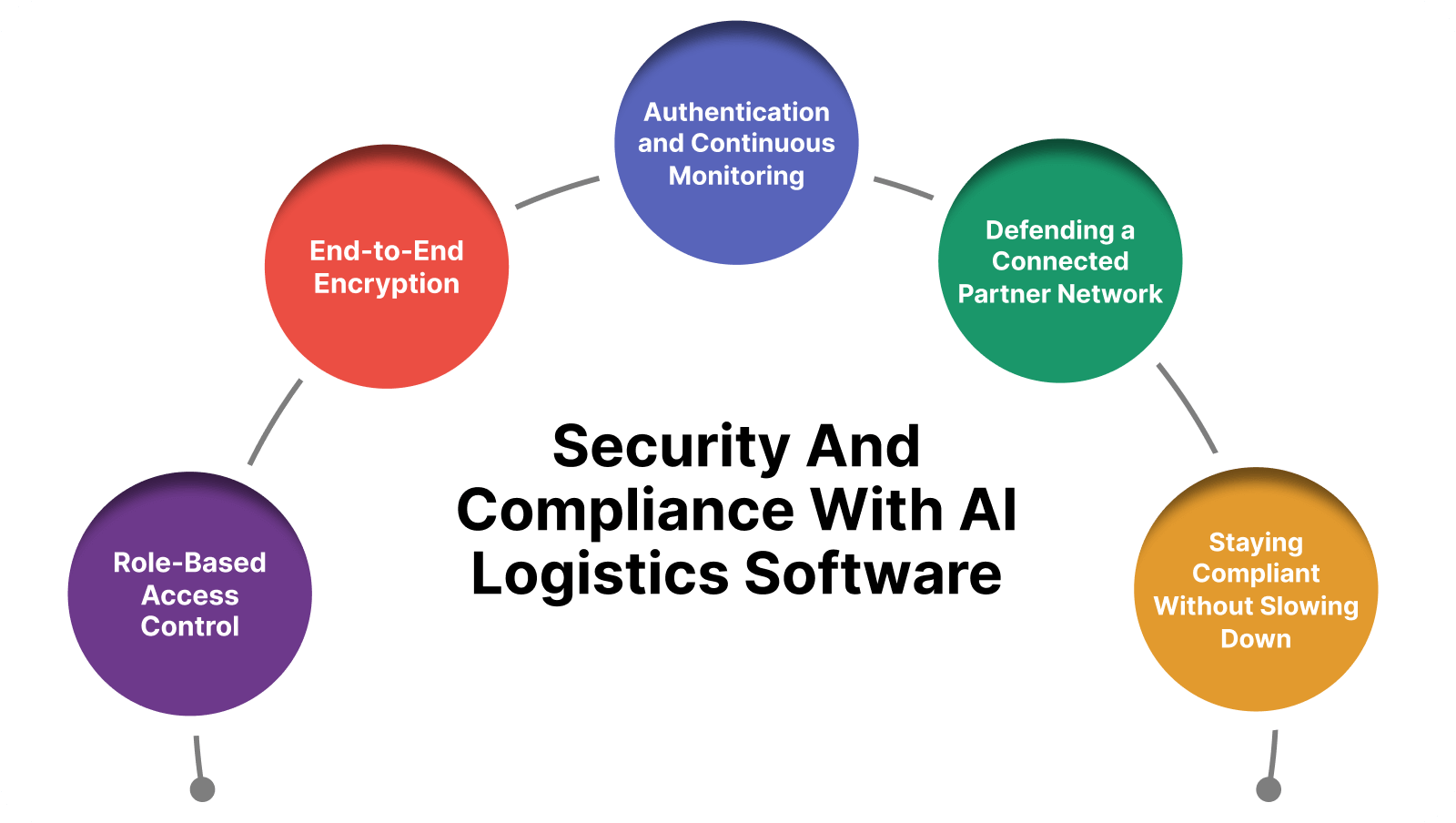
Not everyone needs to see every operation. Drivers should focus on routes and schedules, while finance teams handle numbers without touching operational controls. Assigning permissions by role keeps sensitive information where it belongs. Regular access reviews help catch changes early, and automated offboarding ensures access disappears the moment someone leaves.
Information moves constantly between vehicles, facilities, and offices. Protecting it along the way keeps conversations private and records safe, even when devices or physical locations are compromised. Strong encryption for stored information adds another layer of protection, while routine key rotation and certificate management prevent long-term exposure.
Extra verification steps matter most when teams work remotely or across borders. Multi-step authentication strengthens protection without creating daily friction. Single sign-on simplifies access across tools, while an AI agent for e-commerce logistics software keeps an eye out for unusual behavior. When something looks off, automated responses can limit damage before it spreads.
Modern IoT logistics rarely operate alone. Each partner connection adds value but also introduces risk. Threats today often target shared components rather than individual systems.
Clear visibility into every component makes it easier to react when vulnerabilities surface. Ongoing scanning during development helps catch issues early, while container protection reduces the chance of hidden risks traveling with packaged services. Secure gateways protect external interfaces, and zero-trust principles assume every connection must earn access. That mindset is essential when working with multiple external partners.
Regulatory requirements differ by region and industry, and keeping up manually quickly becomes overwhelming. Building compliance into the core structure of AI-powered logistics automation software keeps obligations manageable instead of disruptive.
Privacy rules in Europe and the United States require clear handling of personal information, while sector-specific regulations demand detailed tracking and reporting. Automated compliance reporting reduces manual effort and lowers the risk of missed requirements. Independent audits add an extra layer of assurance, giving partners and stakeholders confidence that controls are working as intended.
The most effective security and compliance strategies are the ones users barely notice. When protection supports daily work instead of getting in the way, adoption happens naturally, and your supply network stays resilient, even under pressure.
Big ideas are easy to admire, but what matters is the practical execution. The most convincing proof comes from companies operating at a massive scale, where even small improvements translate into serious money and operational stability. Amazon and Walmart are often mentioned for a reason, serving as ultimate case studies for effective problem-solving under constant pressure.
Amazon operates in an environment where minutes matter, and errors multiply fast. To keep up with growing order volumes, the company rethought how fulfillment centers work from the inside out. Instead of relying only on manual picking and static layouts, Amazon introduced fleets of mobile robots that work alongside warehouse teams.
This logistics tracking software application handles repetitive movement tasks, bringing shelves directly to workers instead of sending workers across endless aisles. Eventually, they achieved faster order processing, fewer mistakes, and the ability to scale operations during peak seasons without losing control. What stands out is not the automation itself, but how tightly it is woven into daily workflows. Everything is designed around speed, accuracy, and predictability, even when demand spikes overnight.
Managing inventory across thousands of stores leaves little room for intuition, making Walmart face a classic challenge. Too much stock ties up capital, too little leads to empty shelves and lost sales. However, the corporation didn't hesitate and immediately invested heavily in AI logisticstechnology and inventory pacing across its entire network.
With AI logistics solutions development improving demand analytics and stock movement between distribution centers and stores, Walmart reduced excess inventory while maintaining high availability for customers. On the transportation side, route planning tools helped cut unnecessary miles, improve delivery timing, and keep stores supplied more consistently.
What makes Walmart’s approach compelling is its discipline. The company did not attempt to reinvent everything at once and took it step-by-step. They targeted forecasting and movement first, areas with a direct impact on cost and customer experience, and scaled from there.
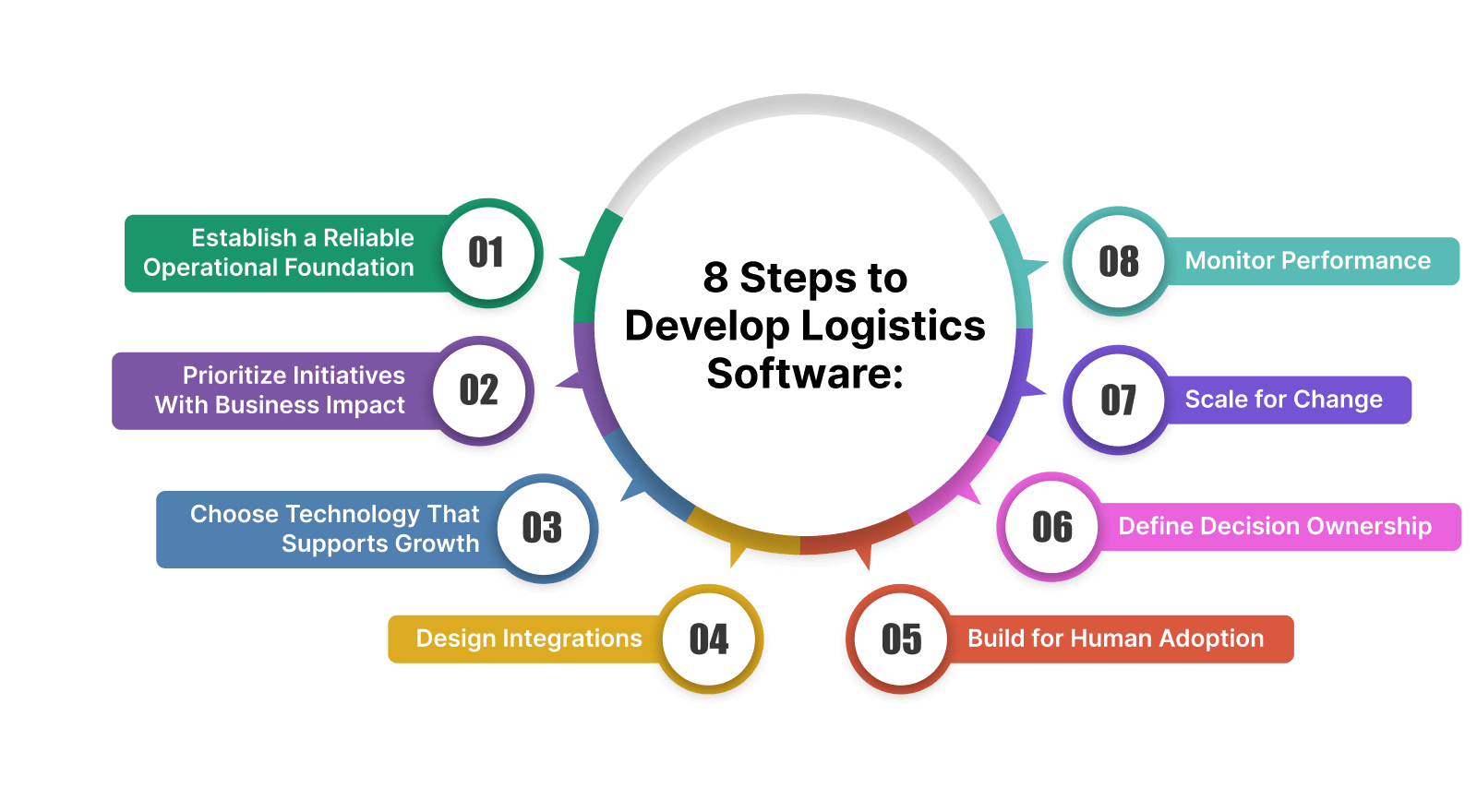
Building a custom transportation logistics management software requires more than technical ambition. Long-term success depends on preparation, ownership, and the ability to evolve as operations grow more complex. The following steps reflect what consistently separates systems that deliver value from those that struggle after launch.
Every effective AI logistics software is built on trust in its operational information. When teams question accuracy or consistency, adoption slows, and decisions become cautious. Creating a stable foundation early removes friction later and allows the system to support planning with confidence rather than guesswork.
Ambition often leads companies to pursue too many initiatives at once. A focused start delivers faster results and helps leadership see value before committing to broader change. Early success also builds internal support across teams that rely on the platform daily.
Decisions made during the early design phase shape operational flexibility for years. AI software development logistics built only for current needs often struggle when volumes increase or new partners come on board. Choosing adaptable technology protects the investment and reduces future rework.
Logistics AI software creates real value only when it connects seamlessly with surrounding systems. Integration should not be treated as a final step but as a central design principle that enables coordination across the entire operation.
Technology cannot operate the business without people. Platforms that ignore daily workflows or introduce unnecessary complexity often face resistance, even if the underlying logic is sound. Designing for real users ensures smoother adoption and long-term use.
As platforms begin influencing operational choices, clarity around responsibility becomes essential. Without clear rules, teams hesitate to act or override recommendations, slowing operations and creating confusion.
Launching a platform is only the beginning. Operational conditions evolve constantly, and systems must adapt alongside them. Planning for change ensures the platform remains relevant instead of becoming a bottleneck.
Consistent results depend on regular evaluation and adjustment. Monitoring performance allows teams to spot gaps early and refine processes before issues affect customers or margins.

The pace of change across delivery and supply operations continues to accelerate, pushing companies to plan rather than respond under pressure. Today, logistics software companies must account for stronger connectivity, tighter collaboration across partners, and rising sustainability expectations.
Research with survey data from 293 manufacturing firms shows that advanced digital and real-time insights significantly boost supply chain integration and efficiency, which in turn drives better overall performance outcomes. Recognizing these shifts early helps you invest in systems that remain stable and effective as operational demands grow.
Next-generation logistics safety AI software is transforming how decisions are made on the move. Higher speeds and lower latency allow vehicles to transmit live video, sensors to report conditions instantly, and operational adjustments to happen without delays. Teams gain better coordination between drivers and control centers, while advanced driver assistance and immersive field tools become viable at scale.
Disconnected systems are giving way to fully connected operational environments that span every function. Information flows smoothly between carriers, warehouses, suppliers, and customers without manual intervention. Standardized formats and open interfaces support easier onboarding of new partners, faster scaling, and long-term flexibility without constant rework.
Automation inside fulfillment centers is evolving toward cooperation rather than substitution. Collaborative robots take on repetitive and physically demanding tasks, allowing staff to focus on supervision, coordination, and quality control. Built-in safety mechanisms support close interaction with human workers, while flexible configuration makes it easier to adapt to changing workflows.
Sustainability is becoming part of everyday operations rather than a separate reporting activity. Emission tracking, fuel usage optimization, reusable packaging strategies, and compliance reporting are increasingly integrated into operational processes. You gain better oversight of environmental impact while making informed choices that support both regulatory needs and long-term efficiency.
Building logistics security AI software is not about reinventing your entire operation overnight. It’s about finally getting a clear, reliable picture of what’s happening across your supply chain and being able to act on it fast.
When your systems work together, delays stop being surprises, planning becomes easier, and everyday decisions feel less reactive. You spend less time putting out fires and more time improving how things actually run. Over time, that means lower costs, happier customers, and a competitive advantage that grows with your business and keeps you one step ahead.


Tech & Innovation Expert
Anastasiya is committed to making the complex simple. Her passion for writing, proficient research, and strong interviewing skills allow her to share in-depth insights into the ever-evolving IT landscape.

Our newsletter is packed with valuable insights, exclusive offers, and helpful resources that can help you grow your business and achieve your goals.