
If you are running a healthcare business and still processing requests by fax, phone, or manual portal entry, you already know the pain even if you have never stopped to fully calculate what it is costing you. When business owners compare prior authorization automation software pricing and features, the numbers often come as a shock, not because automation is expensive, but because the true cost of doing nothing turns out to be staggering. This article breaks down what automation actually costs, what kind of return you can realistically expect, and why the operational case for moving away from manual workflows has never been clearer than it is right now.

Before getting into what automation costs, it is worth being specific about what manual processing costs because most business owners are underestimating it significantly. Understanding the full automated prior authorization cost picture means looking beyond software licensing fees and factoring in the staff hours, error rates, and downstream revenue impact that manual workflows quietly generate every single month. A peer-reviewed study published in Health Affairs Scholar by researchers from Harvard and McKinsey found that the process accounts for an estimated $35 billion in annual US healthcare administrative spending, a figure driven primarily by the inefficiency of manual, fragmented workflows that have no clinical justification for existing the way they do.
Custom medical billing software built around your specific payer mix and service lines can close that gap far more effectively than any off-the-shelf tool because it works with your existing workflows rather than forcing your team to adapt to someone else's system. The cost argument for automation is sitting in your current payroll data, your denial rates, and the time your staff spends on the phone waiting for payer responses.

Pricing varies considerably depending on the type of tool, the depth of integration required, and whether you are licensing an existing platform or building something custom. Here is how the market generally breaks down heading into 2026.
Entry-level cloud-based tools aimed at smaller practices typically run between $500 and $2,500 per month, depending on transaction volume and the number of users. These platforms handle basic electronic submission, status tracking, and payer connectivity, but they tend to be limited in their ability to handle complex multi-service or specialty-specific documentation requirements.
Automating the prior authorization process with FHIR is increasingly the baseline expectation for mid-market platforms, which generally run between $2,500 and $10,000 per month. These tools offer HL7 FHIR R4 API connectivity, real-time eligibility checks, and more sophisticated rules engines that can handle payer-specific documentation criteria. For organizations approaching the 2027 CMS-0057-F API deadlines, FHIR compatibility is not optional — it is the technical foundation everything else sits on.
For hospital networks, large managed care organizations, and multi-specialty groups processing high volumes, enterprise licensing or custom development is typically more cost-effective over a three- to five-year horizon than per-seat SaaS pricing. Custom builds in this category range from $150,000 to $600,000 for initial development, with annual maintenance running 15 to 20 percent of that figure. The upfront number looks large until you model it against the staff costs, denial losses, and compliance penalties of the alternative.
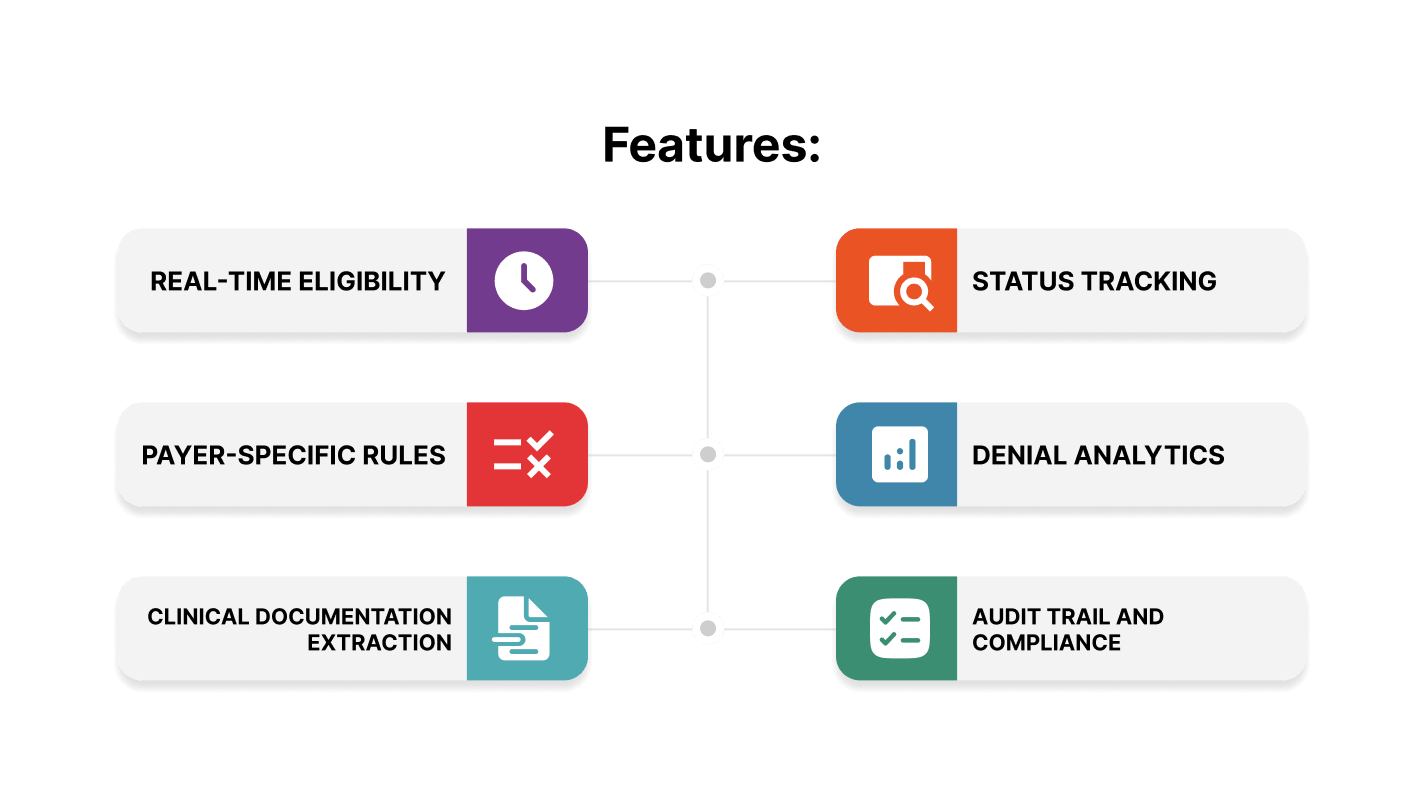
Pricing alone tells you very little about whether a tool will actually work for your organization. The features underneath the price tag are where most purchasing decisions go wrong, because buyers focus on what a platform can do in a demo rather than how it performs under real clinical workflow conditions.
NLP solutions for healthcare are one of the more meaningful differentiators between platforms right now: the ability to read and interpret unstructured clinical notes, pull relevant documentation automatically, and pre-populate requests without requiring staff to manually transcribe information from one system to another. Platforms that include this capability tend to produce significantly higher first-pass approval rates because submissions go out complete and accurate the first time.
Watch out for platforms that lead with AI-powered decision support but cannot actually connect to your payer mix without a six-month implementation. Also be cautious of tools that show excellent demo performance on simple medical authorizations but struggle with specialty-specific criteria, particularly in fields like behavioral health, oncology, or physical therapy where documentation requirements are more complex.
Physical therapy software is a good example of where specialty-specific requirements can make a generic platform more of a liability than an asset. PT authorizations often involve functional outcome measures, ongoing visit limits, and timelines that a standard tool was not designed to handle gracefully. When evaluating any platform, always test it against your highest-complexity types rather than your most straightforward ones.
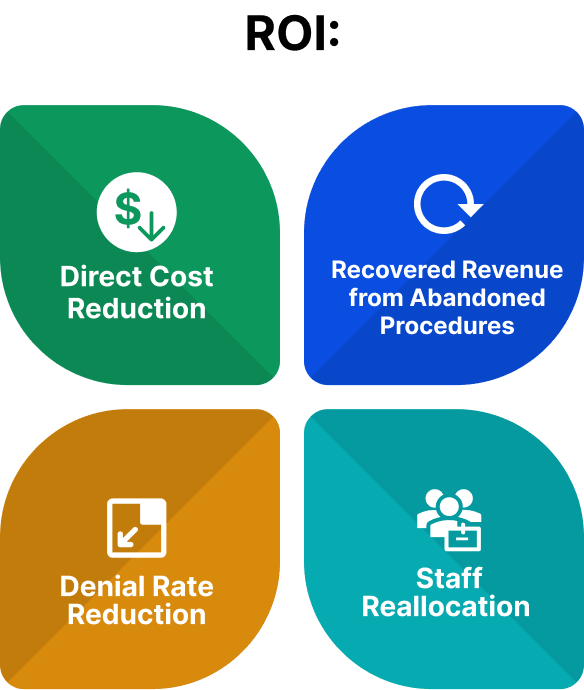
The return on investment from prior authorization automation comes from several directions simultaneously, which is what makes it one of the more compelling technology investments available to healthcare business owners right now. The mistake most organizations make is calculating ROI only on direct cost savings, when the real financial return also includes revenue recovery, staff reallocation, and denial reduction.
Custom software development approaches to prior authorization automation tend to deliver stronger ROI over a multi-year horizon because they are built around the specific payer relationships, service lines, and denial patterns that are unique to your organization rather than averaging performance across a broad customer base the way an off-the-shelf platform does.
For most mid-sized practices and specialty groups, the innovation reaches break-even within six to twelve months of go-live, depending on transaction volume and implementation costs. Organizations with higher volumes and more complex payer mixes tend to see faster payback because the savings accumulate more quickly. When evaluating APA costs against projected returns, the most useful exercise is to calculate your current monthly spend on manual staff time, denial management, and lost procedure revenue and compare that against a realistic automation implementation cost amortized over three years.

The financial case for automation is strong enough to stand on its own, but the operational and clinical benefits matter just as much for healthcare business owners thinking about the long-term health of their practice. The benefits of using automated prior authorization software extend well beyond what shows up on a cost comparison spreadsheet, and for many organizations the non-financial gains end up being just as persuasive as the dollar figures once leadership actually experiences them.
Digital acceleration in healthcare has made it clear that the organizations pulling ahead are not just cutting costs they are building infrastructure that makes them more responsive, more resilient, and more attractive to the providers and patients they serve.
When a patient finds out their recommended treatment or medication is stuck waiting for insurance approval, their frustration lands on your practice. Automation that compresses turnaround from five to fourteen days down to hours changes that dynamic entirely. Patients experience your organization as one that gets things done, and that perception compounds over time into retention, referrals, and reputation.
Prior authorization burden is consistently mentioned as one of the leading contributors to administrative burnout among clinical staff. The scale of the problem is significant: a JAMA study from the University of Colorado found that an estimated 99% of Medicare Advantage plans require it for at least some medical services, making it a near-universal administrative layer that touches virtually every provider working with insured patients.
UI/UX design digital trends in healthcare administrative tools have shifted dramatically toward member- and provider-facing transparency, and the CMS-0057-F requirements for public metrics reporting are pushing organizations to build the tracking and logging infrastructure to support that. Automated systems that capture structured data on every transaction are already producing the metrics that will be required in public reporting by March 2026, while manual systems are going to require significant reconstruction to even approach compliance.
Manual labor scales linearly with volume, leading to more patients meaning more staff hours, almost without exception. Automated systems break that relationship. Organizations that have invested in technology are able to grow their patient volumes without a corresponding increase in administrative headcount, which is one of the more meaningful structural advantages in a market where healthcare staffing costs continue to rise.
Once you have decided that the ROI case is compelling enough to act on, the next decision is whether to license an existing platform, build something custom, or take a hybrid approach. There is no universal right answer, but it depends on your volume, your specialty mix, your existing technology infrastructure, and how closely the available off-the-shelf tools actually match your workflows.
Minimum viable product (MVP) thinking is one of the more practical frameworks for healthcare organizations approaching this decision for the first time. Start with the highest-volume, most standardized types where automation is most straightforward, prove the ROI in that narrow context, and then expand from there. Trying to automate everything at once is one of the more reliable ways to end up with a system that is technically functional but operationally abandoned.
One area that trips up many organizations during vendor evaluation is the automated benefit services prior authorization form workflow; specifically, whether the platform can handle the full documentation and submission process for your payer mix or whether staff will still need to log into individual payer portals to complete portions of the request manually. Any platform that requires significant manual steps to complete a submission is truly automating the process and digitizing the paperwork. Evaluate vendors on the depth of their payer connectivity, the quality of their rules engine updates, and their track record with your specific specialty mix. Ask for reference customers with a similar payer environment to yours.
Organizations that have gone the custom route consistently report that the most important decision they made was investing in discovery and workflow mapping before writing a single line of code. Build to FHIR R4 from the start, involve your clinical and billing staff in the design process, and plan for the payer connectivity work to take longer than the core application build. The compliance and audit logging requirements, particularly under CMS-0057-F need to be part of the architecture from day one, not retrofitted six months after go-live.
Prior authorization automation has moved from an operational upgrade to a strategic necessity. The real comparison is no longer between software vendors — it is between continuing to absorb the hidden costs of manual work and investing in systems that actively return time, revenue, and control back to your organization. With pricing becoming more accessible and technology significantly more capable, the case for action is clearer than ever.
Every day spent on manual prior authorization is a day of lost efficiency, delayed revenue, and unnecessary friction. The organizations that move now are not just solving today’s bottlenecks — they are building a foundation for faster growth, stronger compliance, and better care delivery.
If you are evaluating your next step, start by mapping your current costs and highest-friction workflows. From there, explore whether a platform, a custom build, or a hybrid approach fits your needs best. For organizations with complex requirements or scaling ambitions, partnering with a custom development provider like CleverDev Software can help ensure the solution is built around your workflows — not the other way around. Most importantly, take action.


IT Expert at CleverDev Software
With a tech leadership spanning from 2008, Julia lives by the motto of diving deep into the innovation ocean. Her writing prowess, research acumen, and interviewing expertise enable her to share invaluable insights into IT trends.

Our newsletter is packed with valuable insights, exclusive offers, and helpful resources that can help you grow your business and achieve your goals.


