Have you ever felt like your daily operations keep piling up faster than your team can clear them? This growing pressure is exactly why so many leaders are paying attention to the best AI agents for healthcare and looking for practical ways to ease the load. You might be dealing with slow routines, overwhelmed staff, or tasks that drain time from the work that truly drives progress.
Across the industry, a new wave of digital tools is transforming how organizations handle everyday challenges. These agents streamline complex workflows, support critical decision-making, and help teams operate more efficiently while keeping attention on the outcomes that matter most.


In this article, we explore the most effective tools available and highlight how each can improve operations, save time, and strengthen organizational performance.
Every leader knows the feeling: the day starts with a clear plan, yet by noon, it seems the tasks have doubled, decisions have piled up, and your team is running on fumes. This scenario is not unusual. Across the industry, executives are facing increased workloads, tighter budgets, and higher expectations for outcomes. Traditional workflows that rely heavily on manual effort are often slow, error-prone, and leave little room for strategic thinking.
Digital agents have stepped into this gap. They take over repetitive, time-consuming tasks, track critical information, and provide timely alerts to keep operations flowing. For leaders, this means fewer bottlenecks and faster, more confident decision-making. Teams can spend less energy on mundane tasks and more on initiatives that truly advance organizational goals.
A striking example of this comes from a radiotherapy clinic in Belgium, part of the Iridium Netwerk. The clinic struggled with manually scheduling patient appointments, which led to long wait times, uneven treatment distribution, and heavy administrative work. Through implementing an automated scheduling system, the clinic optimized appointments across multiple machines and teams.
The results were impressive, including average waiting times dropping dramatically, treatment schedules becoming far more consistent, and patients being assigned to the most suitable machines more than 90 percent of the time. Administrative staff could focus on supporting care rather than managing schedules, and leaders gained a clear overview of operational flow. This case highlights how digital agents can deliver measurable improvements in efficiency, resource use, and overall performance.
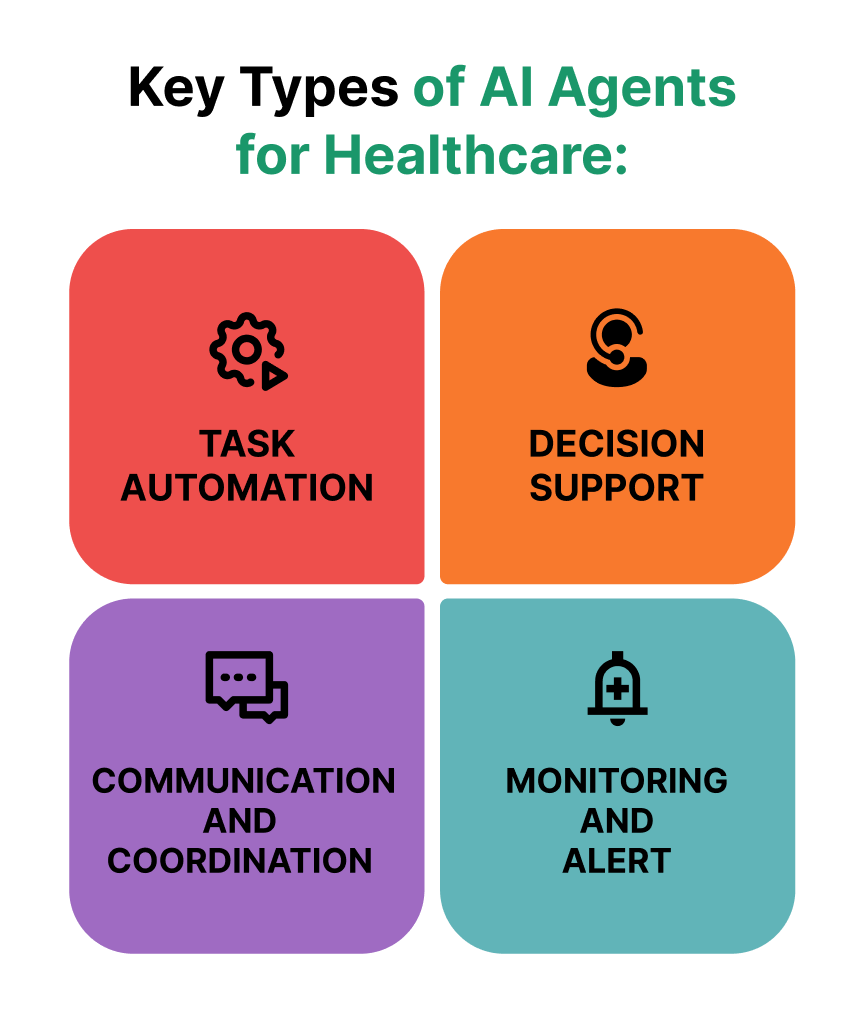
The field of digital agents has grown fast, and each category tackles a specific operational challenge. Having a clear picture of these types helps you understand exactly where your organization can benefit most.

The current landscape of agentic AI offers a wide array of tools, each with strengths tailored to specific challenges. Here’s an overview of some of the most impactful options that leaders are exploring this year.
CleverDev Software develops custom healthcare AI agents tailored to the unique needs of each organization. These agents can manage scheduling, automate routine workflows, analyze operational data, or enhance patient communication — depending on what a hospital, clinic, or healthcare provider requires. Leaders gain actionable insights and clearer oversight of daily operations, while staff benefit from reduced administrative burdens and more efficient processes. Patients experience smoother interactions, timely reminders, and better overall engagement. By designing AI solutions that adapt to specific operational goals, CleverDev Software ensures improved efficiency, accuracy, and care quality across the organization.
This AI virtual assistant manages scheduling, reminders, and follow-ups across multiple teams, ensuring that nothing falls through the cracks. It automates routine appointment management, reducing errors and eliminating missed sessions while saving valuable staff time. Leaders gain a clearer view of operational flow, and teams experience smoother daily routines. This also balances workloads, assigns tasks efficiently, and keeps everyone informed without constant supervision. Organizations using it report higher efficiency in coordinating staff and resources.
Insight Navigator focuses on decision support, analyzing workflow trends and resource use to highlight potential bottlenecks. It presents insights in a clear, actionable format that allows leaders to make informed choices quickly. The best AI agent solutions for healthcare providers bring a bird’s-eye view of operations and identify inefficiencies before they escalate. Staff can prioritize work more effectively, and management gains confidence knowing decisions are supported by reliable analysis. Over time, Insight Navigator contributes to smarter allocation of resources and improved organizational performance.
TaskLink Coordinator enhances team communication and project tracking by centralizing messages, assignments, and updates. Everyone receives the right information at the right time, reducing misunderstandings and delays. Leaders notice that projects move more predictably, and teams feel less frustrated by miscommunications. Managers can track progress without micromanaging, freeing them to focus on higher-level priorities. Teams report a more aligned, efficient workflow when using this tool.
AlertGuard Monitor continuously tracks critical processes and sends real-time notifications when anomalies or delays occur. This early warning system prevents small issues from escalating into major disruptions. Leaders can intervene faster, ensuring workflow consistency and reducing firefighting. Teams feel more supported because potential problems are flagged immediately. The medical insurance verification ai agent also records detailed logs for analysis, helping organizations fine-tune operations for maximum efficiency.
Utilizing it in custom software development optimizes calendars and recurring tasks, suggesting the best times for meetings and deadlines based on team availability. Scheduling conflicts and overbookings decrease, allowing staff to focus on their core responsibilities. Leaders and teams save time that would otherwise be spent coordinating schedules manually. High-priority tasks receive proper attention, improving overall productivity. Organizations using agentic AI for healthcare providers report smoother daily operations and reduced stress around timing and deadlines.
InsightBridge Analyzer examines operational workflows, identifying inefficiencies and areas that need improvement. Leaders receive actionable recommendations for optimizing processes and allocating resources effectively. Patterns that might otherwise go unnoticed become clear, supporting strategic planning. Staff gain clarity on where to focus efforts, to reduce wasted time and duplicated work. InsightBridge Analyzer fosters a culture of continuous improvement and operational excellence.
TeamFlow Organizer keeps all team members updated on tasks, deadlines, and changes in real time. Status meetings and endless email chains become unnecessary, allowing staff to spend more time on productive work. Leaders see progress at a glance and only intervene when required, reducing micromanagement. Accountability improves because everyone knows exactly what is expected. Teams report higher morale and more efficient collaboration when using this tool.
Proactive Alert System monitors ongoing operations and delivers early warnings about potential issues. Leaders can act quickly and decisively, preventing disruptions before they occur. Teams experience fewer interruptions, and critical workflows stay on track. The system also collects valuable information for future process improvements. This proactive approach strengthens both daily operations and long-term planning.
DocuTrack Manager handles document processing, approvals, and record-keeping with speed and accuracy. Errors and delays caused by manual review are significantly reduced. Leaders benefit from fewer administrative bottlenecks, and staff spend less time chasing paperwork. Compliance with organizational standards is easier because audit-ready records are generated automatically. DocuTrack Manager improves the speed, accuracy, and reliability of document-driven workflows.
Resource Optimizer evaluates staff workload and resource allocation to help leaders distribute tasks more effectively. Capacity and demand are clearly visible, highlighting areas where teams may be overloaded or underutilized. Leadership can make informed adjustments to prevent bottlenecks. Balanced workloads improve focus and reduce burnout for teams. Organizations using Resource Optimizer become more agile and capable of handling complex operations efficiently.
These chatbot development services prioritize internal communications, sending essential messages and reminders to the right people at the right time. Clutter is reduced, and important updates are never overlooked. Leaders gain confidence that teams remain aligned, and employees avoid distractions caused by irrelevant messages. Reports on communication effectiveness allow organizations to refine internal processes. Clearer collaboration accelerates decision-making and operational efficiency.
Workflow Sentinel tracks task completion and project progress, highlighting delays and deviations early. Teams can make adjustments quickly without losing momentum. Leaders gain a comprehensive view of operational performance without micromanaging. Staff work with confidence, knowing potential issues are identified promptly. Detailed performance reports help support continuous improvement and strategic planning.
The TaskPilot Coordinator organizes complex projects, managing assignments, deadlines, and dependencies. All stakeholders stay informed, and tasks are completed in the correct sequence. Leaders gain control over multi-step processes, while teams benefit from clearer priorities and reduced disruptions. The special agent's healthcare services medical background reduces the mental load of juggling multiple projects. It ensures the timely delivery of outcomes and minimizes errors.
Operation Insight Agent analyzes operational patterns to identify inefficiencies and opportunities. Leaders receive actionable insights that guide resource allocation and process adjustments. Staff gain clarity on where efforts should be focused, avoiding wasted time. Decisions become more strategic and evidence-based, strengthening organizational performance. Overall, it drives measurable improvements in productivity and workflow efficiency.
This AI assistant for healthcare delivers instant notifications when critical actions are required. Quick responses prevent disruptions and ensure high-priority tasks are addressed promptly. Leaders do not need constant monitoring, freeing them to focus on strategy. Teams act efficiently, knowing that urgent matters are clearly flagged. Historical logs provide insights for future improvement, enhancing reliability and responsiveness.
Such an AI voice assistant for healthcare automates repetitive operational tasks, including record updates, follow-ups, and routine processes. Staff can concentrate on high-value work, while leaders enjoy consistent and accurate execution. Human errors decrease, and essential workflows remain on schedule. Operational productivity improves, and employees experience reduced stress. This agent ensures routine processes run smoothly, creating more time for strategic initiatives.

Organizations that adopt best-rated AI agents for healthcare often see immediate improvements. For example, a 2021 study found that automated assistance systems reduced outpatient waiting times dramatically, cutting average waits from around two hours to just under five minutes. Another study from 2021 demonstrated that an automated triaging system for head MRI scans cut reporting times in half, reducing mean delays from 28 days to 14 days in one hospital and from nine days to five days in another.
These examples show that conversational AI for healthcare can improve efficiency across a range of operational areas, whether scheduling, decision-making, or reporting. Teams experience less stress, projects move forward more smoothly, and leadership can focus on strategy instead of firefighting daily issues.

Selecting the right voice-calling AI agent for healthcare requires a clear understanding of where your organization experiences the most friction. Are appointments or workflows causing delays? Are important decisions slowed by a lack of insight? Are communication gaps creating confusion?
Next, consider scale and complexity. Some AI agents for healthcare compliance are ideal for large, multi-team environments, while others suit smaller groups. Integration is crucial: tools must fit naturally into existing operations rather than disrupt them. Leaders often benefit from piloting agents in one department first, testing effectiveness, training staff, and refining processes before full-scale adoption. A measured approach ensures maximum benefits while minimizing disruption.

The capabilities of healthcare AI agents continue to expand. Advanced systems are beginning to anticipate operational needs, provide deeper insights, and integrate seamlessly across platforms. Leaders who adopt these tools early can gain a competitive edge by running leaner, faster, and more strategically focused operations.
Emerging trends include adaptive workflows, predictive support, and more personalized task management. Organizations that embrace these developments can move proactively, addressing challenges before they arise and maintaining stronger control over operations.
Running a modern organization is already demanding enough, and every interruption or manual task adds friction that your teams should not have to battle. An AI agent in healthcare steps in as steady support, taking over the routines that slow your staff down and offering guidance when decisions need clarity. You get cleaner operations, fewer surprises, and a workplace that finally feels manageable instead of chaotic.
Leaders gain space to think long-term. Teams get time to focus on work that actually moves the needle. Daily operations lose that constant sense of pressure. When these tools work together, they create a calmer, more structured environment where productivity grows naturally rather than through sheer effort.
If you are looking to make your organization more resilient, more predictable, and easier to operate, incorporating the right set of medical AI agents is one of the most effective steps you can take. They help your business run with less noise, less stress, and far more control.


Tech & Innovation Expert
Anastasiya is committed to making the complex simple. Her passion for writing, proficient research, and strong interviewing skills allow her to share in-depth insights into the ever-evolving IT landscape.

Our newsletter is packed with valuable insights, exclusive offers, and helpful resources that can help you grow your business and achieve your goals.