
Have you ever felt your operations slow down because of repetitive tasks and constant manual work? If so, you might be thinking about how to build an AI agent that can take over those processes and make your workflows more efficient.
Every day, business leaders face the challenge of balancing productivity with limited time and resources, and even small inefficiencies can quickly pile up. Creating a well-structured agent can help reduce that burden, keep operations running smoothly, and allow your team to focus on the work that truly drives results.

In this article, we will walk through how to build agentic AI, the step-by-step process of building agents, including planning, design, testing, and deployment.
Starting with the fundamentals, an agent handles recurring tasks automatically, manages regular workflows, and maintains consistency across operations. Imagine functions like invoice processing, vendor management, scheduling, or administrative approvals being handled automatically. Errors decrease, turnaround times shrink, and your staff gains hours previously lost to mundane work.
Routine inefficiencies often seem minor in isolation, yet they add up quickly and create bottlenecks. The advancement reduces this friction, allowing leadership to focus on strategic decisions and giving teams more time to concentrate on high-value work. This shift brings steadier operations, fewer mistakes, and greater overall reliability.
A strong real-life example of how to build AI agents from scratch comes from a semiconductor manufacturer in Silicon Valley. The company partnered with Jade Global to automate invoice processing and vendor management. They handled thousands of invoices each year across hundreds of vendors. After implementing the automated system, invoice processing time fell by ninety-two percent, and the company reclaimed 2,700 work hours annually. Accuracy improved significantly, and staff could redirect effort toward more strategic initiatives. This demonstrates the tangible benefitsa carefully implemented tool can provide when integrated into real business workflows.
It is worth noting that workflow automation is becoming a standard business practice. A study published in 2025 found that companies using automation reported saving 23% of employees’ working hours on repetitive tasks, showing that the value extends beyond a single department.

Setting up an innovation can bring remarkable efficiency gains, but rushing the process or overlooking critical steps can create problems. Some common mistakes include trying to automate too many tasks at once, skipping thorough testing, or neglecting ongoing maintenance. Complexity can lead to instability, while insufficient testing often results in preventable errors that erode trust in the system.
To avoid these pitfalls, start with clear rules and focused workflows. Break down processes into manageable steps and prioritize the areas with the most immediate impact. Human oversight remains crucial for high-stakes operations, such as financial approvals, compliance checks, or critical decision points. A custom AI agent should support judgment rather than replace it, providing actionable assistance while allowing your team to retain control.
Regularly reviewing workflows and updating the logic ensures that it stays aligned with evolving processes. Encourage your team to provide feedback during initial and ongoing use, and assign someone to monitor performance, correct anomalies, and implement improvements. This proactive approach reduces errors and also strengthens confidence in the reliability across the organization.
Getting agentic AI and generative AI to deliver real value requires careful planning and thoughtful integration. However, it is not enough to simply install the system. It is crucial to make sure it fits seamlessly into your current workflows and enhances operations without creating confusion or extra work for your team. Start by mapping out existing processes and identifying where the AI voice assistant can contribute most effectively. Examine interactions with finance systems, databases, tracking tools, and reporting dashboards. Notifications, approvals, and reporting should flow naturally and remain fully transparent, so your team can trust and rely on the system.
Once you have a clear integration plan, begin with a controlled pilot. Use actual operational data and simulate everyday tasks to test performance. Monitor how the no-code AI agents handle routine tasks, how well they communicate with other systems, and where bottlenecks or errors may appear. During this stage, adjust the logic and rules to address any gaps or inefficiencies. A pilot phase gives your team the opportunity to provide feedback, which is invaluable for fine-tuning the voice AI agent before full deployment.
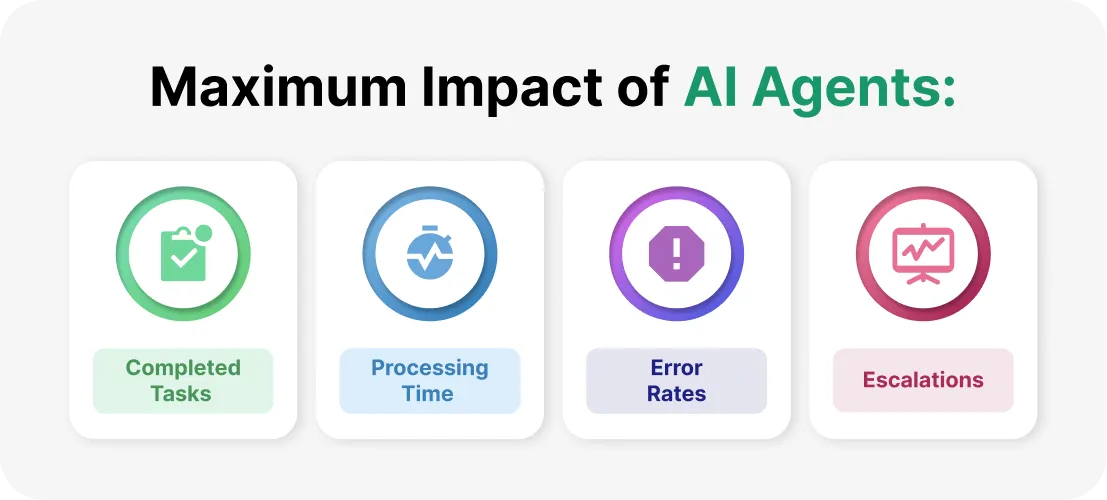
After initial deployment, measurement is key. Therefore, tracking the following critical performance metrics might be handy.
Once reliability and effectiveness are confirmed, plan a gradual expansion. Start by introducing additional workflows or assigning more responsibilities to the conversational AI for healthcare solutions. Consider scaling to different departments only after consistent performance is proven. Continuous monitoring and adjustment will ensure the adaptability to evolving processes and maintain maximum impact over time.
A structured approach like this ensures your team benefits fully, avoids disruption, and positions a trusted tool rather than a burdensome addition.

Even the most capable voice assistant for healthcare fails if it is not adopted. Studies show that automating routine business processes can produce dramatic results. For example, one analysis of financial shared-service centers found that automating the financial close process reduced reporting time from 13 days to under 15 minutes and cut audit-compliance gaps by 80%. This demonstrates the tangible impact well-designed automation can have on efficiency and accuracy.
When your team experiences clear advantages, adoption becomes natural. Encouraging feedback during pilots and adjusting the system according to practical needs ensures smooth adoption. Seeing the guide to building AI agents as something that grows alongside your operations creates far better long-term results.
When you treat the process as an evolving practice rather than a one-time setup, improvements become continuous and meaningful. Assigning a dedicated person to track performance, gather feedback, and refine workflows ensures that the system stays effective and aligned with real business needs. Here are some of the key improvements your team can expect.

Building an AI agent begins with a clear understanding of your operational challenges. Start by examining which tasks consume the most time, create bottlenecks, or introduce repeated errors. Ask yourself where your team spends hours each week on work that could be automated without risking quality or accuracy. Once these tasks are identified, you are ready to follow a structured step-by-step guide to build AI agents.
Begin by articulating exactly what you want to accomplish. Be specific. Are you looking to automate invoice processing, handle vendor follow-ups, or streamline a logistics app? Narrowing the focus keeps your first creation manageable and ensures you can see early results quickly. Write down measurable goals such as reducing invoice processing time by a certain percentage or cutting manual errors in recurring tasks.
Examine the AI agent workflow that will be supported. Document each step in detail, including inputs, decision points, and outputs. Identify where human intervention is required and where automation can safely take over. Visualizing the workflow helps anticipate edge cases and ensures that nothing important is overlooked. This mapping also serves as a guide when building logic later.
Choose platforms or frameworks that support your goals while integrating with your existing systems. Leveraging established tools reduces development time and ensures stability. Consider platforms that allow modular builds, so you can add or adjust AI agents' workflow without starting from scratch. Ensure the chosen tools allow easy monitoring and reporting so you can track performance once it is live.
Translate your workflow map into concrete rules for the custom software development company. Break down each task into precise actions and decision criteria. For example, in invoice processing, define how it identifies invoices, validates fields, checks against vendor records, and determineswhether to approve automatically or escalate for review. Include exception handling for missing information, unexpected delays, or anomalies.
At this stage, you can also structure the logic using bullet points to clarify sequences and responsibilities.
Build a custom AI agent in small components and test each function individually. Begin with simple workflows and gradually integrate more complex tasks. Testing in small increments helps catch errors early and prevents compounding issues. After individual testing, simulate complete end-to-end scenarios using real-world data. Engage team members who perform these tasks daily to provide feedback and identify potential edge cases.
Analyze test results and refine the logic as needed. Pay attention to exceptions, delays, and any points where human intervention might be required. Optimizing the custom chatbot development workflow ensures efficiency and reliability. Focus on making the logic intuitive and maintainable so future updates or expansions are smooth.
Before deployment, plan how the virtual assistants will integrate into your existing systems. Determine how it will interact with databases, reporting tools, finance systems, or task trackers. Ensure notifications and approvals flow naturally, and staff can monitor progress. A well-planned integration minimizes disruption and builds confidence in the reliability.
Launch the AI logistics solutions in a controlled environment or a single department. Observe how it performs under real conditions, collect user feedback, and identify areas for adjustment. Use the pilot to refine workflows, fix overlooked edge cases, and ensure staff feel comfortable with the operations.
After a successful pilot, gradually expand the responsibilities to other teams or departments. Track performance metrics such as tasks completed, time saved, error reduction, and staff satisfaction. Continuous monitoring allows you to maintain efficiency, address emerging issues, and ensure long-term value.

Deployment is only the beginning after you learn how to build AI agents. To see real impact, it is essential to measure performance using both quantitative and qualitative indicators. As an addition to the successful AI agent tutorial, here are several vital metrics to track.
Numbers tell part of the story, but qualitative insights are equally important. Perceptions of reduced workload, greater reliability, and smoother operations indicate whether it truly delivers value for your team.
For example, a semiconductor manufacturing company implementing automation across its document handling and reporting workflows reported significant benefits. Time spent on routine tasks dropped dramatically, errors were reduced, and staff regained hours that could be allocated to strategic initiatives. This case demonstrates how careful planning, stepwise deployment, and constant monitoring can create a powerful tool that accelerates workflows, reduces mistakes, and boosts team satisfaction.
When implemented thoughtfully, technology can reshape the way your organization operates. If you are thinking about building a custom AI sales agent for your CRM, the same principles apply across every department. You are able to reduce the hours lost to repetitive tasks, lower the chance of human error, and bring new speed to processes that once slowed your team down. Your staff can finally focus on strategic, high-value work while routine operations run quietly in the background.
Clear visibility into tasks, workflows, and overall progress helps leaders reach informed decisions faster, and consistent performance strengthens trust across the team. An effective advance enables adjustments to evolving workflows so the advantages continue to grow and the system remainsdependable over time.
In the end, the value of building agentic AI is reflected in real results. Faster turnaround, more accurate operations, better team morale, and the opportunity to reclaim time and resources for strategic priorities all signal that the effort was worth it. With careful planning, structured deployment, and continuous refinement, these gains become attainable for any organization willing to follow a practical, steady approach.


Tech & Innovation Expert
Anastasiya is committed to making the complex simple. Her passion for writing, proficient research, and strong interviewing skills allow her to share in-depth insights into the ever-evolving IT landscape.

Our newsletter is packed with valuable insights, exclusive offers, and helpful resources that can help you grow your business and achieve your goals.


