Shortlisting healthtech software development companies looks simple from a distance and gets complicated fast once you're in it. In healthcare, the wrong partner can mean a failed compliance audit, exposed patient records, or a product that clinicians quietly refuse to use. The market is growing fast, the money is pouring in, and the number of firms claiming healthcare expertise keeps climbing, which makes telling the strong ones from the rest harder than it should be.

In this article we'll cover why the field is booming, what separates a serious healthtech builder from a generalist, what the work costs and how long it takes, the questions to ask before you sign, and the shortlist of companies worth your time.
The money tells the story. The global digital health market was estimated at USD 347.4 billion in 2025 and is projected to reach roughly USD 1.83 trillion by 2033, a compound annual growth rate of 23.4 percent, according to Grand View Research. That is not a niche getting a little bigger but is one of the fastest-growing corners of technology, and healthtech software development sits right at the center of it. Software was the single largest component of that market in 2025 at a 45.7 percent revenue share, which tells you where the demand is concentrated.
Investors are signaling the same trend. According to the OECD 2025 report on venture capital investment in artificial intelligence, AI-related firms attracted over USD 427 billion in global VC funding in 2025, accounting for a majority share of total venture capital activity, with healthcare and life sciences among the fastest-growing application areas as AI moves into regulated, high-value sectors such as clinical decision support and digital health infrastructure.
For a founder or health system leader, the takeaway is clear: capital and strategic attention are increasingly concentrated in AI-enabled software markets, and companies capable of building compliant, production-grade healthcare systems are in consistently high demand.

Healthcare is not a vertical where you can learn on the job at the client's expense. Real healthtech development demands fluency in a set of standards and constraints that simply do not exist in consumer apps. A firm that cannot speak to these on the first call is telling you something important.
Healthtech software development done properly treats all four of these as non-negotiable from day one. The firms that excel are the ones that have shipped compliant products before and can prove it with real case studies, not just confident promises. This is exactly why buyers increasingly seek out a dedicated healthtech software development company rather than asking a generalist agency to figure healthcare out as it goes.
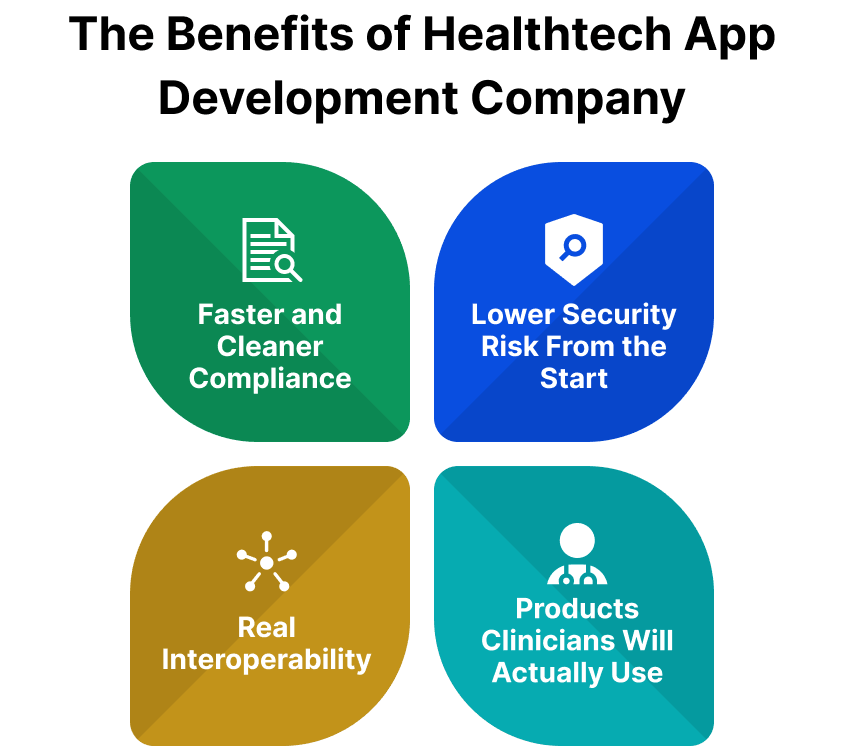
Paying a premium for a focused healthtech app development company pays off in clear ways: in the product, the timeline, and the risk you take on. It's tempting to hire a cheaper generalist and treat healthcare like any other industry with a few extra rules.
That's usually where budgets and deadlines fall apart. A team that has built clinical products before knows where the hard parts hide and which shortcuts you can't take. Here's where that experience pays off.
A specialist already knows what HIPAA, GDPR, and FDA reviewers look for, so compliance is designed into the build rather than bolted on during a frantic pre-launch scramble. That alone can shave months off a timeline and remove the single biggest source of late-stage surprises in healthcare projects.
The financial stakes here are not theoretical. The IBM Cost of a Data Breach Report 2025 found the average healthcare breach reached USD 7.42 million, the highest of any industry for the fourteenth consecutive year, and healthcare breaches took an average of 279 days to identify and contain. A team that builds security in from the first commit is the cheapest insurance policy you can buy against that number.
A specialist has wired products into Epic, Cerner, and Athenahealth before and knows where the integration traps are. That experience turns HL7 and FHIR work from a research project into a known quantity, which protects both your budget and your launch date.
Adoption is where many healthcare products quietly die. A firm that has watched real clinical staff use software knows how to keep common tasks to a couple of clicks, which is the difference between a tool that gets used daily and one that gathers dust.
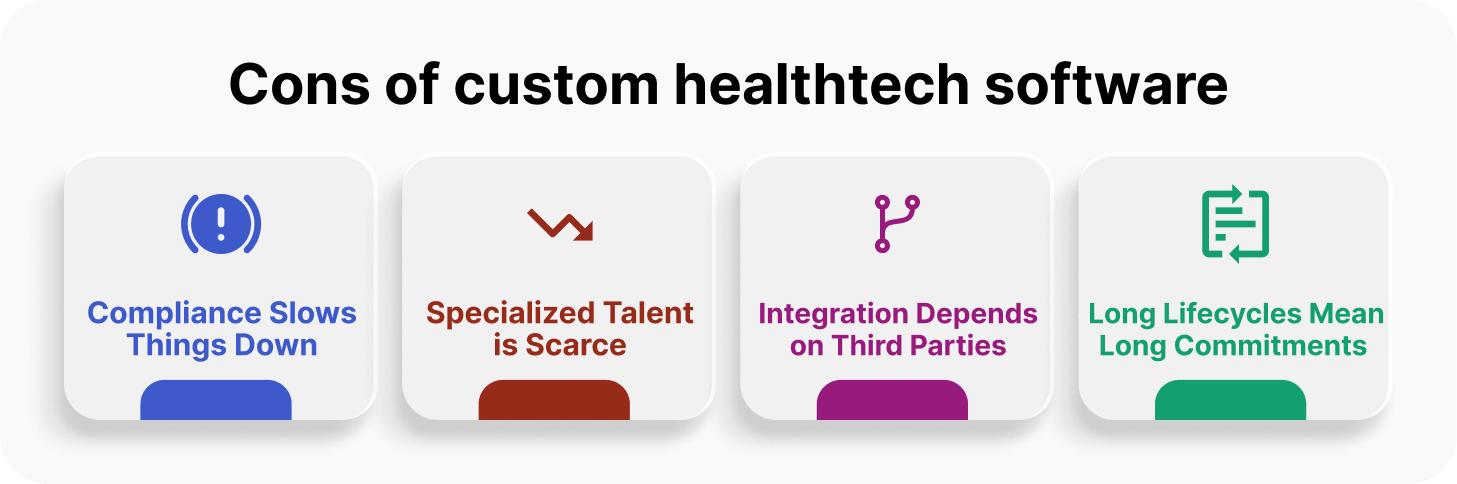
Hiring an outside partner for custom healthtech software development services is not all upside, and an honest firm will tell you where the friction lives. Going in clear-eyed protects you from blaming the builder for problems that are structural to the work itself.
None of these are reasons to avoid building. They are reasons to choose carefully and write the contract accordingly, especially around source-code ownership, security audits, and long-term support. For a complex healthtech enterprise software development program, those terms matter as much as the build itself.

How to develop healthcare software without a budget shock starts with realistic expectations. Costs swing widely with scope, compliance depth, and integration complexity, but some rough 2026 ranges help anchor the conversation:
Two line items buyers routinely forget: compliance certification and security testing, which can add tens of thousands of dollars, and ongoing maintenance, which typically runs 15 to 20 percent of the build cost per year.
A capable healthtech solutions provider will walk you through the total cost of ownership across three years rather than quoting only the headline build price. When comparing a custom healthtech software development quote against an off-the-shelf license, model the five-year cost, since that is where custom builds often pull ahead for complex needs.

Custom software product development in healthcare rewards a sharper interview than a typical agency pitch. Generic portfolio questions barely scratch the surface. These get to what matters:
A firm that answers these crisply, with examples, is showing you the experience that matters. Vagueness is its own answer. Among the broad field of healthtech software development companies on the market, the ones worth your shortlist treat these questions as routine rather than awkward.

Companies in the USA dominate this space, and with all of the earlier points in mind, here is the shortlist. These picks lean toward firms with verifiable, compliant healthcare delivery rather than generalists who list health as one industry among many.
The best healthtech development companies below span a range of sizes and specialties, with the standout choice at number one for good reason. Think of this less as a ranking to copy and more as a starting point to test against the questions above.
Custom software development for healthcare is the core of what puts CleverDev Software first on this list. We build clinical platforms, patient engagement tools, remote monitoring, and the integrations that tie them into existing health systems, with deep strength in FHIR, HIPAA, and AI-native features. As a dedicated healthtech solutions company, our real edge is the engagement model.
We have a senior, dedicated squad that behaves like an in-house team, where the engineers who understand the compliance constraints talk to you directly rather than through layers of account managers. For regulated, integration-heavy builds, that combination of clinical fluency and senior staffing is hard to match.
Taliferro Group builds clinical platforms, patient portals, and provider-facing tools end to end, with careful attention to clinical workflow design. As a smaller, focused shop, it offers close attention and senior involvement, with the natural ceiling that very large enterprise programs can stretch a boutique team.
KMS Healthcare specializes squarely in telehealth, remote monitoring, and clinical platforms, with a strong track record integrating into Epic, Cerner, and Athenahealth. Its narrow healthcare focus is the strength; teams needing broad cross-industry work alongside the health build should look elsewhere.
Empeek focuses on telehealth, medical imaging, and clinical platforms for digital health startups and providers, with HIPAA-aware delivery built into its process. As a mid-size specialist it balances attention and capacity, though the largest multi-site enterprise rollouts may push its limits.
Demigos builds telemedicine, diagnostics, and care-coordination products and is comfortable with the compliance and interoperability work that trips up generalists. Its smaller size means direct senior attention, with bench depth as the usual constraint on very large programs.
Langate has worked in healthcare and life sciences for over two decades, covering EHR-adjacent platforms, practice management, and care coordination. That longevity shows in how it handles compliance, while its breadth means it is less of a razor-thin specialist in any single niche.
Arkenea builds for hospitals, clinics, and digital health startups, with HIPAA-aware delivery and a focus on custom medical software. As a smaller specialist it offers responsiveness and close communication, with capacity being the trade-off on the largest builds.
Softeq spans embedded firmware, mobile, and cloud, which makes it a strong fit when a connected medical device needs all three layers built together. For a pure software platform with no device angle, some of that hardware depth goes unused.
ScienceSoft brings three decades of cross-industry delivery, including a substantial healthcare practice, and is a frequent pick for legacy modernization and large integrations. Its scale supports complex programs, while a firm that broad is rarely the sharpest single-vertical specialist.
Intellectsoft serves enterprise healthcare clients modernizing internal systems and patient-facing tools with a mature delivery process. It suits mid-to-large organizations more than early-stage startups, where its process can feel heavier than a lean first build calls for.
The hardest part of this whole process is resisting the pull of a confident sales pitch. Healthcare software lives or dies on details that never make it into a demo: whether the audit trail holds up under scrutiny. Whether the integration actually survives a real EHR's quirks, whether a nurse can finish a task without fighting the screen. A firm that has been through those battles carries scars worth paying for.
So weigh the portfolio less by its polish and more by its proof. Pull two reference clients, one happy and one that hit turbulence, and listen to how the firm handled the second. Read the contract for who owns the code and what support costs three years out. Push hard on compliance and watch whether the answers get sharper or vaguer. Whatever you build, in healthcare you're not buying a one-time deliverable so much as starting a long relationship, and the partner who understands that from the first call is usually the one still worth having on the last.


Tech & Innovation Expert
Anastasiya is committed to making the complex simple. Her passion for writing, proficient research, and strong interviewing skills allow her to share in-depth insights into the ever-evolving IT landscape.

Our newsletter is packed with valuable insights, exclusive offers, and helpful resources that can help you grow your business and achieve your goals.