
Are you confident that your digital presence will still support your business in 2026, or does it already feel strained by growing expectations and regulatory pressure? Web development for healthcare has become a critical priority as many organizations discover that outdated web platforms slow growth, complicate operations, and weaken trust with partners and stakeholders.

In the years ahead, websites will define how medical businesses present credibility, scale their services, and adapt to constant industry change. In this guide we will focus on what really works, what risks are often overlooked, and how to make smart, future-ready investments that align technology choices with long-term business goals.
A well-executed healthcare website development starts with understanding your business goals. What really matters is how well it supports your business when things get complicated and expectations rise. When you are evaluating your own system, it is important to look past the features and focus on the fundamentals.
For instance, a peer-reviewed study of private service firms in Finland looked at more than 10,000 firm-year observations and found that companies using more advanced digital tools consistently saw higher revenue and productivity growth.
Let’s see how investing in a carefully designed platform can have a direct and measurable impact on how your business performs.
Systems designed with healthcare website development solutions in mind give you the stability your organization expects. Understandably, you need confidence that the performance will be consistent and without constant oversight. Reliability protects reputation, supports continuity, and allows teams to focus on execution rather than firefighting. When a platform behaves predictably, trust grows across the organization.
Using healthcare technology solutions communicates intent clearly to every audience, from external partners to internal teams. Navigation should feel logical, interactions should follow clear patterns, and information should be easy to locate. Confusion slows decisions and creates doubt, while clarity accelerates action and reinforces credibility.
Change is inevitable as markets evolve, regulations shift, and internal priorities adjust. Platforms designed only for current needs quickly become obstacles. A modern technology allows updates and expansion without destabilizing existing operations. This flexibility reduces long-term risk and supports strategic planning rather than reactive adjustment.
A website must remain manageable even as teams, vendors, and priorities change. When future updates depend on fragile custom logic or undocumented decisions, the organization becomes dependent on circumstances rather than strategy. Maintainability protects independence and ensures continuity.

Many organizations continue to rely on programs that technically still function but no longer reflect how the business operates today. They often carry the weight of years of incremental changes, temporary fixes, and evolving requirements that were never addressed holistically.
At first, the impact is easy to dismiss, but over time, it becomes increasingly disruptive. Let’s look at some of the challenges you might face when prolonging the upgrades.
Outdated platforms require constant attention simply to remain operational. What should be straightforward updates turn into lengthy discussions, approvals, and technical checks. Teams hesitate to propose improvements because even small changes can introduce unexpected issues.
As a result, innovation slows not because ideas are lacking, but because the platform cannot support them safely. Maintenance replaces momentum, and the organization becomes cautious rather than confident.
As platforms grow harder to adapt, internal teams compensate in ways that are rarely documented. Eventually, manual processes multiply and information is duplicated across tools. Individuals develop personal methods to complete tasks because the program no longer aligns with real workflows.
These habits allow work to continue, but they also increase inconsistency and reduce transparency. Over time, collaboration suffers and leadership loses clear visibility into how work is actually being done.
When only a small number of people truly understand how a website functions, continuity becomes fragile. Staff changes, audits, or leadership transitions expose dependencies that were previously hidden. What once felt manageable suddenly becomes a significant liability. Therefore, organizations that delay platform renewal often find themselves responding to crises rather than shaping their future deliberately.
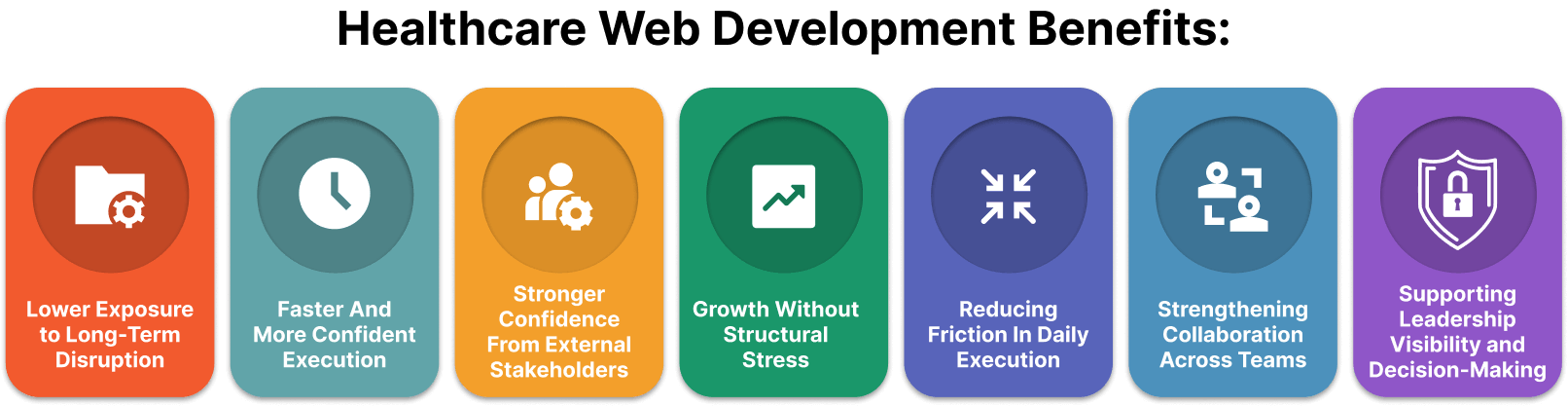
Thoughtful healthcare web app development delivers value that extends far beyond launch. Its impact becomes visible over time, shaping how your organization operates, how confidently you make decisions, and how your business is perceived from the outside. This growing focus on digital presence is not happening in isolation.
According to Statista, nearly 60% of small and medium business owners plan to invest in a new website or improve their existing one, recognizing its direct influence on visibility, credibility, and customer acquisition. Rather than acting as a one-time project, a well-planned platform becomes an ongoing asset that reduces uncertainty and supports consistent progress as expectations continue to rise.
Innovation designed with foresight is far less vulnerable to unexpected breakdowns or urgent corrective work. When structure, scalability, and governance are considered early, then you can avoid situations where small changes trigger wide-reaching consequences.
This stability protects revenue by reducing downtime and prevents leadership from being pulled into constant crisis management. Over time, fewer emergencies translate into steadier operations, clearer planning cycles, and a stronger sense of control at the executive level.
When a cloud technology is predictable and well structured, initiatives move forward with greater confidence. Healthcare web development companies are able to implement updates, launch new offerings, or adjust workflows without fear of destabilizing existing operations.
As a result, decision-making becomes faster because the underlying foundation can be trusted. Instead of hesitating or overchecking every change, teams act with assurance. This creates a rhythm of execution where speed is supported by control rather than undermined by risk.
A clear and reliable platform sends a strong signal to partners, regulators, and investors. It demonstrates that your organization is disciplined, well managed, and prepared for long-term collaboration.
External stakeholders may not see the internal mechanics, but they experience the consistency, clarity, and professionalism the platform conveys. Over time, this builds confidence and reduces friction in negotiations, reviews, and strategic discussions.
Growth often exposes weaknesses that were built only for immediate needs. When expansion requires constant rebuilding or patching, momentum slows and internal strain increases. A platform designed for growth absorbs higher demand, broader scope, and evolving requirements without disrupting existing operations.
This allows leadership to pursue new opportunities with confidence, knowing that expansion will be supported rather than resisted by the underlying structure.
When workflows are accurately reflected in the healthcare web app development, everyday work becomes noticeably easier. Teams spend less time clarifying next steps or correcting misunderstandings and more time focusing on meaningful tasks.
Responsibilities are easier to follow, transitions between roles feel smoother, and interruptions decrease. Eventually, this consistency lowers stress, improves morale, and reduces the likelihood of costly errors that stem from confusion or repetition.
A centralized and well-structured AI healthcare software creates a shared point of reference across the organization. Teams no longer rely on fragmented communication or informal workarounds to stay aligned. Information is easier to find, handovers are clearer, and expectations are more transparent.
As trust grows, teams gain confidence in each other’s work, leading to fewer delays and stronger collaboration across functions.
Clear structure and predictable behavior give leadership a more accurate view of how the organization is operating. This visibility makes it easier to identify patterns, anticipate challenges, and plan with confidence.
Instead of reacting to issues after they escalate, leaders can respond earlier and with greater precision. The result is a more controlled operating environment where decisions are informed, timely, and aligned with long-term direction.

Choosing a partner is not only about who can build the medical scheduling. It is about who can guide you through complex decisions, challenge assumptions when needed, and create a sense of confidence at every stage of the process.
The right partner brings structure and perspective, helping you move forward with fewer doubts and clearer priorities. Here are some of the points that may help you decide on the best-fitted match for you.

Successful digital transformation in healthcare is rarely the result of speed or isolated effort. They come from taking the time to plan deliberately, execute with discipline, and keep business intent aligned with practical decisions along the way. When each stage builds on the previous one, the path from early vision to long-term operation feels clearer and far less uncertain for you as a leader.
Roche provides a clear example of how a well-planned approach delivers long-term value. Through redesigning its global web presence around shared structure and governance, the company built a stable foundation that supported growth, reduced rework, and gave leadership confidence to scale without adding unnecessary complexity.
Below we present our detailed healthcare web app development guide that explains how to achieve even greater results for your business.
The process begins with leadership alignment. Before any structural or technical decisions are made, it is essential to clearly define why the platform exists and what it must achieve for the business. This way you can establish direction and prevent the project from becoming a collection of disconnected requirements.
Clear objectives help determine priorities, set realistic expectations, and guide trade-offs when decisions become complex. Success criteria provide a shared reference point that keeps stakeholders aligned throughout the project. When this foundation is strong, every subsequent decision has context and purpose, reducing the risk of scope drift and misalignment.
Once goals are clear, attention turns to constraints. A detailed assessment of regulatory obligations and internal operating realities ensures that the platform is grounded in real-world conditions rather than assumptions. At this point you shape what is possible and define the boundaries within which the program must operate.
Understanding these requirements early prevents costly revisions later. It also allows leadership to make informed decisions about risk, timing, and investment. When constraints are acknowledged upfront, the project progresses with fewer surprises and greater confidence.
With goals and constraints established, the focus shifts to how the platform will actually be used. At this stage you examine the interactions of different roles and consider real scenarios rather than idealized workflows. Understanding practical usage patterns helps translate business intent into functional structure.
Careful mapping at this stage reduces friction later. It ensures that the platform supports daily work instead of forcing teams to adapt around it. When usage is clearly understood, the resulting platform feels intuitive and aligned with how the organization truly operates.
Architecture decisions form the backbone of the healthcare web application development. They influence performance, adaptability, and independence for years to come. Selecting an approach with long-term stability in mind protects the business from future limitations that are difficult or expensive to correct.
This step requires balancing current needs with future uncertainty. A well-chosen architecture allows the platform to evolve without constant restructuring. For business leaders, this translates into flexibility and resilience as priorities change over time.
Design is approached as a tool for understanding rather than decoration. Here, structure and interface choices are guided by clarity, consistency, and ease of use. The goal is to make the medical device web development understandable without extensive training or explanation.
Purpose-driven design reduces cognitive load and encourages adoption. When users can quickly grasp how the platform works, productivity increases and resistance decreases. Over time, this clarity becomes a quiet but powerful contributor to operational efficiency.
Development progresses in controlled stages rather than a single large delivery. Now teams are able to validate assumptions, test functionality, and incorporate feedback while change is still manageable. Each stage builds confidence and improves quality.
Structured validation reduces risk by catching issues early, providing leadership with visibility into progress, and making it easier to assess readiness and adjust direction if needed. Such steady rhythm supports better outcomes and fewer last-minute surprises.
Before the healthcare web development company makes a broader introduction, it undergoes careful review to confirm alignment with all requirements, including operational readiness, regulatory alignment, and overall stability.
These reviews provide reassurance to leadership and external stakeholders and create confidence that the platform is ready to support the business responsibly and reliably from day one.
A successful launch depends on internal readiness. Teams need to understand not only how to use the technology but also how to support it over time. Clear documentation, defined ownership, and internal alignment are essential at this stage.
Preparation reduces dependency and confusion. When teams feel confident and informed, adoption is smoother and long-term support becomes more sustainable. This step ensures the healthcare web portal development becomes part of normal operations rather than a fragile new addition.
Launch marks the transition from preparation to real-world use. Active monitoring during this phase provides insight into how the platform performs under actual conditions. Early observation reveals patterns, edge cases, and opportunities for refinement.
Addressing issues promptly during this period strengthens trust and reinforces confidence across the organization. A well-managed launch sets the tone for how the platform will be perceived and supported moving forward.
Healthcare web development is never truly finished. Business needs evolve, expectations change, and external conditions shift. Planning for continuous improvement ensures that the platform remains relevant and effective over time.
Regular evaluation creates a feedback loop between strategy and execution. Instead of reacting to problems, the organization can adapt deliberately, keeping alignment with long-term goals and operational realities.

Many challenges do not stem from inherent complexity but from avoidable decisions made at the very beginning of the process. When early choices are rushed or poorly defined, their impact tends to surface later, when changes are more expensive and disruptive. Recognizing these patterns allows you, as a business leader, to approach development with greater awareness and avoid pitfalls that repeatedly undermine otherwise strong initiatives.
Pressure to move quickly often leads healthcare web development agencies to shorten or skip early analysis. While this may create the impression of momentum, it usually results in unclear direction and a fragile structure.
Gaps in early planning tend to reappear as conflicting requirements, stalled progress, or rework during later stages. Time that seems saved at the start is often lost many times over through revisions, delays, and internal frustration. A measured beginning creates smoother progress and more predictable outcomes.
When responsibility is spread across too many roles or remains undefined, progress slows and decisions lose focus. Questions linger longer than they should, priorities shift without resolution, and accountability becomes difficult to enforce. Clear ownership provides a single point of direction and ensures that decisions move forward with purpose. For leadership, this clarity reduces friction and helps maintain steady momentum throughout the project.
Decisions driven primarily by immediate cost often introduce hidden risk. Lower upfront investment may lead to limitations that surface later as operational strain or repeated rework. Stability, adaptability, and clarity are difficult to retrofit once the foundation is in place. Taking a longer perspective allows you to invest in choices that support sustained value rather than temporary savings.
Another common mistake is viewing development as something that ends at launch. This mindset overlooks the reality that business needs evolve and expectations shift. When no plan exists for ongoing evaluation and adjustment, platforms gradually lose relevance. Recognizing development as a continuing responsibility encourages better planning and protects long-term usefulness.
Even with a well-built healthcare web development guide, one can struggle if internal readiness is overlooked. When teams are not prepared for new ways of working, adoption slows and confidence drops. Ignoring the human side of change creates resistance that is difficult to reverse. Early attention to internal alignment helps ensure that the platform supports people rather than disrupting their work.

The cost of building a modern medical website can vary significantly, depending on what it is expected to do and which healthcare web app development company is responsible for building it. Projects can start at around $5,000 and scale beyond $300,000. These differences are driven by functional scope, technical depth, and the geographic location of the development team.
Who you hire for this task can be just as important as what you are building. Developing an internal team introduces additional expenses beyond development time, such as salaries, infrastructure, and long-term maintenance. For example, building a record management platform with in-house medical web developers can easily exceed $150,000 once all internal costs are considered. Working with an external development partner often reduces this figure significantly while still delivering a fully custom result.
The location of the development team also has a strong influence on pricing. Healthcare web developers based in the United States typically charge hourly rates between $60 and $90, which can push total project costs beyond $200,000. In contrast, teams in Central and Eastern Europe usually charge between $35 and $50 per hour, lowering total investment to roughly $60,000 to $120,000 for comparable scope. Custom development in Poland has become a particularly popular option, offering experienced teams, familiarity with regulated environments, and more predictable budgets.
While custom medical web development requires meaningful investment, the long-term value of a well-planned innovation often outweighs the initial cost. When built with foresight, it supports stable operations, limits future rework, and becomes a dependable business asset rather than an ongoing expense.
Digital healthcare web development plays a quiet but decisive role in how medical businesses operate, scale, and maintain credibility. The decisions you make around them influence how confidently your organization moves forward, especially when conditions change or expectations rise. High-quality technology becomes a source of stability rather than something that constantly demands attention.
When approached strategically, web development gives you control instead of uncertainty. It allows your teams to work with clarity, reduces friction in everyday operations, and supports growth without repeated disruption. Over time, this consistency strengthens trust with partners and reinforces the sense that your business is well governed and prepared.
Above all, a thoughtfully built platform reflects intent. It shows that your organization takes its future seriously and invests with purpose. By making deliberate choices today, you create a foundation that supports steady progress and lets you focus on leading the business, not managing avoidable complexity.


Tech & Innovation Expert
Anastasiya is committed to making the complex simple. Her passion for writing, proficient research, and strong interviewing skills allow her to share in-depth insights into the ever-evolving IT landscape.

Our newsletter is packed with valuable insights, exclusive offers, and helpful resources that can help you grow your business and achieve your goals.


