Your teams are overwhelmed with information, yet critical decisions still get delayed because the right answers are hard to surface at the right moment. If this is your case, you probably have tried researching RAG vs. agentic AI, trying to figure out which approach can finally bring clarity and control to this chaos.
On one side, there are systems designed to retrieve precise information from your internal knowledge base in seconds. On the other, there are technologies capable of reasoning through tasks, planning next steps, and interacting with multiple tools with minimal human guidance. Both approaches can reshape operations. Both require investment and strategic thinking.
However, the real struggle is deeply understanding what fits your current infrastructure, your risk profile, and your growth plans. Eventually it goes beyond technical definitions, requiring a need for a practical comparison that connects directly to performance, efficiency, and long-term scalability.

Retrieval augmented generation (RAG) is a framework that strengthens large language models by connecting them to relevant, real-time knowledge sources. Instead of depending only on what the model learned during initial training, RAG pulls in the most relevant documents at the moment a question is asked and uses that material as context. Essentially, it reflects current information and your company’s specific expertise rather than generic output.
Many organizations now treat GenAI RAG as a core architecture for enterprise-level initiatives.
As generative systems expand into areas such as customer support, internal knowledge management, and compliance, RAG plays a critical role. It connects broad language capabilities with your organization’s actual documentation, policies, and operational records. For business leaders who value accuracy and accountability, that connection is what turns experimental technology into something dependable and practical for real-world use.

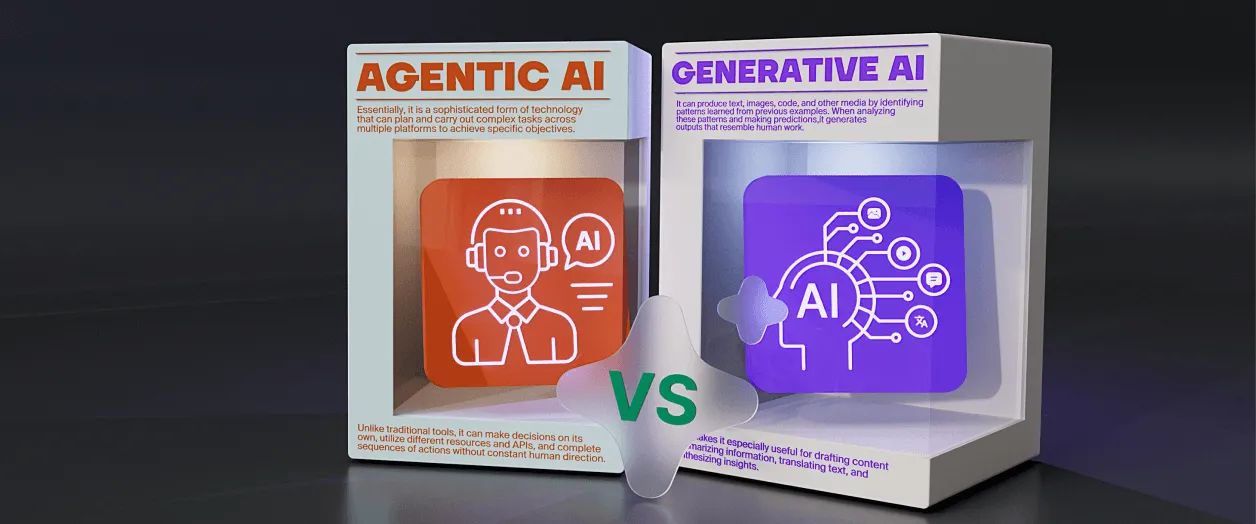
Agentic AI refers to systems designed to achieve a defined objective with minimal human oversight. At the core are intelligent agents, machine learning models that replicate structured human decision-making to address challenges as they arise. In multiagent environments, each agent is responsible for a specific subtask, and their activities are aligned through an orchestration layer that ensures all efforts contribute to a shared outcome.
This model differs from traditional custom software development that operates within strict predefined rules and relies heavily on continuous human input. Agentic AI demonstrates autonomy, acts with purpose, and adapts when conditions shift. The term “agentic” highlights exactly this quality: the ability to operate independently and intentionally rather than simply respond to instructions.
Technically, agentic systems build upon generative techniques and large language models to function in changing, real-world environments. Generative models are designed to produce content based on learned patterns, whether that is text, visuals, or code. Agentic AI takes this a step further. It uses generated output as a tool to accomplish broader objectives.
For example, a generative model might suggest the best time to climb Mount Everest based on your availability. An agentic system could move beyond recommendation. It could assess travel options, secure reservations, coordinate bookings, and organize the entire trip through integrated external tools. In essence, it transitions from delivering information to executing the plan.
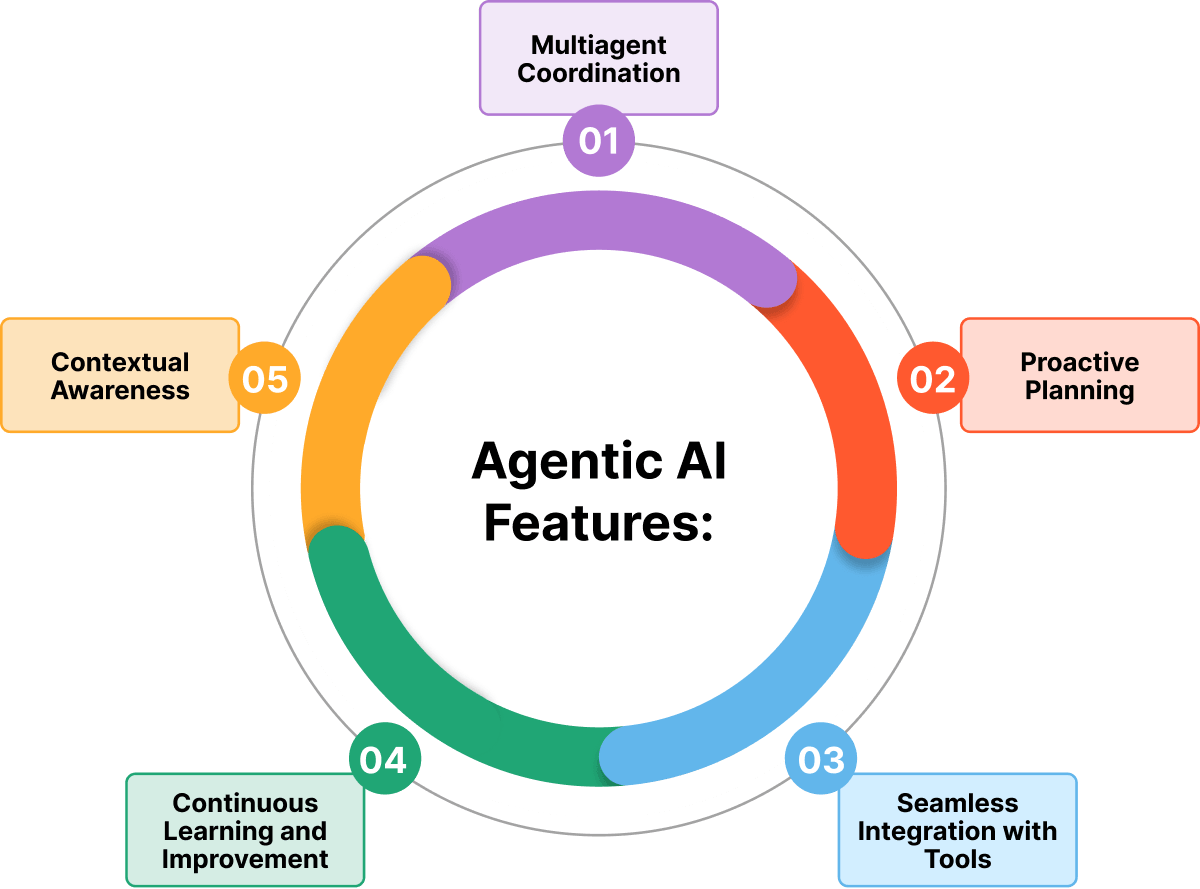
Agentic AI doesn’t act completely independently since it’s packed with capabilities that allow it to operate intelligently, handle complex tasks, and continuously improve over time. Understanding these features helps businesses see how these systems can transform operations and decision-making.

In modern businesses, speed and accuracy alone aren’t enough. Decisions must be informed, actions must be timely, and complex tasks shouldn’t stall because of human limitations. When considering agentic RAG vs agentic AI, the latter changes the game by not just providing information but actively driving outcomes and adapting in ways that feel intuitive and intelligent. Here’s how it delivers real value beyond traditional systems.
Agentic AI can take a challenge and figure out the steps needed to reach a goal without constant human oversight. It’s like having a team member who not only knows what needs to be done but also takes the initiative to make it happen. This reduces bottlenecks, accelerates workflows, and ensures progress even when human attention is limited.
Rather than sticking to a fixed plan, it constantly evaluates the situation and claims processing and adjusts its approach based on new insights or changing circumstances. If priorities shift or unexpected obstacles appear, it recalibrates automatically. This makes it especially valuable in fast-moving industries where static processes quickly fall behind.
If you decide to build an agentic AI, it can coordinate multiple subtasks simultaneously, acting like a conductor for complex operations. Whether it’s managing parallel workflows, synchronizing departments, or aligning processes across locations, it ensures that every moving part works together smoothly toward a shared goal.
Instead of consuming unnecessary time, attention, or computational power, agentic AI focuses on what truly matters. It prioritizes actions, reduces wasted effort, and handles repetitive or intricate processes efficiently, letting human teams concentrate on high-value decisions.
Decisions made by agentic AI are grounded in real-time inputs and situational understanding rather than fixed rules. It interprets the context of each task, weighs relevant factors, and produces outcomes that are tailored, precise, and actionable, making the system trustworthy for critical operations.

AI agents in healthcare are autonomous systems that can observe their environment, make decisions, and take actions to achieve a goal. It adds another layer of sophistication by allowing these agents to plan and reason so they can act proactively instead of just reacting. This means the system can decide its next move without waiting for human instructions.
The RAG definition addresses a common limitation of traditional models: static knowledge. Instead of relying solely on pre-trained information, RAG dynamically pulls in up-to-date context from sources like APIs, databases, or internal records. This allows it to generate responses that are accurate, relevant, and grounded in the latest available information. Industries such as healthcare, education, and business find this especially valuable, where timely information is essential.
Now, imagine combining these two concepts. Agentic RAG merges the proactive problem-solving ability with NLP and the real-time knowledge retrieval of RAG. The result is a system that actively seeks out the information needed to get it done. Think of it as an intelligent assistant that goes beyond following instructions to independently tackling challenges and delivering results.
The market momentum behind this shift is significant. Recent industry analysis estimates that the global market for autonomous systems is valued at approximately USD 5.3 billion and is projected to exceed USD 50 billion by 2030, reflecting rapid enterprise adoption and investment in systems capable of reasoning and execution. This growth underscores that agentic RAG represents a major strategic direction in how businesses are building next-generation intelligent systems.
Understanding how retrieval augmented generation operates in practice makes its value much clearer. The workflow is essentially a cycle of perception, retrieval, reasoning, and action — all coordinated to achieve a specific goal. A strong real-world example of this can be seen at Morgan Stanley, where an AI-powered assistant was introduced to support financial advisors.
In this case, the AI software first perceives a query from an advisor, such as a request for insights about a market trend or a specific client scenario. It then retrieves relevant information from tens of thousands of internal research documents, reports, and knowledge sources. Instead of simply presenting raw search results, the system moves to the reasoning phase, where it synthesizes and prioritizes the most relevant insights in context. Finally, it supports action by delivering structured, advisor-ready responses that can directly inform client conversations and investment decisions.
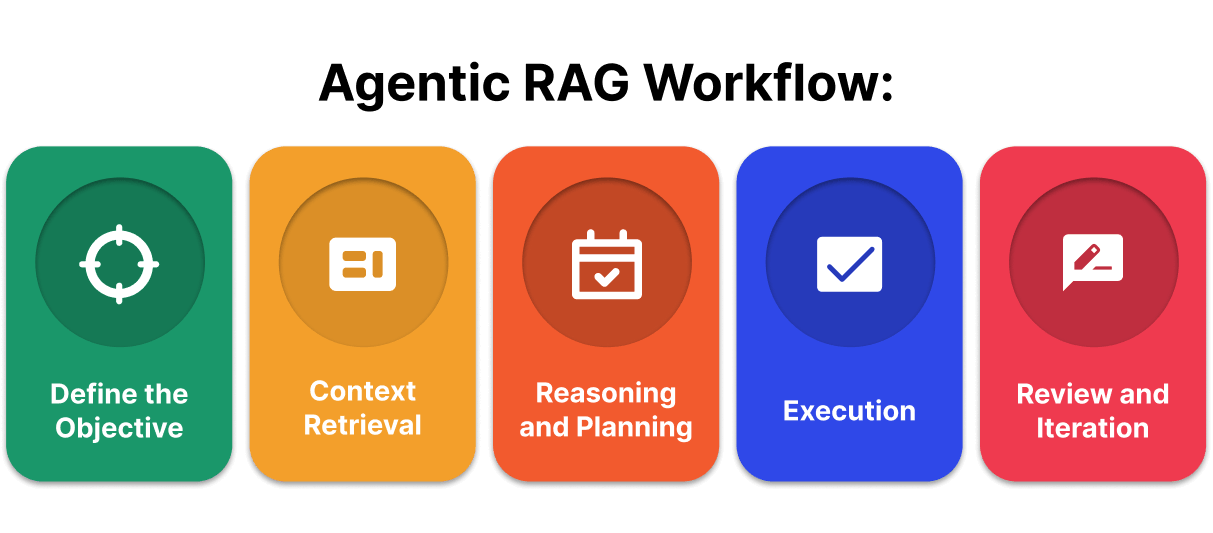
Everything starts with a goal. The system identifies the target outcome, whether that’s solving a customer inquiry, analyzing market trends, or ensuring compliance with internal policies.
Once the objective is clear, the system pulls in relevant information. This could be documents, records, internal databases, or live APIs. Unlike static models, it retrieves data in real time, ensuring the next steps are based on the most current and relevant context.
With the information in hand, the RAG AI agent evaluates options, sequences tasks, and creates a plan. It determines dependencies, anticipates potential obstacles, and outlines the steps needed to move toward the goal efficiently.
The system then takes action. It can interact with multiple tools, generate outputs, update records, or trigger processes across platforms. The focus is on achieving the goal, not just providing information.
Finally, agentic RAG monitors progress and adjusts as necessary. If something doesn’t go as planned, it can re-evaluate the data, tweak the plan, and continue until the objective is met. Human oversight can be added at any stage for additional assurance.

AI agent vs. RAG represents a digital transformation in healthcare to gather, process, and act on knowledge. By combining autonomous decision-making with traditional retrieval, it delivers results with higher precision, flexibility, and reliability—capabilities that classic RAG alone can’t match. A strong real-world example of this approach can be seen at PwC, where agent-driven systems have been introduced to transform tax and compliance workflows.
In PwC’s case, the system doesn’t simply retrieve regulatory documents or tax guidance. It begins by identifying the objective, such as preparing complex tax documentation or assessing compliance requirements for a specific client scenario. From there, it retrieves relevant regulatory texts, internal knowledge bases, and prior case materials. The agentic layer then reasons over this information, interpreting rules in context, resolving ambiguities, and determining the necessary steps to complete the task.
Here’s why it matters for your business:
This shift is already happening at scale. A 2025 survey by McKinsey & Company found that 23% of organizations are scaling agentic AI systems across at least one function, while 39% are actively experimenting with them. As adoption grows, the ability to learn and refine decision-making becomes a clear competitive advantage rather than just a technical enhancement.
Selecting the right approach for your business starts with understanding agentic AI vs agentic RAG in capabilities, impact, and real-world use. Both can improve efficiency and accuracy, but they operate very differently.
Navigating the world of rag vs agentic rag doesn’t have to feel overwhelming. Each approach brings unique strengths to the table, and understanding those differences is the key to leveraging them effectively.
RAG excels at delivering fast, reliable insights grounded in your organization’s knowledge. It’s ideal for teams that need accurate information quickly and want to minimize errors without adding complexity. AI agent development meanwhile, takes autonomy and adaptability to the next level, executing multi-step tasks, adjusting to changing conditions, and tackling problems that evolve over time.
For many businesses, the most powerful option is a combination of Agentic RAG. It merges precise knowledge retrieval with intelligent action, creating a system that not only knows what to do but actively figures out how to do it. This hybrid approach can transform workflows, speed up decision-making, and reduce operational risk.
Ultimately, the right choice depends on your goals, resources, and growth plans. By evaluating your business needs against the capabilities, limitations, and strategic value of each system, you can make an informed decision that drives efficiency, clarity, and real impact across your organization.


Tech & Innovation Expert
Anastasiya is committed to making the complex simple. Her passion for writing, proficient research, and strong interviewing skills allow her to share in-depth insights into the ever-evolving IT landscape.

Our newsletter is packed with valuable insights, exclusive offers, and helpful resources that can help you grow your business and achieve your goals.