
How do you keep your retail business running smoothly when customers constantly move between online stores, mobile apps, and physical locations? For many companies, software development for retail has become a critical topic as they try to manage this growing operational complexity.
The challenge has gone beyond simply attracting customers anymore. It is coordinating everything that happens behind the scenes. Orders arrive from several channels at once, inventory must stay accurate across warehouses and stores, and shoppers expect the same experience wherever they interact with your brand. When the underlying technology cannot support this pace, operations begin to slow down.
Many retailers try to address these issues by adopting ready-made tools. While they may work at first, they often struggle to keep up with unique workflows or rapid business expansion. Over time, companies discover that their technology environment creates more limitations than opportunities.

This is why many growing ventures begin investing in tailored digital platforms. When systems are designed around your specific processes, it becomes much easier to coordinate sales channels, automate daily operations, and maintain a consistent customer experience across every touchpoint.
In this guide, we will walk through how businesses approach building scalable platforms that support omnichannel growth. You will learn about the core types of systems retailers rely on, the development process behind them, the common challenges companies encounter, and practical strategies for creating technology that can grow alongside your business.
Building digital systems for modern stores means creating tailored tools like point-of-sale platforms, inventory tracking environments, and enterprise management platforms that keep daily operations running smoothly. These systems connect physical locations with online storefronts so you can manage orders, stock, payments, and customer interactions in one coordinated environment. When designed well, they help leadership teams see what is happening across every channel, make informed decisions faster, and keep sales moving even as the company grows.
If you are exploring how to build a custom platform for your business while dealing with tight budgets, aging technology, or a shortage of skilled engineers, this guide was written for you.
In the sections ahead, we will walk through what modern commerce platforms can do for growing brands. You will see how advanced capabilities such as AI-driven analytics, virtual try-on experiences powered by augmented reality, and connected inventory tracking with IoT devices are already reshaping the way companies operate. We will also talk about the reality many businesses face when updating older systems and share real examples of organizations that successfully modernized their technology environments with our help.
Let’s begin by looking at how purpose-built digital platforms can transform everyday operations for companies selling across multiple channels.
When businesses start exploring digital tools for their operations, one of the first decisions they face is simple in theory but important in practice. Should you rely on ready-made products or invest in a platform built specifically for your company?
Ready-made products are widely available and usually quicker to adopt. Many companies choose them because the upfront cost is lower and the implementation process can begin almost immediately. However, these products are designed for a broad audience. That means they rarely match the exact way your business operates.
A tailored platform, on the other hand, is built around the way your company actually works. Instead of adjusting your processes to fit a rigid product, the technology adapts to your workflows. The difference becomes noticeable very quickly. Teams spend less time working around limitations and more time focusing on growth.
Industry numbers reflect how strongly companies are investing in modern technology. According to Verified Market Reports, the management platform market is projected to grow at a compound annual growth rate of 9.2% between 2026 and 2033. This growth is largely driven by the rising demand for automation and stronger operational visibility. If you choose to move toward custom retail software solutions, you can often see higher productivity because they can introduce capabilities that generic products simply do not provide.
Additionally, the financial impact becomes clear within daily operations. When routine activities such as stock updates or financial reconciliation happen automatically, your team no longer spends hours managing repetitive tasks. Instead, they can focus on initiatives that actually move the business forward, whether that means expanding into new channels, refining pricing strategies, or improving customer engagement.
Another advantage appears when you start examining customer behavior more closely. A tailored platform can help you understand purchasing patterns, seasonal trends, and preferences across different channels. With this visibility, marketing teams can create far more precise campaigns, and customers receive product recommendations that actually match their interests.
Cost control is another important factor. With ready-made products, you might often end up paying for many modules they never use. A platform built for your organization avoids that problem. Every feature is there for a reason, which allows you to allocate your budget where it truly matters.
There is also a competitive aspect to consider. When every competitor uses the same generic tools, customer experiences tend to look identical. A tailored platform allows you to introduce distinctive capabilities. This might include intelligent product suggestions powered by AI, advanced demand forecasting, or more flexible purchasing journeys across digital and physical channels. These experiences can leave a lasting impression and keep customers coming back.

Running a growing business means coordinating dozens of moving parts every day. Orders come from multiple channels, inventory moves across warehouses and stores, customers expect fast service, and leadership teams need clear visibility into what is happening across the entire company.
Because of this complexity, many organizations invest in purpose-built digital platforms that focus on specific operational areas. While every business will require a slightly different technology stack, the following categories often form the backbone of a strong and scalable environment.
Let’s explore the platforms that most frequently make a real difference.
A management platform acts as the operational command center for the entire business. It connects daily activities such as employee scheduling, order processing, stock tracking, and financial reporting into one coordinated environment.
Without this level of coordination, teams often rely on multiple disconnected tools. Information becomes scattered, processes get duplicated, and leadership struggles to see the full picture of what is happening across the company.
When building a management platform, one of the most important considerations is how information moves between different modules. Accounting, inventory tracking, and eCommerce systems must communicate smoothly. If they do not, small errors can quickly multiply into serious operational problems.
Another essential capability is flexible import and export of information. You often need to migrate historical records from previous custom retail software development solutions or incorporate information from partners such as suppliers, logistics providers, or marketing platforms. A well-designed architecture makes these transitions far easier and prevents disruptions during implementation.
When everything is connected properly, a management platform gives executives and operational teams a single place to oversee daily activity. Instead of juggling multiple dashboards, they gain a clear operational view of the entire organization.
The point of sale platform sits at the center of daily transactions. Every purchase, return, and payment flows through this environment, which makes reliability absolutely critical.
Modern POS platforms do far more than process payments. They synchronize stock levels, manage loyalty programs, track purchasing patterns, and connect in-store transactions with online activity.
Many ready-made POS products exist, and they work well for smaller operations. However, there are situations where a tailored approach becomes necessary. Firms with unique workflows, specialized hardware requirements, or advanced operational features often find that generic tools simply cannot support their needs.
In these situations, building a dedicated POS environment provides far greater flexibility. It allows companies to connect barcode scanners, receipt printers, card readers, and other devices while maintaining stable performance.
Reliability is the most important measure of success here. Even a few minutes of downtime during peak hours can result in lost revenue and frustrated customers. Thorough testing with hardware devices and payment infrastructure is therefore essential.
Scalability also matters. During major sales events or seasonal peaks such as holiday shopping periods, the POS must handle thousands of transactions without slowing down.
When implemented correctly, a strong POS environment shortens checkout times, improves customer satisfaction, and keeps sales operations running smoothly.
Understanding customers is one of the most valuable advantages a growing brand can have. A customer management platform focuses on exactly that.
These systems record purchasing behavior, shopping frequency, product preferences, and responses to marketing campaigns. Over time, this information helps you recognize patterns and build far more personalized interactions.
Many ready-made CRM products exist, but some organizations choose tailored retail software development solutions when they require deeper personalization, complex integrations, or specialized workflows.
Accuracy is extremely important in customer management environments. Duplicate records or incomplete profiles can lead to misleading insights. Automated validation rules and structured record management help maintain reliable information.
A well-designed CRM also connects online and in-store activity. Purchases made in a physical location appear alongside online orders, creating a complete picture of each customer's journey.
From there, companies can introduce advanced capabilities such as intelligent segmentation, targeted promotions, or loyalty programs that reward returning shoppers.
When marketing teams, sales teams, and support teams all operate from the same customer view, collaboration becomes far easier and customer experiences improve significantly.
An ERP platform connects the deeper operational layers of a company. Finance, human resources, logistics, supply chain operations, and inventory planning often run through this environment.
Introducing an ERP into an organization requires careful planning. Deploying everything at once can overwhelm teams who are used to simpler systems.
Many companies take a phased approach instead. They begin with essential modules such as inventory and financial management. Additional capabilities such as warehouse coordination or customer management are introduced gradually as teams become comfortable with the new environment.
Training also plays a critical role. Employees who rely on these tools every day need time to learn the new workflows and provide feedback during early stages.
Once fully implemented, an ERP brings operational alignment across departments. Financial planning becomes more accurate, supply chain coordination improves, and leadership gains better visibility into spending and performance.
Inventory control is one of the most critical operational areas for retail businesses. Without accurate stock tracking, companies risk overstocking items that do not sell or running out of products customers want.
Ecom solutions monitor product levels across warehouses, distribution centers, and physical stores in real time. They notify teams when stock runs low and coordinate replenishment before shortages occur.
Many modern environments also integrate connected devices. Sensors can monitor product temperature, beverage levels in draft systems, or storage conditions for perishable goods.
For example, some firms use connected monitoring to track beverage systems in restaurants or bars. The retail software development services measure usage and automatically adjust restocking schedules. This reduces waste and improves inventory planning.
When these devices communicate directly with inventory platforms, information is collected automatically without manual input. This level of accuracy allows companies to fulfill orders faster while reducing operational guesswork.
Today’s customers rarely interact with brands through a single channel. They may browse products on their phone, read reviews on a laptop, and later visit a physical location to complete the purchase. An omnichannel platform connects all of these touchpoints.
Websites, mobile apps, physical stores, fulfillment systems, and logistics operations all work within the same ecosystem. Inventory updates instantly, order statuses remain accurate, and customer profiles stay consistent across every channel.
Building this type of environment requires thoughtful integration planning. You might often rely on different retail software deployment services for eCommerce operations, warehouse coordination, and marketing automation. An omnichannel architecture connects them through structured interfaces.
The result is a seamless experience. A customer might discover a promotion online and redeem it in-store without complications. Orders placed through a mobile app can be picked up at a nearby location within hours.
When done correctly, omnichannel environments improve customer loyalty and remove friction from the purchasing journey.
Augmented reality has introduced an entirely new way for customers to explore products. Virtual try-on technology allows shoppers to see how items look before making a purchase.
Online shoppers can test clothing, glasses, or cosmetics using a phone camera or web interface. In physical locations, interactive mirrors allow customers to experiment with different products without physically trying them on.
Behind the scenes, these experiences rely on a combination of augmented reality frameworks and advanced image recognition. For simple items like hats or glasses, basic tracking works well. More detailed products such as makeup often require sophisticated object detection to accurately map facial features.
Beyond the novelty factor, virtual try-on environments offer real value. Customers feel more confident in their purchase decisions, which reduces product returns and increases engagement.
Every transaction, shipment, and customer interaction generates valuable operational information. When analyzed properly, this information helps you anticipate demand, refine pricing strategies, and plan inventory more accurately.
Forecasting custom software development examines historical sales patterns, seasonal fluctuations, and external influences such as local events or weather conditions. From there, predictive models estimate future demand.
These insights help you decide how much stock to order and when to replenish inventory. Companies can avoid both lost sales from empty shelves and excess inventory sitting in storage.
Accuracy depends heavily on reliable inputs. Processes for validation, cleaning, and ongoing monitoring are essential. Even the most advanced algorithms cannot produce reliable forecasts if the underlying information is inconsistent.
When implemented properly, forecasting platforms help leadership teams make smarter operational and financial decisions.
Self-checkout technology allows customers to scan and pay for items independently, reducing wait times and improving convenience.
While the concept seems simple, these environments require careful design. They must manage scanning errors, verify payments, and detect potential theft attempts without slowing down the purchasing process.
Advanced implementations use computer vision to identify products automatically or recognize items without barcodes. This makes checkout even faster while maintaining accuracy.
After deployment, businesses usually monitor customer feedback closely. Interface adjustments and workflow improvements help ensure that the experience remains smooth and intuitive.
Integration with the main POS environment is also critical. Each completed purchase must update inventory counts instantly to maintain accurate stock levels.

If you are planning to build SaaS software for your retail business, it helps to understand what the journey actually looks like. You might imagine development as a single long technical phase, but in reality it is a structured process with several stages that guide the project from idea to launch.
Each stage builds on the previous one and usually involves close collaboration between stakeholders, designers, engineers, and operational teams. Let’s walk through the key steps that bring retail software development to life.
Every successful project begins with a clear understanding of the problem you want to solve.
Start by asking direct operational questions. Are checkout lines slowing down sales in physical locations? Are stock counts inaccurate across warehouses and stores? Do leadership teams lack visibility into performance across online and offline channels?
When these challenges are clearly defined, it becomes much easier to shape the platform around real priorities rather than abstract technical ideas.
This stage also includes studying the needs of different users. Store employees, warehouse staff, managers, and customers all interact with the platform in different ways. Understanding their daily workflows helps determine which features are essential.
The result of this step is a detailed list of requirements. Think of it as the blueprint for the entire project. It ensures that every decision made later in the process supports your operational goals.
Retail environments rarely operate in isolation. Most companies already rely on payment gateways, accounting, logistics systems, or warehouse management tools.
Because of this, integration planning is a crucial step early in the process.
Your new software development for retail may need to connect with existing ERP environments, payment providers, barcode scanners, or other hardware used in stores. Some companies also introduce automated customer service tools that handle common inquiries or assist shoppers online.
Mapping these connections early helps prevent costly changes later. It also ensures that information flows smoothly between systems so teams do not have to manually transfer records from one platform to another.
When integrations are planned properly, the entire operational ecosystem works together instead of functioning as disconnected tools.
Once goals and integrations are clear, the next step is turning those insights into a structured technical plan.
This includes selecting the technology stack, defining the system architecture, and estimating the resources required for development. At this stage, teams also outline how different components will communicate with each other and how the platform will handle growth over time.
Budget planning happens here as well. Leaders need a realistic understanding of development costs, infrastructure requirements, and future expansion plans.
A strong strategy also considers potential risks. Unexpected technical challenges can arise during any complex project. Preparing for these possibilities early allows teams to respond quickly without disrupting the timeline.
Now the project begins to take a more visible shape.
Architects and designers translate the technical strategy into structured workflows and visual diagrams that show how everything will function. These diagrams explain how different modules interact and how users will navigate the environment.
Design teams also focus on the user experience. Store employees, warehouse operators, and managers all need interfaces that are easy to understand and quick to use during busy workdays.
To validate ideas before development begins, teams often create wireframes or interactive prototypes. These early models allow stakeholders to explore payment software solutions for retailers and provide feedback before a single line of code is written.
This approach helps identify usability issues early and reduces the risk of expensive redesign later in the project.
With the design approved, the retail software development company begins building the platform.
Most modern retail software developers follow an Agile approach. Instead of working on the entire project at once, the work is divided into smaller cycles often called sprints. Each sprint focuses on specific features or modules.
At the end of each cycle, stakeholders review the progress and provide feedback. This allows teams to adjust priorities, refine features, or introduce improvements without waiting until the entire project is finished.
During this phase, engineers also implement coding standards and structured version control to keep the platform maintainable in the long term. Automated integration pipelines help teams continuously test and deploy updates throughout the development process.
Before launch, the platform must go through extensive testing to ensure it performs reliably under real operating conditions.
Testing happens at several levels. Engineers verify individual components through unit tests. Integration testing checks how modules interact with each other. Functional testing recreates real user scenarios to confirm that workflows operate correctly.
Teams also conduct user acceptance testing where employees or stakeholders interact with the platform and confirm that it meets operational expectations.
Performance testing is equally important. Retail environments often experience sudden spikes in activity, especially during seasonal sales or promotional events. Stress testing ensures the handling of heavy workloads without slowing down or failing.
A thoughtful quality strategy helps prevent problems after launch and protects the business from operational disruptions.
The final stage is launching. Depending on the project, this could involve releasing a new mobile application, upgrading in-store checkout systems, or moving internal platforms to cloud infrastructure.
During the initial launch period, teams monitor performance closely. They watch for slow response times, unexpected errors, or security vulnerabilities. Quick adjustments during this stage help stabilize the platform and ensure smooth operations.
Development rarely ends after launch. Businesses continue to refine features, fix minor issues, and introduce improvements as customer expectations evolve and the company grows.
This ongoing process keeps the platform aligned with changing market conditions and ensures that it continues supporting the long-term growth of the business.
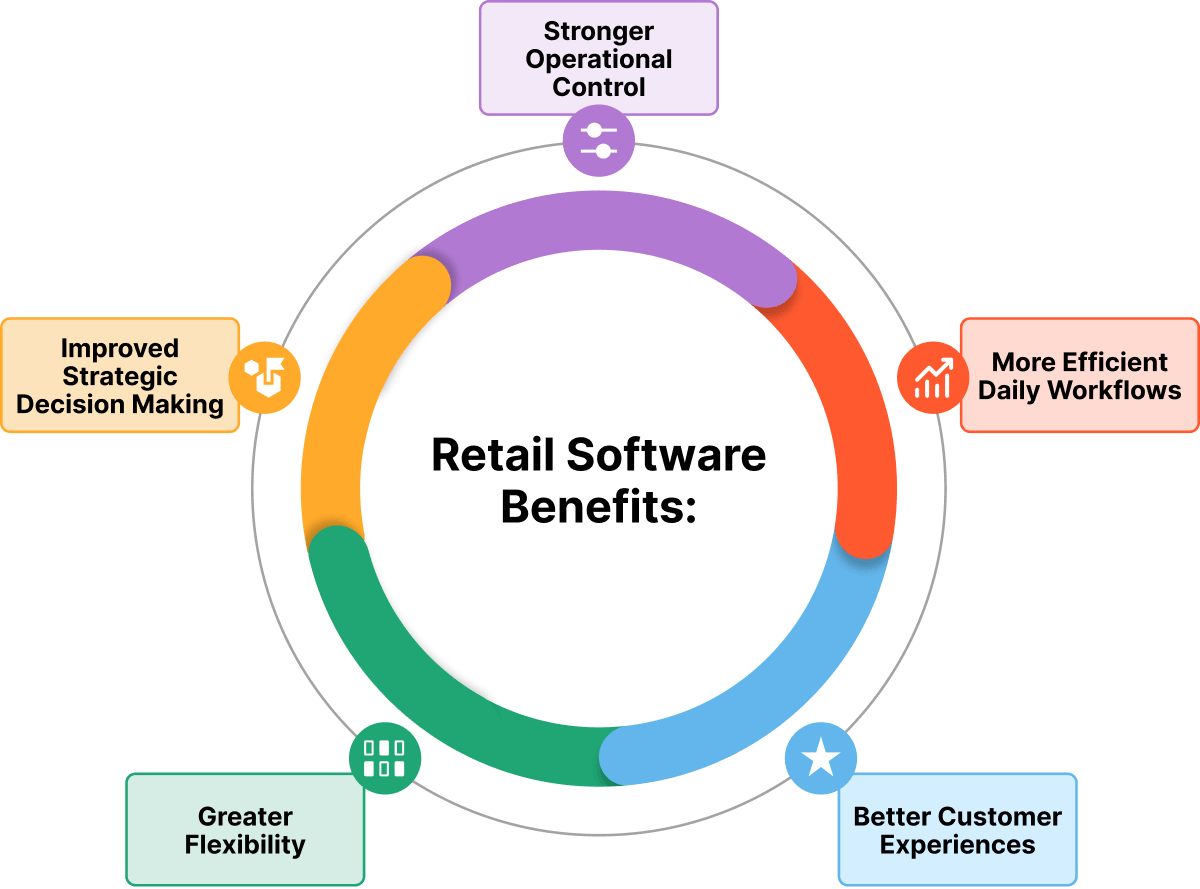
When companies expand across multiple channels, operations quickly become more complex. Orders arrive from physical locations, online stores, and mobile apps at the same time. Inventory moves between warehouses and stores, and customers expect fast service no matter where they shop.
This is where a purpose-built digital platform becomes a real advantage. Instead of relying on disconnected tools, you can coordinate their entire operation through one environment designed specifically for their workflows.
Below are several benefits that owners often see when they invest in custom-built platforms.
One of the biggest advantages is visibility. When core retail software deployment services operate within a single environment, leadership teams gain a clear picture of what is happening across the entire enterprise.
Managers can track inventory levels, sales performance, order fulfillment, and store activity in one place. This makes it much easier to identify bottlenecks and respond quickly when issues arise. Instead of reacting after problems occur, teams can make faster and more informed operational decisions.
Many employees spend a large portion of their time managing repetitive tasks. Updating stock counts, transferring order information between custom retail software, and reconciling sales records can consume hours every week.
Automation reduces this manual workload. Routine processes run automatically, which frees employees to focus on tasks that contribute directly to growth, such as customer service, merchandising strategies, or expanding into new markets. Over time, this efficiency translates into lower operational costs and smoother daily operations.
Modern shoppers expect convenience. They want to browse online, check product availability in nearby stores, and complete purchases without delays.
Custom platforms allow companies to create consistent experiences across all channels. Customers can move between mobile apps, websites, and physical stores without confusion or interruptions. When shopping journeys feel smooth and reliable, customer satisfaction increases and repeat purchases become more likely.
The markets evolve quickly. New sales channels emerge, customer behavior shifts, and product catalogs expand.
A tailored platform gives you the flexibility to adapt to these changes. New features can be added as the company grows, integrations can connect additional services, and the cost-effective custom software development for retail operations can scale to support higher traffic levels. This adaptability helps organizations stay competitive without constantly replacing their technology stack.
Accurate operational insights allow you to plan more effectively. When sales trends, inventory movement, and customer behavior are visible in one environment, executives can make more confident strategic decisions.
They can identify which products perform best, determine when demand increases, and adjust pricing or marketing campaigns accordingly. Over time, this level of visibility helps you allocate resources more efficiently and plan future expansion with greater certainty.
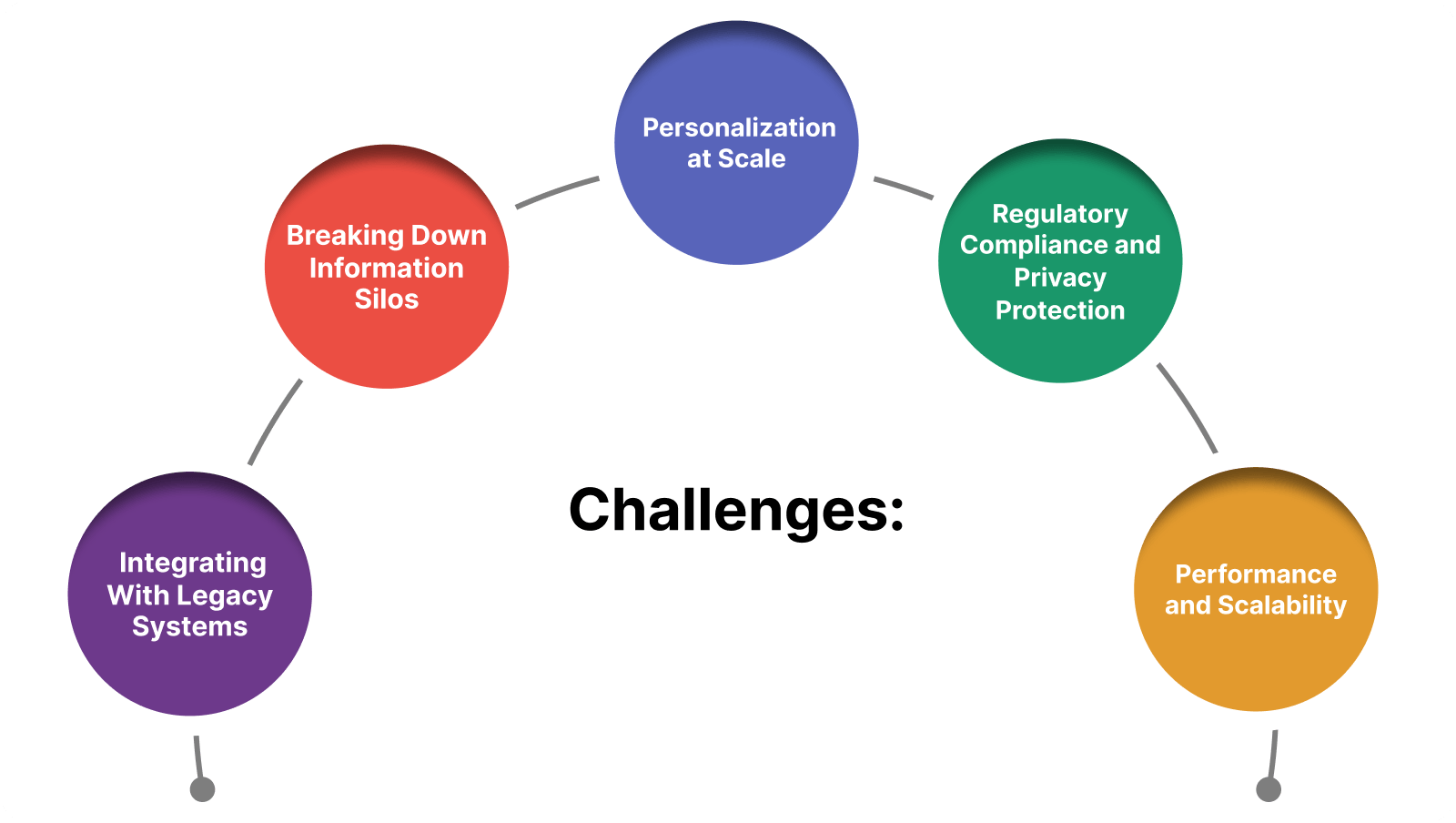
Building a retail software solution for a growing firm is rarely a straightforward process. Even with a clear vision, companies often encounter technical and operational obstacles along the way.
The good news is that most of these challenges are predictable. With the right planning and experienced engineering teams, they can be addressed before they become serious problems.
Below are five common difficulties companies face when developing a custom platform and practical ways to approach them.
Many companies rely on long-standing internal platforms that were built years ago. These older environments often play a critical role in daily operations, which makes replacing them risky and complicated.
The difficulty appears when new modules or modern tools must connect to these existing systems. Older architectures were not always designed to support modern integrations. As a result, teams may encounter incompatible interfaces, inconsistent information exchange, or disruptions in daily operations.
A smart approach begins with a full technology audit. This review helps identify which effective solutions for retail software development with fraud detection must remain in place, which ones require upgrades, and which could eventually be replaced.
Rather than attempting a complete overhaul at once, many organizations move forward with phased modernization. This method gradually introduces new components while keeping existing processes stable. It reduces operational risk and allows teams to adapt step by step.
Information silos remain one of the most persistent issues in organizations.
These silos appear when departments store information in separate systems that do not communicate with each other. Marketing teams may track customer behavior in one platform while warehouse teams manage stock levels in another. Leadership then struggles to obtain a clear view of the entire business.
When information cannot move freely between departments, everyday decisions become slower and less accurate.
Addressing this challenge usually requires a combination of technical upgrades and organizational improvements. Older platforms may need to be modernized, internal processes may need adjustment, and a clear architecture plan should guide how different systems interact.
Many companies also introduce intelligent automation that consolidates information from multiple sources. When information flows smoothly across the organization, teams gain better visibility and can respond more quickly to market changes.
Today’s customers expect personalized experiences when they shop. Product recommendations, tailored promotions, and customized communication can significantly improve engagement.
Delivering this level of personalization requires advanced analytical capabilities. Machine learning models analyze purchasing behavior, browsing patterns, and past interactions to identify relevant offers for each customer.
However, collecting and managing this information also introduces responsibility. If customer information is stored or processed improperly, companies risk damaging customer trust or violating privacy regulations.
This is why strong governance practices are essential. Clear rules must define how information is collected, stored, and used across the organization. With these safeguards in place, companies can provide personalized experiences while maintaining strong privacy protection.
Firms operate within a strict regulatory environment. Laws such as the General Data Protection Regulation in Europe and the California Consumer Privacy Act in the United States define how personal information must be handled.
Failure to comply with these regulations can lead to significant financial penalties and reputational damage.
To avoid these risks, compliance requirements should be incorporated into the platform architecture from the beginning. Attempting to add privacy protections later often leads to costly redesigns.
Legal advisors and security specialists should participate early in the development process. At the same time, engineering teams must follow secure coding practices and implement strong access control mechanisms.
When privacy and compliance are considered from the start, you can operate with confidence while protecting customer trust.
Operations rarely experience steady demand. Traffic levels can change dramatically during major promotions, holiday seasons, or viral marketing campaigns.
If the platform cannot handle these sudden spikes, checkout systems slow down, orders fail to process, and customers quickly lose patience.
Scalability must therefore be part of the architecture from day one.
Tech teams often rely on load balancing, modular system design, and optimized database queries to maintain stable performance during heavy traffic periods. Regular stress testing also plays a critical role. By simulating high traffic scenarios in advance, teams can identify bottlenecks and address them before real customers encounter them.
When performance planning is done properly, the platform remains stable even during the busiest sales events, protecting both revenue and customer satisfaction.

Selecting the right development partner is one of the most important decisions you will make during a digital transformation project. The team you choose will influence not only how the retail software solutions are built but also how smoothly the entire process unfolds. This decision has become even more critical as operations grow increasingly complex. A systematic literature review published in the Journal of Cleaner Production analyzed 99 peer-reviewed studies on omnichannel and digital transformation and highlighted the expanding role of digital platforms in supply chains, logistics, and customer engagement.
Many companies focus heavily on price or timelines during vendor selection. While those factors matter, they should not be the only criteria. A successful partnership depends on technical competence, industry understanding, and clear communication throughout the project.
If you are evaluating potential partners, the following factors can help guide your decision.

It is one thing to talk about modern platforms in theory. It is another to see how major companies apply these technologies to solve real operational challenges and support rapid growth.
An academic field experiment studying generative AI adoption in online found that integrating AI tools into operations increased sales by up to 16.3%, demonstrating how advanced digital technologies can directly influence revenue and operational productivity in environments.
Below are two well-known examples that show how the right technology strategy can transform the way a business operates.
Fashion brand Zara built its global success on speed and operational precision. The company needed a way to coordinate thousands of stores while responding quickly to constantly changing fashion trends.
To achieve this, Zara invested heavily in a centralized inventory and store management environment that connects physical locations with distribution centers. Each store reports sales activity continuously, allowing headquarters to see which products are selling and which are slowing down.
This visibility allows the company to adjust production and restocking decisions almost immediately. When a product becomes popular in certain regions, inventory can be redirected quickly to meet demand. If an item underperforms, production can be reduced before excess stock accumulates.
Store employees also use handheld devices to check product availability across nearby locations. If a customer cannot find an item in one store, staff can quickly locate it in another branch and arrange delivery or pickup.
This approach allows Zara to introduce new collections far more frequently than many competitors. Instead of relying on long seasonal cycles, the company continuously updates its product selection based on real sales performance.
Such example highlights the power of integrated inventory and store management technology. When operational information flows quickly across the organization, companies can react to demand faster and reduce costly overproduction.
Beauty retailer Sephora has become a leading example of how technology can transform the customer journey.
The company built a strong omnichannel environment that connects its physical stores, mobile app, and eCommerce platform into a single experience. Customers can browse products online, test items in store, and complete purchases through whichever channel feels most convenient.
One of Sephora’s most recognizable innovations is its virtual try-on technology. Through its mobile app, shoppers can use augmented reality to see how different makeup products look on their face before purchasing. This interactive experience helps customers make more confident decisions and reduces product returns.
Sephora also uses advanced analytics and personalization tools to recommend products based on past purchases and browsing behavior. Loyalty members receive tailored offers and product suggestions that match their preferences.
Inside physical stores, beauty advisors can access customer profiles to see previous purchases and recommend products accordingly. This creates a more personalized experience even during in-person consultations.
By connecting online and offline experiences so closely, Sephora has built a shopping journey that feels seamless for customers. Shoppers can move between channels without losing progress or information. Sephora demonstrates how personalization and omnichannel coordination can strengthen customer loyalty and create a more engaging shopping experience.
As retail businesses expand across physical stores, online platforms, and mobile channels, the technology behind daily operations becomes increasingly important. Purpose-built digital platforms allow companies to streamline internal processes, improve customer interactions, and make better strategic decisions based on operational insights.
From modern checkout environments and inventory tracking platforms to intelligent demand forecasting and seamless omnichannel experiences, construction compliance management software for retail architecture development is reshaping how companies operate and grow. You are no longer limited by rigid tools that force you to adapt your workflows. Instead, they can build platforms that support the exact way their organization runs.
However, the technology itself is only part of the equation. The success of a project depends heavily on the team responsible for building it.
That is why choosing a trusted development partner matters. An experienced team can help you navigate complex architecture decisions, plan integrations with existing systems, and design a platform that continues to support your business as it grows.


Tech & Innovation Expert
Anastasiya is committed to making the complex simple. Her passion for writing, proficient research, and strong interviewing skills allow her to share in-depth insights into the ever-evolving IT landscape.

Our newsletter is packed with valuable insights, exclusive offers, and helpful resources that can help you grow your business and achieve your goals.


