green blur shape

CMS-0057-F Compliance Case Study: 6-Month FHIR Prior Authorization Enablement Layer for a Healthcare Clearinghouse

CMS-0057-F compliance is driving a structural shift in healthcare toward FHIR-based prior authorization and standardized interoperability across payors, providers, and clearinghouses. In this case study, a U.S. healthcare clearinghouse partnered with CleverDev Software to deliver a production-ready FHIR enablement layer in 6 months, integrating directly with existing systems without operational disruption. The implementation improved prior authorization processing speed, reduced manual coordination across systems, and enabled external FHIR-based integrations while preserving existing operational workflows.
cms-0057-f compliance

Overview

A U.S. healthcare clearinghouse engaged CleverDev Software to design and implement a FHIR-based interoperability enablement layer for CMS-0057-F readiness.

The objective was to introduce FHIR Prior Authorization APIs and an interoperability bridge that could operate alongside legacy transaction systems without disrupting production workflows.

Within a 6-month delivery window, CleverDev Software delivered:

  • a FHIR Prior Authorization API layer
  • a legacy-to-FHIR interoperability bridge
  • a controlled pilot onboarding framework for payor integrations

This created a FHIR-compatible integration layer for prior authorization workflows while preserving existing system behavior.  

About the Client

The client is a U.S. healthcare clearinghouse responsible for routing eligibility, claims, and prior authorization transactions between payors and providers.

While operational systems were stable, prior authorization workflows were fragmented across multiple internal systems, limiting real-time visibility for payor partners.

At the same time, payor organizations were increasingly expecting FHIR-based prior authorization APIs aligned with CMS interoperability direction.

Industry Context: CMS-0057-F and Prior Authorization Modernization

CMS-0057-F is a Centers for Medicare & Medicaid Services interoperability rule that modernizes prior authorization using HL7 FHIR standards. FHIR enables standardized, API-based healthcare data exchange, complementing existing legacy workflows.

The rule drives the industry toward:

  • standardized prior authorization APIs
  • improved transparency in authorization decisions
  • reduced administrative burden in payor workflows
  • interoperability between payors, providers, and clearinghouses
  • alignment with HL7 Da Vinci implementation guides (CRD, DTR, PAS)

While compliance deadlines extend into 2026–2027, payor expectations are already shifting toward FHIR-first integration models.

Business Context

CMS finalized CMS-0057-F to modernize prior authorization and expand access to health information through standardized FHIR-based APIs. The rule is projected to deliver ~$15 billion in system-wide savings over 10 years, driven by reduced friction and automation in payer workflows.
In practice, stakeholders often evaluate whether Medicare advantage plans require prior authorization when aligning utilization management policies with CMS-driven interoperability requirements. These determinations vary by service category and plan design under federal guidelines.
Operational teams frequently assess what type of medicare advantage plans require prior authorization when mapping automation rules into FHIR-based workflows and prior authorization engines. CAQH estimates ~14 minutes saved per electronic prior authorization, contributing to ~$515M annual savings.
CMS emphasizes that fragmented prior authorization processes can delay care delivery and reduce treatment continuity across patient populations. These inefficiencies reinforce the need for interoperable, FHIR-based workflows that improve speed, transparency, and consistency of clinical decision-making. In this context, medicare advantage plans require prior authorization policies to become a key driver of automation design and compliance alignment.

The Challenge

The core challenge was not API development — it was inconsistent prior authorization state representation across systems.

Different internal systems interpreted authorization status differently:

  • pending
  • awaiting documentation
  • incomplete or missing transitions

This made it difficult to expose reliable FHIR-based prior authorization APIs without normalization.

Additional constraints included:
  • existing systems could not be modified
  • payor expectations for FHIR readiness varied significantly
  • no unified authorization lifecycle model existed
health plan case study

Solution Delivered by CleverDev Software

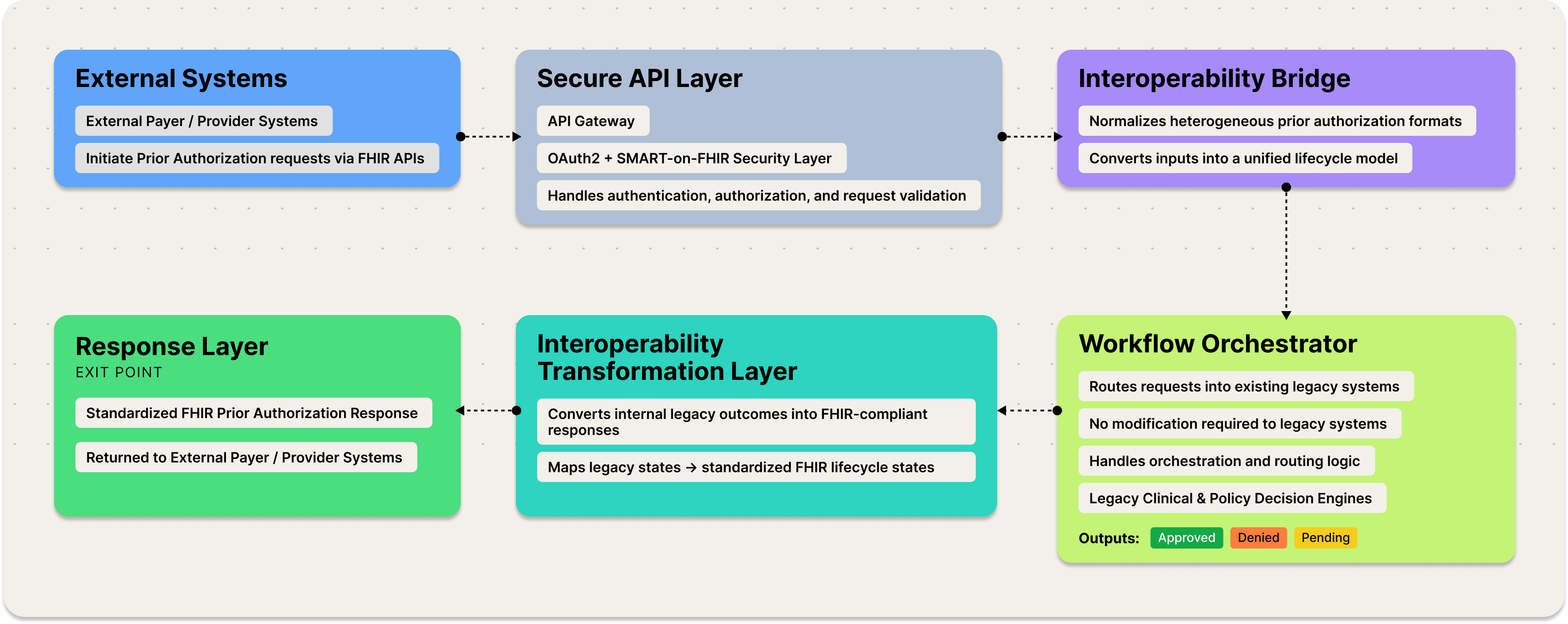
The architecture introduced a FHIR interoperability enablement layer designed to sit above legacy systems.

1. FHIR Prior Authorization API Layer

Standardized APIs for:

  • prior authorization submission
  • status retrieval
  • decision responses

This enabled external FHIR-based API integrations without impacting internal workflows.

2. Interoperability Bridge (Core Layer)

A transformation layer that maps internal workflow states into FHIR-compatible representations at request time. This mapping is deterministic but does not enforce a canonical lifecycle model across systems.

3. Event-Driven Architecture

Instead of polling-based status checks, the system used:

  • Kafka-based event streaming
  • webhook notifications

This enabled near real-time prior authorization status updates.

4. Audit & Traceability Layer

A lightweight event log enabling:

  • lifecycle reconstruction
  • operational transparency
  • integration troubleshooting

This layer supports operational observability but does not provide a complete, system-of-record audit history.

Implementation

The delivery followed a phased interoperability approach.  

  • Compliance Mapping & Architecture Design. Defined CMS-0057-F requirements and mapped them to system capabilities and API design.
  • FHIR API & Logging Layer Development. Built Prior Authorization APIs and implemented compliance-grade audit logging.
  • Interoperability Integration. Connected FHIR layer with internal systems while preserving operational continuity.
  • Compliance Pilot Deployment. Validated workflows and reporting outputs with selected payor partners.
  • Readiness Validation & Hardening. Finalized compliance reporting, audit trails, and system performance tuning.

Technology Stack

  • Backend: Java (Spring Boot microservices)
  • Standards: HL7 FHIR R4
  • Integration: interoperability bridge + workflow normalization engine
  • APIs: REST + OpenAPI
  • Cloud: AWS (EKS, Lambda, RDS, S3)
  • Security: OAuth 2.0, SMART-on-FHIR, TLS
  • DevOps: Kubernetes, Docker, CI/CD pipelines
  • Observability: Prometheus, Grafana, centralized logging
a part of logo

Results

The clearinghouse deployed a FHIR-compatible prior authorization interface within 6 months while maintaining uninterrupted existing operations:

  • improved payor visibility into prior authorization status via APIs
  • reduced manual reconciliation efforts
  • faster onboarding for pilot payor integrations

The solution provides a pragmatic compliance layer for CMS-0057-F readiness, enabling external integrations without requiring immediate re-platforming of legacy systems.

Ready for CMS-0057-F Interoperability Readiness?

If your organization is implementing HL7 FHIR R4-based prior authorization APIs, planning for CMS-0057-F, or exposing legacy workflows through modern interfaces, CleverDev Software supports pragmatic, low-risk approaches to healthcare integrations aligned with real system constraints.  

We work with healthcare clearinghouses, payors, and RCM platforms to design and deliver:

  • FHIR API layers aligned with Da Vinci implementation guides (CRD, DTR, PAS)
  • Prior authorization workflow integration and automation
  • Legacy system integration and FHIR translation layers

Our focus is on enabling compliance and external interoperability without requiring immediate re-platforming of core systems.

a small logomarka big logomark

We Are Open to New Projects

Thank you! Your submission has been received!
Our customer care specialist will get in touch with you within a business day.
Oops! Something went wrong while submitting the form.

People Also Ask

What is CMS-0057-F in healthcare interoperability?

icon plusicon minus

Do healthcare clearinghouses need to comply with CMS-0057-F?

icon plusicon minus

What is a FHIR prior authorization API?

icon plusicon minus

Let’s Transform Your Business

Get in touch with us, and we will gladly get back to you as soon as possible. If you need a professional team, CleverDev Software will be happy to assist you in making your vision a reality.
Thank you! Your submission has been received!
Our customer care specialist will get in touch with you within a business day.
Oops! Something went wrong while submitting the form.