
If you manage a health plan, run a managed care organization, or sit in compliance at a Medicare Advantage or Medicaid operation, CMS-0057-F is probably already on your radar. And if it is not, it needs to be because the deadlines are not moving, and the work required to meet them is significant. This rule reshapes how impacted payers handle prior authorization, share member data, and communicate with providers. CleverDev Software can support organizations in navigating these requirements by building compliant, interoperable solutions tailored to evolving CMS standards. Getting it right takes planning, internal coordination, and a clear picture of what is actually required versus what is simply recommended. This guide breaks all of that down in plain language so you can walk away with a real plan of action.


The cms-0057-f final rule is the CMS Interoperability and Prior Authorization Final Rule, published on January 17, 2024. It was built to fix something that the healthcare industry has struggled with for years: a process that is slow, manual, inconsistent, and genuinely harmful to patient care.
Custom software product development in healthcare has made it increasingly clear just how broken the process really is. According to the American Medical Association’s physician survey, physicians complete an average of 43 prior authorizations per week, with requirements consuming the equivalent of 12 hours of physician and staff time each week. That is nearly a third of a working week spent navigating a process that exists largely on fax machines and phone calls. For health plans, that same inefficiency drives up administrative costs, creates friction with providers, and generates member dissatisfaction that is hard to recover from.
The rule responds to all of that by requiring impacted payers to build standardized digital interfaces, tighten their decision timelines, and make information visible to the people who actually need it which are patients and providers. The end goal is a process that runs electronically, moves faster, and produces transparent outcomes.

The CMS-0057-f interoperability and prior authorization final rule fact sheet published by CMS makes it clear that not every health plan is in scope, so the first thing to settle is whether your organization is actually required to comply. The rule applies to what CMS calls “impacted payers,” which includes Medicare Advantage organizations, state Medicaid and CHIP fee-for-service programs, Medicaid managed care plans, CHIP managed care entities, and Qualified Health Plan issuers on the Federally Facilitated Exchanges. If your organization participates in any of those programs, you are in scope.
SaaS software development teams working with health plans have increasingly had to grapple with these compliance boundaries, particularly when a single vendor serves both regulated and non-regulated plan types. Commercial employer-based plans that operate outside those programs are not required to comply, though CMS has encouraged all payers to voluntarily adopt the requirements so that all members have equal access to their data.
According to a peer-reviewed study published in Health Affairs Scholar, the process alone is estimated to account for $35 billion in annual US healthcare administrative spending, a figure that researchers from McKinsey and Harvard argue could be substantially reduced through the kind of electronic standardization CMS-0057-F requires.
The CMS 0057f fact sheet also makes a clear distinction that catches some organizations off guard: prescription drugs are excluded from both the API requirements and the operational process changes. The rule covers medical items and services only. A follow-on proposed rule, CMS-0062-P, is working to extend those requirements to drugs, but that is a separate rulemaking still moving through the process.
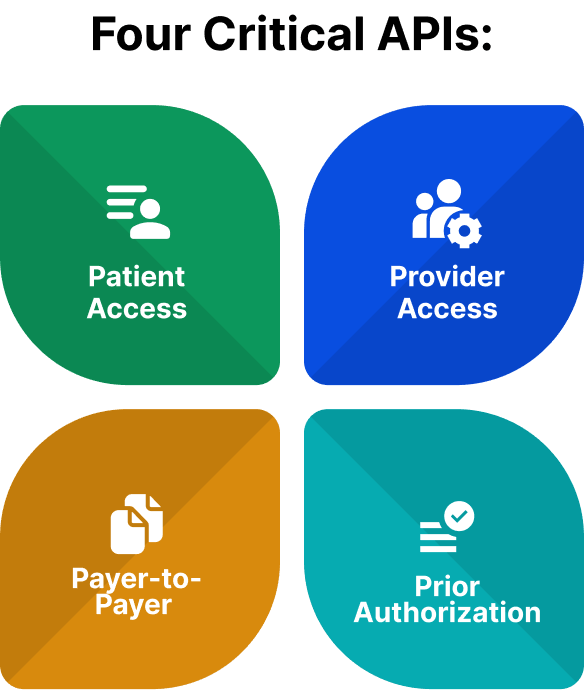
At the technical core of the cms 0057-f final rule are four Fast Healthcare Interoperability Resources APIs, all built to the HL7 FHIR R4 standard.
A study published in the Journal of Clinical Oncology found that introducing a new requirement on an already established drug increased the odds of patients discontinuing that medication within 120 days by a factor of 7.1, meaning cancer patients on stable treatment regimens were seven times more likely to stop their medication simply because of a paperwork change.
Let’s go through four of the most critical ones below.
This one builds on what was already required under the 2020 interoperability rule. The new addition is data. Members need to be able to access their claims history and status, including whether a request was approved, denied, or is still pending, through an app of their choice. That data must remain accessible for at least one year after the last status change on the authorization.
Healthcare-focused AI agent technologies are starting to play a real role in how this API gets used in practice, surfacing relevant member information for providers at the point of care rather than requiring manual lookups. The API itself covers claims and encounters and clinical data matching United States Core Data for Interoperability standards and information for the patients' providers are actively treating. Members must have the ability to opt out of this sharing, and they must be notified of that option clearly.
When a member switches health plans, their new payer is required to request statistics from the previous payer within one week of coverage starting, provided the member has opted in. The previous payer must share up to five years of relevant records. For organizations growing through acquisition or serving high-turnover populations, this API requires real thought about architecture and governance.
This is the centerpiece of the CMS interoperability and prior authorization final rule CMS-0057-f summary. The API must tell providers which services require prior authorization, what documentation is needed to get a request approved, and accept and respond to requests electronically. Every response, whether it is an approval, a denial, or a request for more information, must be communicated through the API, and denials must include a specific reason, not a generic code.

While the API deadline sits in 2027, the operational requirements kick in a full year earlier. If you go back to the CMS-0057-f federal register publication, you will see that these process changes were intentionally staged ahead of the technology requirements to give organizations time to fix their workflows before the APIs needed to sit on top of them.
Starting January 1, 2026, impacted payers (excluding QHP issuers on the Federally Facilitated Exchanges) must meet new turnaround requirements for decisions: 72 hours for expedited requests and 7 calendar days for standard ones. That is a meaningful tightening for any organization currently measuring turnaround in weeks.
Inventory management system solutions in healthcare might not seem immediately connected to reform, but for payers managing large volumes of requests across multiple service lines, having structured tracking infrastructure in place is exactly what makes the new metrics reporting requirements achievable. Alongside the new decision timelines, payers must also:
The public reporting piece is often underestimated. Your 2025 data becomes your first public report. If your collection infrastructure is not clean and structured from the start of 2025, you will be scrambling to compile that report under time pressure. Getting this right means treating 2025 as your data baseline year, not a practice run.
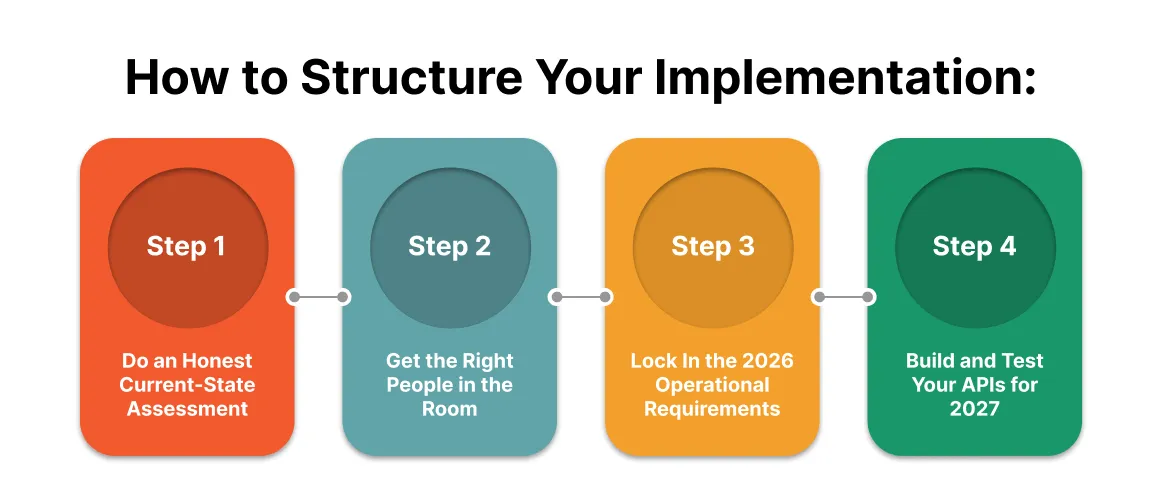
Most organizations that handle this well treat the cms-0057-f interoperability and final rule as a phased program rather than a single project with a finish line.
Research presented at the 2025 ASCO Quality Care Symposium found that over 90% of radiation oncologists reported delays in cancer treatment, with more than half of those delays lasting five days or longer, 30% leading to major clinical complications, and 7% linked to patient deaths.
Here is how to approach it in practice.
Before deciding what to build, you need a clear picture of what you already have. Audit your existing Patient Access API, your intake and review workflows, your denial communication processes, and the state of your data infrastructure. Most organizations find gaps during this phase they did not expect, particularly around denial language specificity and the structural integrity of their prior tracking.
Web development for healthcare organizations often surfaces these gaps faster than internal audits do, because building a compliant member-facing interface forces you to confront exactly what records you have, how it is structured, and whether it can actually be served through an API in a meaningful way. Questions worth working through in this phase:
This is not an IT initiative with compliance sign-off at the end. It requires clinical operations, compliance, legal, provider relations, and technology working together from the beginning. If those groups are operating in silos, you will build something that is technically functional but operationally broken a common and expensive failure mode. Executive sponsorship matters here too, because the budget and resource decisions involved in a multi-year implementation program need leadership backing, not just IT goodwill.
Custom business process automation is one of the more effective ways to meet the new decision turnaround requirements without simply throwing headcount at the problem. Automating intake, routing, and status communication across your workflow can get you to the 72-hour and 7-day thresholds far more reliably than manual processes can. According to the CMS-0057-f interoperability and prior authorization final rule fact sheet CMS published at the time of the rule’s release, the 2026 operational requirements were deliberately staged ahead of the API deadlines, and your implementation plan should reflect that same sequencing.
Specific things to prioritize before January 1, 2026:
The CMS-0057-f interoperability and prior authorization final rule summary makes clear that all four APIs: Patient Access, Provider Access, Payer-to-Payer, and Prior Authorization, must be live in production by January 1, 2027. Healthcare website development is often the first place members interact with their status, which means the API work and the member-facing interface need to be designed together, not handed off sequentially. A few additional principles that matter here:

Most compliance failures follow predictable patterns. The CMS-0057-f interoperability prior authorization final rule is no exception since the organizations that struggle tend to make the same handful of avoidable errors.
AI agents for healthcare business operations are increasingly being used to flag these failure patterns early, monitoring queues, identifying where requests are stalling, and surfacing denial pattern anomalies before they show up in a public metrics report. But technology alone does not prevent implementation failures. The errors below are organizational as much as they are technical.
The CMS 0057 final rule is one of the most significant operational changes to hit managed care in years. But if you look at it clearly, it is also a legitimate opportunity. Healthcare software infrastructure that is built to meet these requirements becomes the foundation for better provider relationships, faster care decisions, and member experiences that actually hold up under scrutiny. CleverDev Software can play a key role in helping organizations design and implement these compliant, scalable systems effectively. The organizations that implement this well will come out the other side with operational systems they can genuinely build on. According to the AMA’s 2024 survey, more than 95% of physicians report that somewhat or significantly increases physician burnout, and your providers are living that reality every week. The organizations that take this rule seriously are the ones that will actually change that experience. The planning decisions you make now determine which category you end up in.


Tech & Innovation Expert
Anastasiya is committed to making the complex simple. Her passion for writing, proficient research, and strong interviewing skills allow her to share in-depth insights into the ever-evolving IT landscape.

Our newsletter is packed with valuable insights, exclusive offers, and helpful resources that can help you grow your business and achieve your goals.


