
Texas is one of the fastest-growing business markets in the country, and if you're running a company here, you already know that staying competitive means staying ahead. That's exactly why more Texas businesses are turning to custom software development in Texas to build the tools they actually need, rather than settling for something off the shelf that only gets them halfway there.

In this article, we'll walk you through what custom development really involves, how to pick the right partner, what it typically costs, and which industries in Texas are getting the most out of going custom.
When you rely on software off the shelf, you're making a trade-off that isn't always obvious at first: you get something fast and familiar, but you give up the ability to make it work exactly the way your business does. That trade-off is fine early on. Most businesses start that way. The problems show up later, when your operation grows past what the tool was designed to handle.
You start working around the tool instead of with it. Your team develops workarounds. Someone builds a spreadsheet to fill the gaps. Another person builds a second spreadsheet to track the first one. Before long, your staff is spending more time managing the limitations of your tools than actually doing their jobs.
Any experienced custom software developer in Texas will tell you the same thing: the businesses that come to them most frustrated are rarely dealing with a technology problem. They're dealing with a growth problem that their current tools can't keep up with.
Custom-built applications remove that ceiling. You get something designed specifically for how your business operates, not how some product manager in another state imagined businesses operate.

Custom software product development is a broad term that covers a lot of ground, and it's worth getting specific before you start any vendor conversations. Whether you're working with a custom software development company in Texas or evaluating whether to build an internal team, the engagement can take several different shapes depending on where you are and what you need:
Understanding the benefits of custom software development is what usually turns a hesitant business owner into a committed one. The business case isn't hard to make once you put real numbers behind it, but it helps to understand where the value actually comes from rather than taking a vendor's word for it.
The most immediate benefit is fit. A purpose-built system matches your actual workflows, which means your team spends less time navigating menus that weren't designed for them and more time doing the work that drives revenue. That reduction in friction is hard to quantify before you experience it, but most businesses that make the switch report it as the first thing they notice.
The second benefit is ownership. With a packaged product, you're always subject to the vendor's roadmap, pricing decisions, and support priorities. With something you've built, you control it. You decide what gets added, what gets changed, and who has access.
The third, and often most significant benefit over time, is scalability. A well-architected custom system grows with your business. You add modules, users, and integrations as you need them, without hitting artificial ceilings or paying for tiers of features you don't use.

Custom software development companies vary more than most business owners expect before they start this process. Capability, culture, communication style, and domain expertise all differ significantly from firm to firm, and the wrong fit can derail a project even when the technical work is solid.
89% of large companies globally have a digital and AI transformation journey underway, but they've captured only 31% of expected revenue lift and 25% of expected cost savings.
There's also a meaningful difference between working with a custom software development agency in Texas versus a smaller boutique firm or a freelance team. Agencies typically bring a full bench: project managers, architects, designers, QA engineers, and developers working as a coordinated unit. Smaller firms can be just as capable, but you'll want to confirm that the same people who pitch you are the ones actually building your product.
Here's what actually matters when you're evaluating any partner:
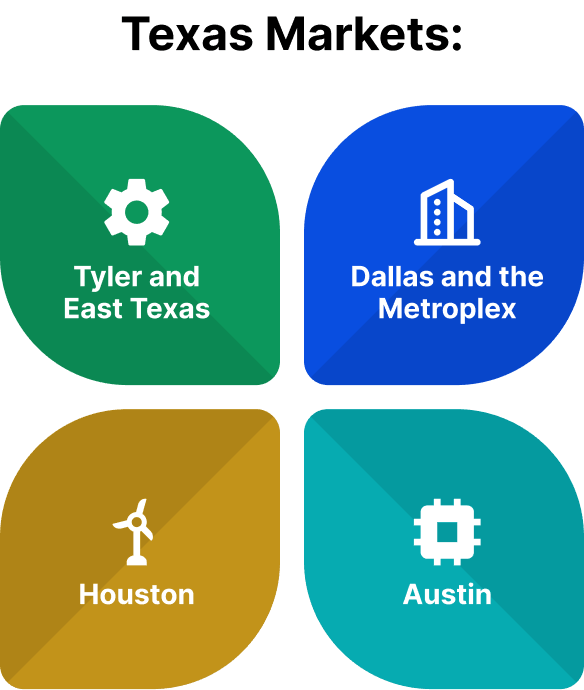
Texas doesn't operate as one monolithic tech market. Different cities have different strengths, and knowing where to look matters depending on your industry and what you need built.
Custom software development in Dallas, Texas is particularly well-suited to mid- to large businesses operating in finance, telecommunications, healthcare administration, and logistics—all sectors with major footprints in the DFW area. The city has a dense concentration of enterprise-focused firms with long track records in complex, multi-system environments.
Companies evaluating a custom software development company in Dallas, Texas specifically benefit from that local talent pool and its proximity to major corporate headquarters, which means local firms have often already solved problems similar to yours. The Metroplex also houses Irving, one of the area's most active commercial corridors. Businesses pursuing custom software development in Irving, Texas, have access to that same DFW talent ecosystem, with a slightly more mid-market feel and strong representation from financial services and logistics companies that call Irving home.
When evaluating custom software development in Dallas, Texas firms, look specifically at their track record with multi-location businesses and enterprise integrations, since those are where most Dallas-area projects tend to end up.
Austin remains the most innovation-focused market in the state, with a startup-driven culture and a strong bench of engineers across web, mobile, and cloud development. It's also where you're most likely to find firms comfortable with rapid iteration and product-style thinking.
Houston's development market is heavily shaped by energy, healthcare, and industrial operations. Firms here tend to have specialized knowledge in compliance-heavy environments and large-scale operational systems.
Businesses in smaller markets often assume they have to look outside their region for serious development work. That's becoming less true. Custom software development in Tyler, Texas is a real and growing option, particularly for healthcare, manufacturing, and agriculture-adjacent businesses that want a partner who understands the regional market and can show up in person when it matters.
Regarding SaaS software development services, they are worth discussing separately, because they represent a specific model that's becoming more common among Texas businesses that want to build a product rather than just an internal tool. If you're a company looking to commercialize a workflow you've already mastered internally, or if you want to offer your clients a branded platform rather than a white-labeled third-party product, SaaS architecture is likely the right direction.
Initially, custom web app development services sit right at the foundation of most SaaS products. A web application gives you browser-based access from any device, which means no installation headaches for your users and a much faster path to adoption. For Texas businesses serving clients across multiple locations or time zones, that accessibility matters a lot.
The key distinction to understand is that a web app built for internal use and a SaaS product built for external customers have meaningfully different architecture requirements. Multi-tenancy, billing integration, user onboarding flows, and support infrastructure all need to be designed in from the start. If you're thinking about a SaaS product, make sure the firm you hire has built and launched one before, not just web applications in general.
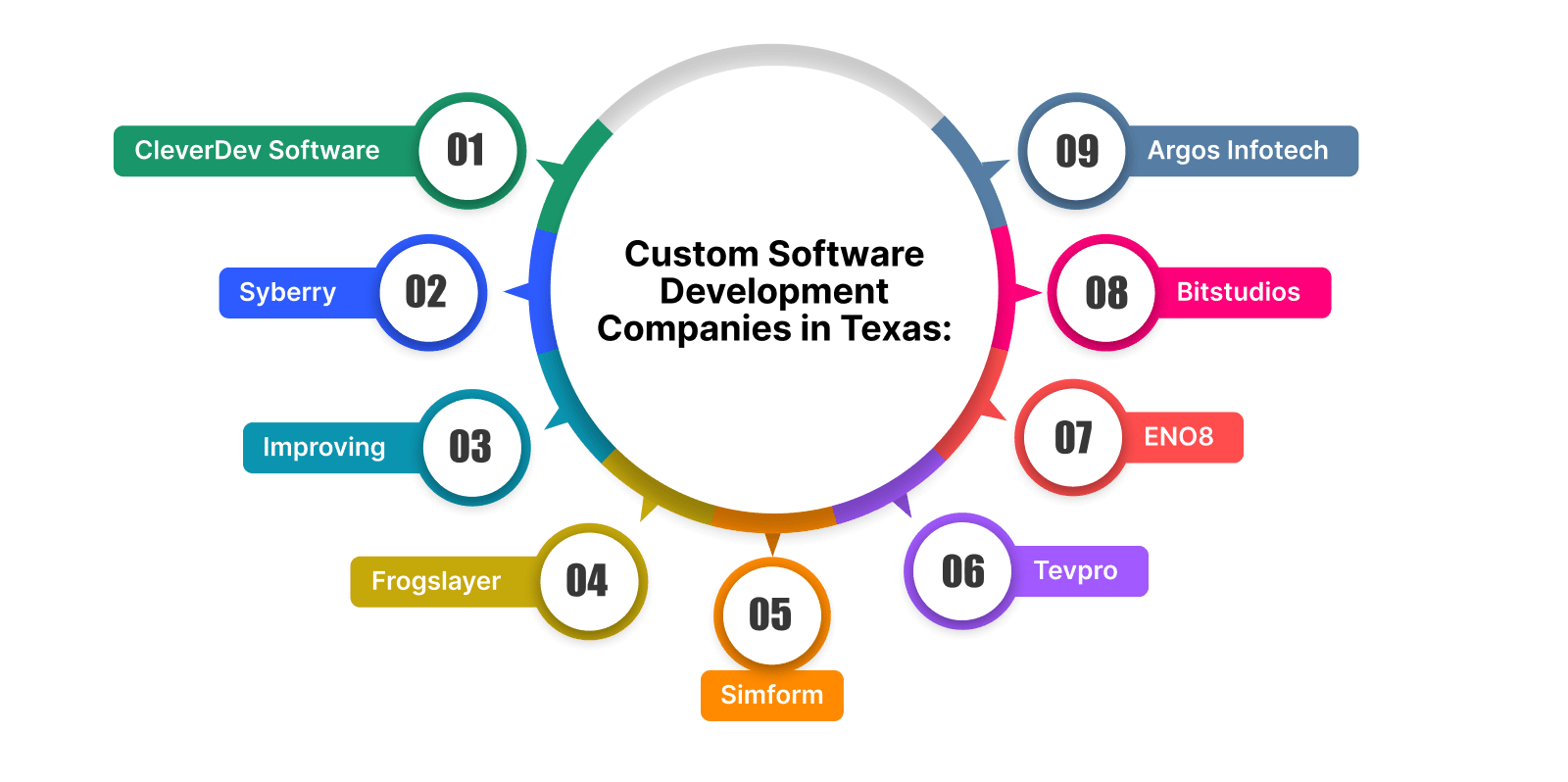
Texas has no shortage of development firms, but the ones worth talking to are a much shorter list. The best firms combine genuine industry expertise, transparent processes, and a track record of delivering on complex projects.
Here's an honest overview of the companies consistently earning their reputation in this market.
CleverDev Software is a full-cycle custom software development firm in Texas with over 15 years of experience, helping companies across industries build systems that deliver measurable results. Our team works directly with businesses to design and build tools that fit how they actually operate, not generic products repurposed for a new client.
We specialize in driving digital transformation across HealthTech, FinTech, insurance, manufacturing, and logistics, covering everything from custom development and business process automation to system integration, cloud applications, legacy modernization, AI, and strategic IT consulting.
Syberry is an Austin-based firm that has built a strong reputation for custom product development and legacy modernization. They work primarily with mid-market companies that need serious engineering chops without the overhead of a large enterprise firm. Their client list includes names like PayPal, Shell, and Campus Suite, a mix that reflects their comfort working across both high-compliance and high-growth environments.
Their approach centers on long-term partnership rather than project-based engagements, which means they invest in understanding your business before they start writing code. For companies that expect to grow their systems over time, that orientation makes a meaningful difference.
Improving is a Dallas-based technology consulting and development firm with a track record in enterprise-grade engineering. They specialize in helping larger organizations modernize aging systems, build new applications, and structure their development processes around agile practices that actually hold up at scale.
What they do well is bridge the gap between business strategy and technical execution, a gap that trips up a lot of development engagements when the firm doesn't understand the business context well enough to make the right architecture decisions. Improving has consistently received strong client feedback for its communication standards and project governance.
Frogslayer occupies an interesting niche: they work specifically with organizations that need custom-built SaaS platforms and business automation tools, and they bring genuine product thinking to every engagement.
They've delivered enterprise systems for Fortune 500 clients and well-funded startups alike, and their reputation for treating development as a business discipline rather than a technical exercise has made them a go-to for product-stage companies in Texas that are ready to build something serious.
Simform is a custom software development company specializing in tailored applications across SaaS, healthcare, and financial services and consistently receives positive feedback, with 88 percent of reviewers praising their technical expertise, project management, and alignment with client values.
What makes Simform genuinely worth paying attention to is their engineering depth. The firm has a proven track record of delivering innovative digital products, scalable cloud and MACH infrastructures, and intelligent data systems across high-tech, fintech, healthcare and life sciences, supply chain and logistics, retail and e-commerce, and professional services.
Tevpro is a custom software development service in Texas specializing in app development, legacy modernization, data solutions, AI, and API and systems integrations, with a focus on enhancing business agility for enterprise clients, particularly those with complex financial reporting requirements.
Their founders bring serious depth to the work. With over 60 years of collective experience across industries and technologies, Tevpro delivers expert guidance on time and within budget, with a stated philosophy of giving clients a comprehensive and realistic picture of what is available and possible free of hype.
ENO8 is a Dallas-based innovation studio that empowers companies to design and develop digital products, with clients ranging from early-stage startups to Fortune 100 companies and a track record that landed them on the Inc. 5000 list of America's fastest-growing private companies.
What makes ENO8 different from most firms in this market is their innovation lab process. Rather than executing on requirements without sufficient validation, ENO8 built a proprietary front-end process that inspects every aspect of a concept from idea to innovation, producing detailed roadmaps, clickable prototypes, user personas, wireframes, and journey maps before a line of production code is written.
Bitstudios is one of the more tenured firms in Texas, with over 33 years of development experience and 350+ completed projects across a wide range of industries. That longevity is meaningful in this industry and means they've navigated multiple technology generations and still have clients who return project after project.
Their technical breadth covers React, Angular, Vue, Java, C#, Python, .NET, Node.js, Flutter, and major cloud platforms, including AWS. Industry experience spans real estate, healthcare, telecommunications, manufacturing, insurance, e-learning, and construction — with clients including Alltel, Pfizer, HP, and Heinz. They've earned consistent recognition from Clutch, The Manifest, and similar platforms for client satisfaction and delivery quality.
Argos Infotech is a Dallas-based web application and custom development firm with 18+ years in the market and over 100 delivered projects. They specialize in web application development and custom builds for clients across financial services, healthcare, oil and gas, insurance, retail, and beauty and fashion.
Their technical stack centers on Angular, PHP, Laravel, .NET, and WordPress, with experience managing database-driven enterprise applications and client portals. What they're known for in the Dallas market specifically is that they get into requirements quickly, set realistic timelines, and follow through on them.

One of the fastest-growing categories across Texas right now is custom manufacturing software development services that are driven by the state's large industrial base and the increasing complexity of modern production environments. But manufacturing is just one piece of a much broader picture. Texas has an unusually diverse economy, and the businesses investing most heavily in custom development tend to fall into a few clear categories.

It's one thing to talk about the theory. It's more useful to look at what actually happened when organizations committed to building the right tools for their operations.
The statistics prove that point. According to the research, the US custom development market was valued at $15.2 billion in 2024 and is projected to reach $54.3 billion by 2033, growing at a rate of 15.2% annually.
That shows how businesses across every sector recognize that proprietary, purpose-built tools give them an edge that off-the-shelf products simply can't match.
Dell's Austin headquarters is a good example of what happens when a large, complex organization stops tolerating disconnected systems. If you've ever spoken with a custom software development company in Austin, Texas, about what kinds of problems drive companies to build custom, disconnected internal systems, they are almost always near the top of the list.
By 2017, Dell's Global Operations group was managing 392,000 stock-keeping units across 25 global locations, handling 220,000 orders per day, and employees were still relying heavily on Microsoft Excel for data analytics and sharing, with little coordination across the operation.
That wasn't sustainable, so Dell launched a structured digital transformation of its supply chain, built around three pillars: transparency, predictive analytics, and automation. The initiative began with robotic process automation, which was applied across use cases including automating parts receipt, consolidating shipper data, and managing customer delivery inquiries, saving 200,000 hours of manual work.
The lesson here for mid-sized businesses isn't that you need to replicate what Dell did. It's that even a company with massive resources and existing infrastructure hit a wall when its internal tools couldn't keep up with its operational complexity. Custom-built systems weren't a luxury; they were what let the business actually function at scale.
Shell's Houston operations offer a different kind of example, one that's more relevant to businesses thinking about building targeted tools rather than overhauling everything at once.
Shell faced a significant challenge in managing thousands of spare parts across its global facilities, and its inventory analysts were struggling to determine the right levels to hold at each warehouse. By building a custom analytics layer into its operations, Shell was able to run over 10,000 inventory simulations across all its parts and facilities, with prediction models that now run in hours rather than days significantly improving stocking practices and generating meaningful cost savings annually.
That's the kind of outcome that generic inventory management products don't deliver, because they're not built around Shell's specific supply chain reality.
In summary, Texas has established itself as a leading destination for innovations by combining a strong talent pool, business-friendly conditions, and a rapidly growing tech ecosystem across cities like Austin, Dallas, and Houston.
Companies operating in the state are well-equipped to meet strict industry regulations by implementing robust security practices, compliance frameworks, and continuous monitoring tailored to sectors such as healthcare and finance. At the same time, working with Texas-based teams offers clear practical advantages for North American businesses, including real-time collaboration, smoother communication, and easier coordination thanks to shared time zones and geographic proximity.


Tech & Innovation Expert
Anastasiya is committed to making the complex simple. Her passion for writing, proficient research, and strong interviewing skills allow her to share in-depth insights into the ever-evolving IT landscape.

Our newsletter is packed with valuable insights, exclusive offers, and helpful resources that can help you grow your business and achieve your goals.


