Building an AI product involves more than choosing a model and connecting it to an application. You need to identify a real business problem, validate demand, test whether AI can solve the problem reliably, and understand the costs and risks before investing in a full-scale product.
This guide explains how to approach AI MVP development from initial idea to a validated product. You’ll learn how to define your minimum viable product (MVP), select the right technology stack, estimate development costs, measure results, and decide when to scale.
Whether you’re launching a new AI startup or introducing AI into an existing business, the goal is the same: build the smallest useful product that generates meaningful evidence about its business potential.
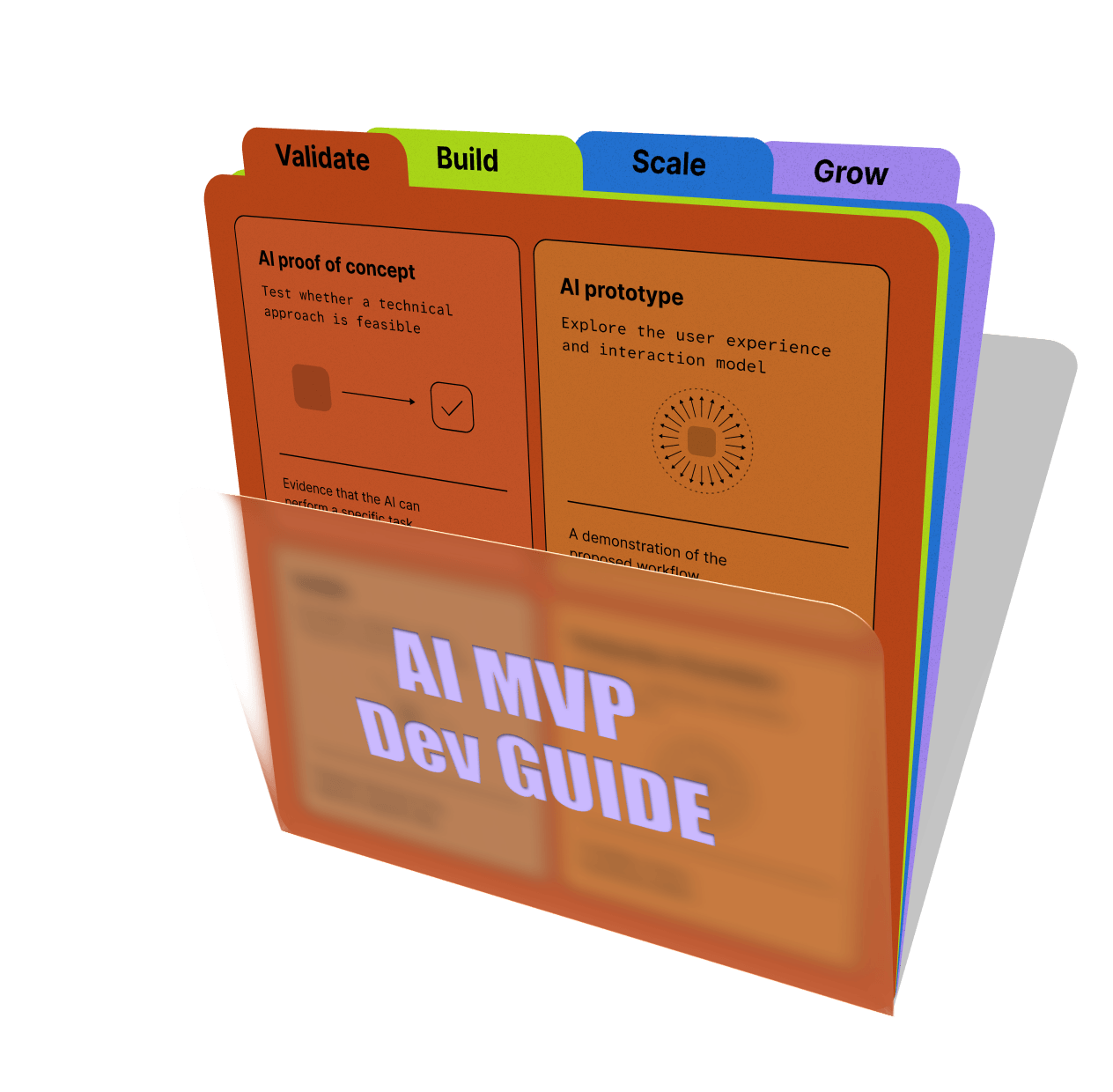

An AI MVP is a minimum viable product that uses artificial intelligence to solve a specific user problem while including only the features necessary to test the core value proposition.
Unlike a traditional software MVP, an AI MVP must also demonstrate that its AI component performs well enough under real-world conditions. A functional interface is not sufficient if the model produces inaccurate answers, makes inconsistent predictions, or fails when users provide unexpected input.
A typical AI MVP may include a range of features.
For example, an internal knowledge assistant might allow employees to ask questions about company documents. The MVP could support a limited set of document types, return answers with citations, and record unanswered questions for review. It would not need advanced analytics, multilingual support, or complex integrations from day one.
These terms describe different stages of product development.
Understanding AI proof of concept vs MVP is particularly important when planning a budget. A proof of concept can establish that a model performs a task in a controlled environment, but it does not necessarily show that users will adopt the product or that the solution will be economical at scale.
Developing an AI product before validating the underlying assumptions can lead to expensive rework. Model performance may be inconsistent, users may not need the proposed functionality, or inference costs may make the business model impractical.
An MVP helps you test these assumptions before committing to a larger investment.
The 2025 Stanford AI Index reported that 78% of surveyed organizations used AI in 2024, compared with 55% in 2023. The report also found that generative AI adoption in at least one business function rose from 33% to 71% over the same period. These are survey findings rather than guarantees of business value, but they illustrate the growing interest in AI adoption.
An MVP helps turn that interest into a measurable business case through business case evaluation, which compares expected benefits with development effort, operating expenses, implementation risks, and the cost of maintaining the product.
Early user feedback helps you determine whether your product solves a sufficiently important problem. It can also reveal which features users value most and which proposed capabilities are unnecessary. This is especially relevant to MVP development for startups, where limited resources make prioritization essential.
AI systems can behave differently when exposed to real-world data than when evaluated using carefully selected examples. An MVP lets you assess accuracy, reliability, response quality, latency, and the frequency of incorrect outputs.
AI expenses extend beyond initial implementation. Depending on the solution, you may pay for model inference, data storage, retrieval infrastructure, monitoring, and human review. These inference costs should be estimated using realistic request volumes, model pricing, average input and output sizes, and expected user behavior.
A focused MVP helps estimate these costs using actual usage patterns rather than assumptions alone.
A lean product approach supports broader software development for startups by helping teams avoid building features before their value has been demonstrated.
The objective is not to create the cheapest possible product. It is to make the smallest investment that produces reliable evidence about feasibility, demand, and commercial potential.
The right use case depends on the problem, the available data, the consequences of errors, and the expected return on investment. Some AI applications can be validated with existing models, while others require specialized data pipelines or custom model development.
A customer support assistant can answer common questions, retrieve relevant information, summarize conversations, or suggest responses to human agents.
In a peer-reviewed study published in the Quarterly Journal of Economics, researchers examined a generative AI assistant used by 5,172 customer-support agents. Access to the assistant increased issues resolved per hour by 15% on average. The effects varied across workers, so the result should not be interpreted as a guaranteed improvement for every support team.
An MVP could focus on a limited set of frequently asked questions, with human escalation for uncertain or sensitive requests.
AI can help users search internal documentation, extract information from contracts, classify incoming files, or summarize lengthy reports. Retrieval-augmented generation (RAG) is one approach for building knowledge assistants. It retrieves relevant information from an external knowledge source and supplies it to a language model to help generate an answer. A well-planned RAG implementation needs to consider document parsing, chunking, indexing, retrieval relevance, permissions, and the way retrieved evidence is presented to the model.
The foundational RAG research by Lewis and colleagues describes combining retrieved knowledge with a generative model. Its findings support the approach for certain knowledge-intensive tasks, but they do not establish that RAG is the best solution for every application.
For an initial release, limit the document sources and file formats, provide citations where possible, and evaluate whether answers are supported by the underlying evidence.
Predictive AI can help estimate demand, identify unusual transactions, forecast equipment failures, or prioritize leads. These products depend heavily on the quality and relevance of historical data. Before implementing a complex model, compare its performance with a simple baseline. If a basic statistical method performs nearly as well, a more complex model may not justify its additional cost and maintenance.
AI copilots help people complete tasks, while AI agents may execute multiple steps toward a goal using tools and external systems. For an initial product, constrain the actions the system can take. An assistant that drafts a response for approval is usually easier to validate than one that sends messages, modifies financial records, or changes production systems autonomously.
Anthropic’s February 2025 Economic Index analyzed observed Claude.ai usage and classified 57% of the analyzed activity as augmentation and 43% as automation. These figures describe activity on one platform, not all AI users or business applications.
Industry requirements can substantially change the development approach. Financial services, healthcare, logistics, and insurance may involve sensitive information, strict auditability requirements, and costly errors.
A team exploring best ai firms for fast mvp development financial services should prioritize providers with relevant security practices, experience integrating with financial systems, and a clear approach to model evaluation and regulatory requirements. Speed alone is not an adequate selection criterion.
A structured AI MVP development process helps keep scope manageable while ensuring that technical decisions support business validation.
Start with the specific problem your product will solve.
Identify who experiences it, how they currently address it, what the existing process costs, and why current solutions are insufficient. Speak with potential users and document their workflows before choosing an AI model.
For example, instead of defining the goal as “build an AI agent,” define it as “help support agents find accurate answers in internal documentation without searching multiple systems.”
The second statement gives you a clearer basis for evaluating the product.
Turn the product idea into a hypothesis that can be tested.
For example:
“We believe support agents will use a document-grounded AI assistant if it provides relevant answers with traceable sources and reduces the time required to find information.”
Define success criteria before development begins. These might include answer correctness, source relevance, task completion time, adoption, and user satisfaction.
Choose one core workflow and exclude features that do not directly support validation.
For an internal knowledge assistant, the first version might include document ingestion, search, answer generation, source citations, and a feedback mechanism. It might exclude voice interaction, complex user permissions, multilingual support, and advanced reporting until the core workflow has been validated.
A well-scoped early-stage startup mvp development guide should emphasize this principle: prioritize evidence of user value over feature volume.
Determine whether you have enough relevant, lawful, and usable data to build the solution. This data availability assessment should identify data sources, access restrictions, coverage gaps, freshness, and the effort required to make the information suitable for development.
Check for missing values, inconsistent formats, outdated records, duplicates, and sensitive information. If your product depends on company documents, assess whether the documents can be indexed and whether their access permissions must be preserved during retrieval.
Dataset preparation may include cleaning, labeling, deduplication, normalization, and creating representative training or evaluation examples. This work can be a significant part of the project and should be included in the plan rather than treated as an afterthought.
Choose the simplest approach that can meet your requirements. Define model selection criteria before comparing candidates, including task quality, latency, cost, context limits, privacy requirements, deployment options, and ease of integration.
Possible options include:
The right choice depends on evaluation results, not on whether a technology is fashionable.
Implement the core workflow, including the interface, backend, data handling, and AI integration. A practical ai-powered mvp development project should include enough logging to understand how the system behaves. Record relevant inputs, outputs, latency, model versions, and evaluation outcomes where appropriate, while respecting privacy and data-retention requirements.
For systems using multiple services, api orchestration coordinates requests between the application, model providers, retrieval systems, and external tools. Keep these interactions observable and handle timeouts, rate limits, retries, and provider errors deliberately.
Avoid collecting sensitive information that is not necessary for the product or its evaluation.
Create a representative evaluation dataset before exposing the system to a wider audience.
For a knowledge assistant, assess whether retrieved documents are relevant, whether answers are factually supported, and whether the system appropriately acknowledges uncertainty.
Define evaluation metrics that reflect both technical quality and the user’s task. These could include retrieval relevance, answer correctness, response time, task completion, and the rate of outputs that require human correction.
For generative AI, ai output accuracy should be assessed against representative examples and clear acceptance criteria rather than inferred from a few impressive demonstrations.
Hallucination mitigation can involve grounding responses in retrieved sources, instructing the model to acknowledge insufficient evidence, testing adversarial or ambiguous inputs, and providing a safe fallback when confidence is inadequate.
For higher-risk workflows, human-in-the-loop validation allows qualified reviewers to verify outputs or approve actions before they affect customers, financial records, or other consequential processes.
Run a controlled pilot with users who resemble your intended customers.
Observe how they use the product, where they lose confidence, which outputs they reject, and what they do when the AI voice agent fails. Collect structured feedback and compare results with the baseline workflow.
A product can perform well on a technical benchmark yet fail to fit naturally into the user’s day-to-day work. Both dimensions matter.
Use the results to make a deliberate decision.
This decision framework also applies to startup building more broadly: an MVP should help the team make better investment decisions, including the decision not to continue with an unviable idea.
Your AI MVP tech stack should be selected around the use case, development constraints, data requirements, and expected workload. There is no universally best stack for every AI product.
A hosted model API can simplify initial development because the provider manages the underlying model infrastructure. It may be a good starting point when speed and experimentation matter more than deployment control.
Self-hosted or open-source models may provide more control over deployment, customization, and data handling, but they introduce infrastructure and operational responsibilities.
Evaluate models using representative tasks. Compare output quality, latency, availability, integration complexity, and total operating costs rather than relying exclusively on benchmark rankings.
Depending on the application, this layer may include a relational database, object storage, search infrastructure, or a vector database.
A vector database can support semantic retrieval, but it is not automatically necessary. Conventional search, database queries, or a hybrid retrieval approach may be sufficient for a narrow use case.
The backend manages authentication, business logic, integrations, data access, and communication with the AI model. The frontend provides the interface through which users interact with the product.
Choose technologies the team can maintain effectively. For example, Python is commonly used for AI and data workloads, while TypeScript can support web interfaces and backend services. These are options rather than mandatory choices.
A clear prototype architecture helps the team identify the core components and their boundaries before implementation. Keep the first design simple enough to change as evaluation results and user feedback reveal new requirements.
Even a small MVP needs basic operational controls. Consider access management, encryption, secrets management, error monitoring, usage limits, backups, and appropriate logging.
Document the relevant security considerations, including personal data handling, model-provider retention policies, access controls, data residency where applicable, and the risks of exposing confidential information through prompts or retrieved content.
If the product processes sensitive data, evaluate where information is sent, how long it is retained, and which providers or subprocessors can access it.
The decision should be based on the full cost of ownership. Hosted APIs may reduce initial engineering and infrastructure work but introduce usage-based charges and provider dependencies. Self-hosting may offer more control but requires deployment, monitoring, scaling, and model maintenance.
Stanford’s 2025 AI Index reported a substantial historical decline in the inference cost of models reaching a GPT-3.5-equivalent score on the MMLU benchmark: from $20 per million tokens in November 2022 to $0.07 in October 2024. This benchmark-matched comparison illustrates how quickly costs changed during that period. It is not a current price quote or a prediction of costs for every model and workload.

For ai for mvp development, test the actual workload before making a long-term infrastructure decision. Use relevant performance benchmarks to compare candidate models on your own representative tasks, accounting for quality, latency, throughput, and resource consumption.
The ai mvp development cost depends on the product’s scope, data readiness, AI requirements, integrations, security needs, and team composition. A document assistant built on an existing model may have very different requirements from a computer vision system that needs custom data collection and model training.
A reliable estimate should be based on a defined scope rather than a generic market average.
Break the estimate into four categories:
For recurring costs, estimate expected usage rather than relying on a single illustrative number. For example, calculate expected requests per user, average tokens per request, model prices, retrieval costs, and any human-review expenses. Then test how those costs change under lower- and higher-usage scenarios.
A clear estimate should state its assumptions, exclusions, dependencies, and uncertainty. If data quality or model performance is not yet known, allow for an initial technical validation phase before committing to the entire implementation budget.
Development time depends on scope and uncertainty. A product using an existing model, clean data, and a small number of integrations is generally less complex than one requiring custom model training, extensive data preparation, or regulated deployment.
Rather than promising a universal timeline, divide the project into stages:
A repeatable deployment pipeline helps move code and configuration through testing and release environments with consistent checks. For an AI MVP, it should also account for model or prompt changes, regression testing, configuration management, and rollback procedures.
Some stages can overlap, but skipping validation can create additional rework later.
The main schedule risks are often unclear requirements, unavailable data, unexpected model limitations, integration dependencies, and slow stakeholder feedback. Identifying these risks early makes estimates more useful.
An AI MVP should be evaluated against predefined business and technical goals. Model accuracy alone does not prove that the product is useful or commercially viable.
Choose metrics appropriate to the use case. These may include task accuracy, precision and recall, retrieval relevance, unsupported-answer rate, latency, system availability, and the frequency of failures requiring human intervention. For generative AI, automated metrics can be useful, but they should be supplemented with human review when the task requires nuanced judgments.
Track whether users complete the target workflow more successfully or efficiently. Useful measures may include task completion rate, time saved, repeat usage, user satisfaction, and the proportion of AI outputs accepted without substantial correction. Compare results with a baseline whenever possible. Without a baseline, it is difficult to determine whether the AI meaningfully improves the process.
Depending on the business model, relevant measures may include cost per completed task, customer retention, conversion, support workload, or revenue attributable to the product. Be careful when interpreting results from small pilots. Early users may be unusually motivated, and observed improvements may not persist as the user base grows.
AI coding tools can accelerate some engineering tasks, but their effects depend on the developer, task, codebase, and review requirements.
A 2025 randomized controlled study by METR examined 16 experienced open-source developers completing 246 tasks in mature repositories. In that specific setting, developers took 19% longer when AI tools were allowed, despite expecting a speedup. The study had a limited sample and context; it does not establish that AI coding tools universally reduce productivity.
The practical lesson is to measure delivery outcomes and review effort instead of assuming that using AI automatically makes development faster.
Before expanding the product, verify that it performs reliably under representative workloads and that the business case remains viable. Review model quality, data access, infrastructure capacity, security, operating costs, support requirements, and fallback procedures. Experiment tracking helps maintain a record of model versions, prompts, configurations, datasets, and evaluation results so the team can understand which changes improve or degrade performance.

As usage grows, continuous model monitoring can reveal changes in input data, output quality, latency, cost, and failure rates. Monitoring should be paired with clear thresholds and a response process so the team knows when to investigate, roll back a change, or route work to a human. Scaling should follow evidence of value, not simply the completion of the first release.
The decision depends on your team’s capabilities, delivery priorities, budget, and the technical risks of the product.
An internal team can maintain direct control over product decisions, architecture, and accumulated technical knowledge. This can be attractive when AI is central to the company’s long-term strategy and the necessary expertise is already available.
However, hiring and coordinating specialists can take time. Your team may need experience in AI engineering, backend development, data engineering, product design, evaluation, and deployment.
An external mvp software development company may provide access to a multidisciplinary team without requiring every role to be hired internally.
When comparing providers, assess their discovery process, technical reasoning, evaluation practices, security approach, communication, and willingness to challenge unrealistic assumptions.
A credible mvp development service should help clarify the problem and define a testable scope, not merely promise a rapid launch.
Compare proposals based on deliverables, ownership, exclusions, team composition, and post-launch responsibilities. A low initial quote may not include data preparation, evaluation, deployment, or maintenance.
Different projects require different levels of support. Some teams need a focused technical validation; others need a complete initial product.
When comparing mvp software development services, check whether discovery, design, implementation, testing, deployment, and ongoing support are included or priced separately.
For products intended for mobile users, mvp app development services should also address the platform requirements, API architecture, and any AI-specific constraints of the mobile experience.
For founders with limited internal engineering capacity, mvp development services for startups may be useful when they provide a transparent process, clear ownership arrangements, and practical knowledge transfer.
If your product depends on substantial AI staff augmentation expertise, compare several ai mvp development companies and ask how they evaluate model quality, manage uncertainty, and control operating costs.
A provider offering best custom ai development service for tech startups should be assessed on its actual technical fit and delivery process rather than on marketing claims or broad promises of innovation.
The choice between internal development and an external partner is not always binary. A hybrid model can keep product strategy and key architectural decisions in-house while using an external team for specialized implementation.
When evaluating in-house vs outsourcing development: pros and cons for startups, consider time to assemble the team, access to expertise, control over intellectual property, communication overhead, knowledge retention, and long-term maintenance.
Startup outsourcing software development can help fill capability gaps, but it works best when responsibilities, acceptance criteria, code ownership, documentation, and security expectations are defined from the beginning.
A successful AI MVP starts with a clearly defined problem, not a particular model or technology stack. By limiting the initial scope, testing technical feasibility, evaluating outputs, and collecting feedback from real users, you can make more informed decisions about where to invest next.
The right approach to startup software development combines product validation with engineering discipline. Choose technologies based on evidence, account for data and operating costs, and establish measurable criteria for success before scaling.
If you are exploring how to create a startup around an AI-powered product, begin with the workflow that matters most to your intended users. Validate that workflow before committing to a broad feature set or complex architecture.
The same principle applies to startup web app development company selection and app development for startups: prioritize a team that can turn a clear business hypothesis into a usable, testable product.
For founders considering AI startup software development services, the most valuable partner is one that can help assess feasibility, define the right MVP scope, and build a foundation for future development without overengineering the first release.
When evaluating MVP development services, focus on the quality of the process and the evidence the team helps you generate. The best first release is not necessarily the one with the most features. It is the one that provides a reliable basis for deciding what to build next.
CleverDev Software can be approached to discuss your product idea, requirements, and potential development approach. Before choosing a delivery model, clarify your goals, data constraints, evaluation criteria, and expected operating costs.
Ready to explore your AI MVP idea? Discuss your AI MVP requirements with a development team and identify the most practical next step.


IT Expert at CleverDev Software
With a tech leadership spanning from 2008, Julia lives by the motto of diving deep into the innovation ocean. Her writing prowess, research acumen, and interviewing expertise enable her to share invaluable insights into IT trends.

Our newsletter is packed with valuable insights, exclusive offers, and helpful resources that can help you grow your business and achieve your goals.