Turn your AI idea into a working minimum viable product. Our team provides AI MVP development services to help you validate business assumptions, test core functionality, and bring an AI-powered solution to market without investing in a full-scale product from day one.
Our AI MVP development approach combines product discovery, technical feasibility assessment, AI integration, software engineering, and launch support to help you make informed decisions about your product's future.

Building an AI product requires more than connecting a model to an application. You need to identify the right use case, assess data readiness, choose suitable technologies, and define how success will be measured.
As your AI MVP development partner, we combine AI engineering, software development, and product thinking to turn an initial concept into a testable solution. We can work alongside your existing development team or provide the capabilities needed to move a project forward independently.
Our approach aligns business and technical objectives so that product decisions support measurable outcomes rather than technology adoption for its own sake.
An AI MVP is an initial version of an AI-powered product that includes enough functionality to test its value with real users or within a business environment.
Rather than building every planned feature, an MVP focuses on the core capabilities needed to validate the product concept, evaluate AI for healthcare performance, and collect meaningful feedback.
This approach can help you determine whether AI can solve the intended problem, whether your data is sufficient, and whether the proposed solution can meet your business requirements.
The goal is not simply to build a smaller product. It is to reduce uncertainty, validate the concept, and make better-informed decisions about further investment.

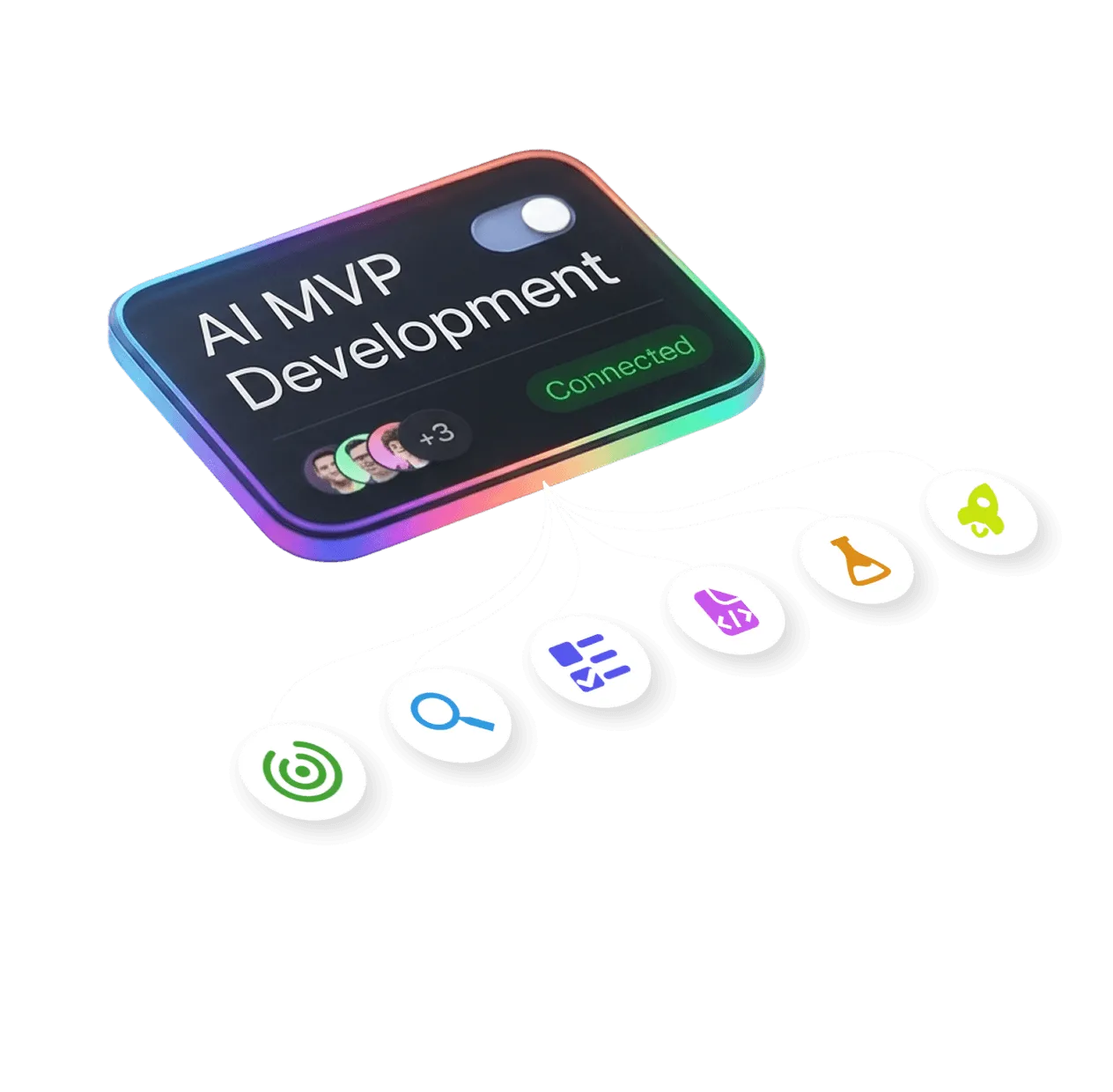
Our AI MVP development services cover the key stages of planning, building, testing, and launching an AI-powered product.
Our iterative approach keeps each stage focused on the most important business and technical questions.
We identify the problem your product should solve, who will use it, and what success should look like. Together, we establish the initial scope and key performance indicators.
We assess data availability, integration requirements, AI capabilities, technical constraints, and potential risks. This helps determine the most practical implementation approach.
We distinguish essential functionality from features that can wait. The initial release focuses on the smallest useful solution capable of testing the main product assumptions.
We design the user experience, implement the application, integrate the selected AI capabilities, and connect the required data sources and systems.
We validate application functionality and evaluate AI outputs against defined criteria. Findings inform adjustments to prompts, retrieval methods, data processing, or other components.
We deploy the MVP, gather feedback, and review performance. The results help determine which features to refine, which assumptions to revisit, and what to prioritize next.

An AI MVP can help validate a wide range of product concepts and business applications.
For products built around mvp ai concepts, the key is to connect the technology to a clearly defined user need and a measurable outcome.
The feasibility and expected results of each use case depend on data quality, workflow complexity, evaluation requirements, and the consequences of incorrect outputs.

The right technology depends on what your product needs to accomplish. We help select an approach that balances functionality, implementation effort, performance, and cost.
Some products can be built using existing AI APIs, while others may require open-source models, additional retrieval capabilities, customization, or a hybrid architecture.
Our recommendation is based on your business objectives, data, security requirements, and budget — not on using the most complex technology available.
For teams looking to build mvp products around language models, we assess whether existing services can support the core use case before recommending more extensive customization.
Traditional software MVPs often focus on validating functionality and user demand. AI products must also establish whether the underlying technology can perform the intended task reliably enough for its target context.
AI performance can depend on the availability, quality, relevance, and permitted use of data. Assessing data requirements early helps identify gaps before they become expensive development issues.
AI-generated outputs can vary and may contain errors. We define evaluation criteria and test representative scenarios rather than relying only on demonstrations or a few successful examples.
The AI component must work within the wider application. Response times, service availability, data flows, error handling, and integration constraints all influence the user experience.
Model usage, data processing, infrastructure, and external services can affect the cost of running an AI product. These factors influence technology choices and the long-term viability of the solution.
Some use cases require human review, approval, or escalation when confidence is low or an action carries significant consequences. These controls should be considered as part of the product design.
Addressing these questions early helps you evaluate practical viability, not just whether the technology can produce an impressive demonstration.
Real project experience demonstrates how AI development can translate into business value.
For each relevant case study, we recommend presenting:
Where available, include verified metrics such as reduced processing time, improved task completion, lower manual workload, or adoption by target users.

MVP development for startups helps founders validate a product idea, test core functionality with early users, and gather evidence before making a larger investment.
For early-stage teams, outsourcing software development for startups can provide access to specialized engineering capabilities without requiring every role to be hired in-house.
Depending on the product and available resources, businesses may also outsource software development for startups to extend their existing team or accelerate implementation.
Explore AI for eCommerce opportunities, test new workflows, or assess whether an AI-enabled solution can address a specific operational challenge.
Turn a concept or proof of concept into a usable application that can be evaluated in a realistic environment.
Test AI capabilities alongside existing software, data sources, and business processes before expanding the solution across the organization.
If you are evaluating outsourcing startup development, start by defining the product goal, expected deliverables, required expertise, and level of collaboration your team needs.
An AI MVP should be designed with its intended use, data sensitivity, and potential consequences in mind.
Our development approach can incorporate relevant safeguards, including:
The specific controls depend on the product, deployment environment, and applicable requirements. Security, privacy, and compliance needs should be identified during discovery rather than treated as last-minute additions.
The cost and delivery timeline depend on the product's scope and technical complexity. There is no single estimate that applies to every AI project.
A focused MVP using an existing AI service and a limited set of workflows may require substantially less effort than a solution involving complex integrations, specialized data processing, or custom model development.
When comparing an mvp development company with an in-house team, consider not only the initial estimate but also technical expertise, communication, ownership terms, and the ability to support future iterations.
An mvp app development company should be able to explain how it translates business requirements into a realistic scope, identifies technical risks, and measures progress.
Depending on the project, you may also consider an mvp development agency with a cross-functional team covering product discovery, design, engineering, and testing.
For organizations seeking custom mvp development ai expertise, the scope should specify which capabilities will be implemented, how AI quality will be evaluated, and what constitutes a successful delivery.
If you are comparing an ai mvp development agency with other delivery options, assess the team's relevant experience, technical approach, project governance, and post-launch support.
For products that depend heavily on autonomous workflows, look for an ai agent mvp development company that can address tool integration, permissions, evaluation, error handling, and human oversight — not just agent demonstrations.
If your use case centers on language models, ai and gpt driven mvp development may involve integrating existing models into a broader product workflow, with appropriate testing and controls.
The right ai mvp builder is not simply a platform or team that can produce a prototype. It should help you validate the core product assumptions and establish a practical route to the next stage.
Before finalizing the scope and estimate, agree on the business goal, key deliverables, evaluation criteria, and project assumptions.



Launching the first version is an opportunity to gather evidence and decide what to do next.
After deployment, evaluate user feedback, task completion, AI output quality, reliability, and operating costs. These findings can inform the next development cycle.
Depending on the results, further work may include:
A long-term mvp development company relationship may be useful when the product requires continued iteration, although the next stage should always be driven by validated demand, observed performance, and clear business priorities.


Have an AI product idea you want to validate? We can help you assess its feasibility, define the essential features, and identify a practical path from concept to working MVP.
Whether you need to build mvp app functionality from the ground up or extend an existing product, we can discuss your requirements, priorities, and technical constraints.
Our team can also help you assess whether custom mvp development ai is appropriate for your use case or whether existing AI services offer a simpler route to validation.
Tell us about your business challenge, target users, and intended outcome. We'll discuss the requirements and the next steps for your project.