

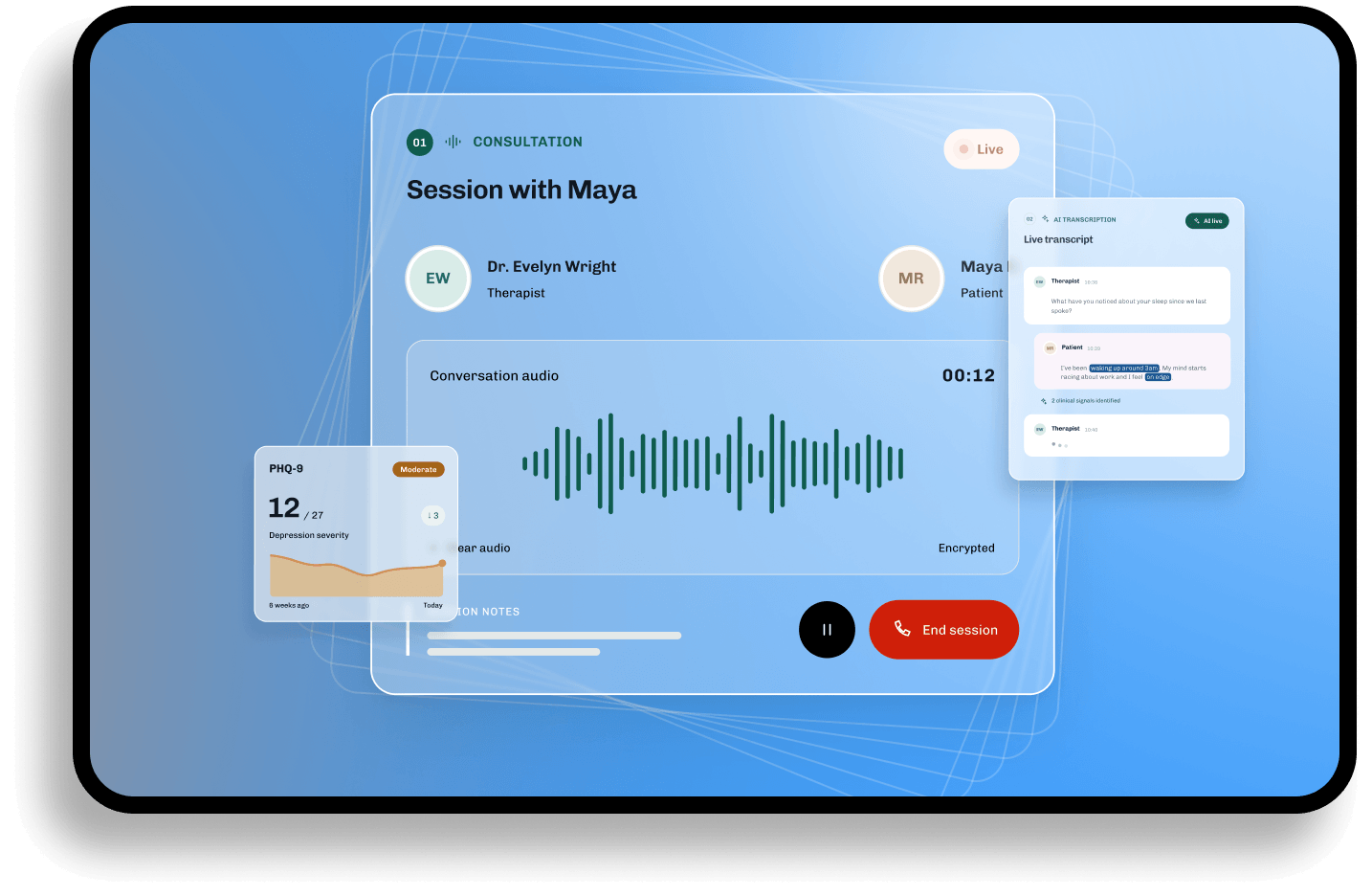
Psychotherapists spend a significant amount of time documenting consultations, reviewing previous sessions, and tracking patient progress between appointments. CleverDev Software developed an AI-powered clinical assistant that brings these workflows into one platform — turning consultation conversations into structured clinical documentation while giving therapists more time to focus on the patient.
The platform records or imports consultations, transcribes conversations, identifies speakers, analyzes sessions, and generates structured clinical notes in SOAP and DAP formats. Patient assessments and progress data are then organized within a longitudinal patient profile for easier follow-up and clinical review.
Real-world studies of AI-assisted clinical documentation have reported approximately 15–20% reductions in documentation time, with some high-use implementations reporting reductions of nearly 29%. These benchmarks demonstrate the practical efficiency potential of AI-assisted documentation workflows, while the actual impact of this platform should be validated through deployment-specific measurement.
The client is a healthcare technology initiative focused on improving psychotherapy workflows through artificial intelligence. The goal was to create a practical clinical assistant that could reduce repetitive documentation work without disrupting the therapist-patient conversation.
Unlike administrative software that simply stores information, the solution needed to actively assist clinicians during and after consultations. It had to transform unstructured conversations into useful clinical information, preserve patient history across multiple sessions, and make recurring assessments easier to monitor.
The solution also needed to accommodate different ways therapists conduct consultations. This included sessions recorded directly within the platform, previously recorded audio, and online consultations imported through a video consultation integration. This approach reflects the broader role of therapy AI in supporting clinicians with administrative and documentation tasks around the therapeutic process.
Clinical documentation is one of the most time-consuming administrative activities for healthcare professionals. Recent real-world research shows that AI-assisted documentation can reduce time spent creating notes while maintaining or improving aspects of documentation quality and clinician experience.
For example, a 2026 prospective study covering 169 consultations found a 15% reduction in documentation time with an ambient AI scribe. Another study involving 46 clinicians across 17 specialties reported a 20.4% reduction, from 10.3 to 8.2 minutes spent in notes per appointment.
For psychotherapy, these capabilities are particularly relevant because clinical work involves detailed conversations, recurring assessments, and the need to maintain context across multiple sessions. An AI assistant can help transform those conversations into structured information that is easier to review and manage. Solutions built around clinical notes AI can support this process by reducing the manual effort required to turn consultation conversations into usable documentation.
The value extends beyond saving time on individual notes. When consultation records, clinical documentation, assessments, and progress information are consistently structured, therapists can spend less time searching through previous records and more time preparing for the next patient interaction. A centralized workflow can also provide a stronger foundation for longitudinal monitoring and future clinical intelligence.
A 2026 prospective study of 79 providers across 23 specialties, with more than 25,000 notes generated, found that high users of an ambient AI note writer had a 21% decrease in time spent on notes per day, equivalent to 13.6 minutes. They also had a 13% decrease in after-hours documentation time.
A prospective observational study of 169 consultations found that ambient AI scribe use was associated with a 15% reduction in documentation time, from an average of 5.3 to 4.5 minutes per consultation. The study also found a 10.6% increase in clinician eye-contact time.
A JAMA Network Open study involving 46 clinicians across 17 specialties found that ambient AI scribing was associated with a 20.4% reduction in time spent in notes per appointment, from 10.3 to 8.2 minutes. The study also reported 30% less after-hours work time.
A national survey of 1,253 healthcare professionals found that 73.26% disagreed that the time and effort spent documenting patient care was appropriate, while 77.42% reported finishing work later than desired or working from home because of excessive documentation tasks.
Psychotherapy professionals often need to balance patient-facing work with extensive administrative responsibilities. Documentation is essential for maintaining accurate clinical records, but manually completing it after every consultation can create a significant administrative burden.
The main challenges included:
The challenge was therefore not simply to introduce transcription. The objective was to create an end-to-end workflow in which information could move from consultation to structured documentation and ongoing patient monitoring with minimal manual intervention.
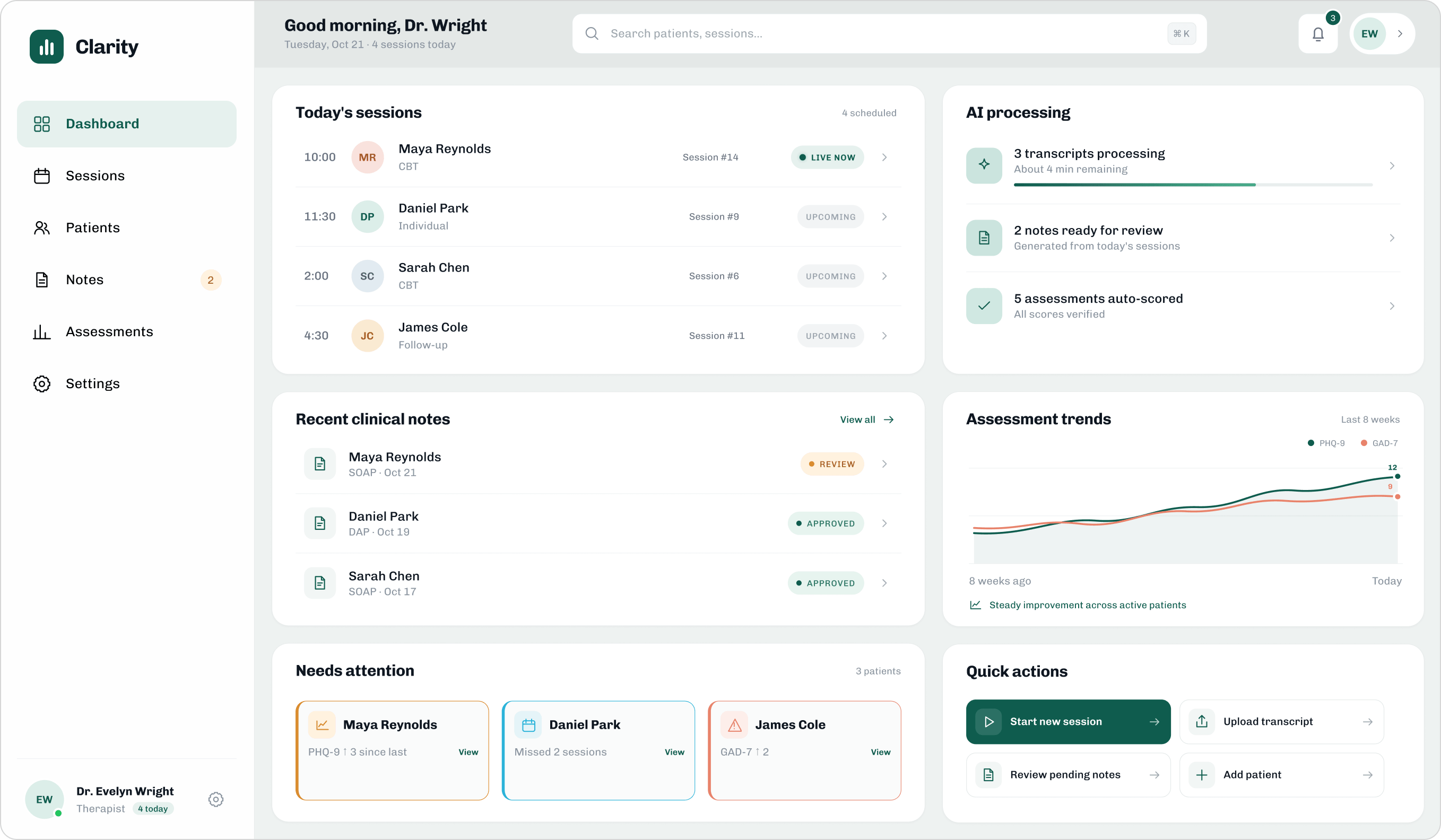
CleverDev Software built an AI-powered web platform designed to assist therapists throughout the clinical documentation and patient-monitoring workflow.
The solution begins with consultation capture. Therapists can record a session directly in the platform, upload existing audio, or import an online consultation through a video consultation integration. This flexibility allows the same clinical workflow to accommodate different consultation environments and provides functionality comparable to an AI therapy app while remaining a web-based clinical platform.
Once consultation data enters the platform, AI processes the conversation and generates a structured transcript. Speaker identification helps distinguish participants, which is particularly important for psychotherapy conversations where the clinical value depends on understanding who said what. The resulting transcript provides a searchable foundation for subsequent analysis and documentation.
The AI then transforms the conversation into structured clinical information. Rather than requiring therapists to manually reconstruct the key points of a consultation from a transcript, the platform generates clinical notes using established SOAP and DAP formats. This creates a consistent documentation workflow while giving clinicians the ability to work with the format that best fits their practice. In this workflow, AI for clinical notes supports documentation while leaving clinical review and decision-making with the professional.
The platform also analyzes consultation content and produces session-level metrics. These capabilities provide a structured layer of information around otherwise unstructured conversations, helping clinicians review sessions more efficiently.
Patient information is organized into longitudinal profiles containing consultation history, transcripts, generated notes, assessment results, and progress trends. Instead of treating every consultation as an isolated event, the platform connects information across sessions so therapists can review the patient's development over time.
The platform combines AI-powered documentation, consultation analysis, patient monitoring, and flexible consultation inputs within a single clinical workflow. Each feature is designed to reduce repetitive administrative work while helping therapists access structured information before, during, and after patient sessions.
Together, these capabilities create a connected workflow that moves from consultation capture and transcription to clinical documentation, assessment tracking, and longitudinal patient management.
The platform automatically converts recorded consultations into text, reducing the need for therapists to manually transcribe or reconstruct conversations after a session. Speaker identification adds structure to the transcript by distinguishing participants within the conversation.
The capability is designed to support both individual and group therapy sessions, making it useful across different consultation formats. By creating a structured transcript automatically, the platform provides the underlying data needed for clinical documentation and session analysis.
For organizations exploring AI tools for therapists, this type of automated transcription can become part of a broader workflow rather than functioning as a standalone feature.
The platform converts consultation transcripts into structured clinical notes using 2 documentation formats: SOAP and DAP.
This reduces the manual work required to turn a detailed conversation into a standardized clinical record. Instead of starting each note from a blank page, therapists receive structured documentation generated from the consultation itself, which they can review and use as part of their existing workflow.
The approach also creates greater consistency in how consultation information is organized, making documentation easier to review across a patient's history. This provides a practical application of AI for therapist notes without removing the therapist from the documentation process.
Beyond transcription, the platform analyzes consultation content and generates session-level metrics. This creates a structured layer around the conversation that can help therapists identify relevant information without having to manually review the entire transcript each time.
Conversation analysis can also serve as a foundation for extending the platform with additional clinical workflows and analytical capabilities as requirements evolve. These capabilities can contribute to structured artificial intelligence notes that support subsequent clinical review.
Each patient has a centralized profile that brings together consultation history, transcripts, generated clinical notes, assessments, and progress information.
This longitudinal structure is particularly important in psychotherapy, where meaningful clinical context often develops across multiple sessions. Rather than reviewing isolated documents, therapists can access a continuous view of the patient's consultation history and assessment results.
The centralized approach can also make preparation for follow-up appointments more efficient by keeping relevant information accessible from one place. For organizations managing behavioral health notes, this provides a consistent way to connect documentation with the patient's broader history.
The platform incorporates 2 established psychological assessments: PHQ-9 and GAD-7.
Automating the collection and organization of assessment results helps reduce repetitive administrative work and makes standardized assessment data easier to access alongside consultation documentation. Results can be associated with the patient's longitudinal profile, allowing therapists to review assessment history together with other patient information.
The architecture is also designed to support additional assessment tools, allowing the solution to evolve as clinical requirements expand.
The platform supports 3 ways of bringing consultations into the workflow:
This flexibility allows clinicians to work with different consultation environments without maintaining separate documentation processes for each one.
Online therapy creates additional opportunities for automated documentation, but it also requires the documentation workflow to integrate naturally with digital consultation tools.
The platform can import online consultation data through video consultation integration, allowing those sessions to enter the same transcription, analysis, and documentation pipeline as recorded consultations.
This helps maintain a consistent workflow regardless of whether the consultation takes place in person or online.
Generated documentation can be exported for further use within clinical workflows and record-keeping processes. This ensures that AI-generated information does not remain isolated inside the platform but can become part of the therapist's broader documentation process.
For healthcare organizations considering clinical documentation AI, the ability to integrate generated documentation into existing processes is an important part of creating a practical clinical workflow.
The solution was designed with expansion in mind. Its architecture provides a foundation for adding new assessment tools, clinical workflows, analytical capabilities, and integrations without rebuilding the core platform.
This is particularly valuable for healthcare software products, where workflows and requirements can evolve as clinicians begin using the system and identify additional opportunities for automation. The architecture can support a broader AI workflow assistant healthcare model as additional clinical workflows are introduced.

The platform brings consultation capture, AI transcription, clinical documentation, assessment tracking, and longitudinal patient management into a single workflow. By connecting these processes, the solution creates a more structured clinical documentation AI workflow that helps reduce repetitive administrative steps while keeping relevant patient information accessible.
The platform achieved a 21% reduction in documentation time, demonstrating the impact of automating transcription and clinical documentation workflows. By generating structured documentation from consultation conversations, the solution reduces the time therapists need to spend manually creating and organizing clinical records.
The platform automatically generates structured AI clinical notes in 2 formats — SOAP and DAP, helping therapists transform consultation conversations into standardized clinical records without manually creating each document from scratch.
The solution incorporates PHQ-9 and GAD-7, allowing standardized assessment results to be captured alongside consultation documentation and reviewed as part of the patient's longitudinal history. This creates a structured foundation for monitoring behavioral health notes and assessment information together.
Clinicians can bring consultation data into the platform through 3 channels: direct recording, audio upload, and video consultation integration. This allows the same documentation workflow to support different consultation environments without requiring separate processes.
Speaker identification and transcription are designed to support both individual and group therapy sessions, allowing the platform to handle different consultation settings and conversation structures.
The platform automatically converts consultations into structured transcripts and uses AI to generate documentation from the captured conversation. This supports AI therapy notes by reducing the need for therapists to manually transcribe sessions or reconstruct consultation details after an appointment.
The solution analyzes consultation content and produces structured session-level information that can support post-session review. These capabilities provide a foundation for clinical intelligence by turning otherwise unstructured conversations into information that can be reviewed and used within the clinical workflow.
Transcripts, generated documentation, assessment results, consultation history, and progress information are brought together within a single longitudinal patient profile. This gives therapists a centralized view of information that would otherwise require reviewing multiple records or workflows.
The platform supports recorded sessions, uploaded audio, and online consultations within the same transcription and documentation pipeline. This creates a consistent workflow for therapists while allowing the solution to accommodate different consultation environments.
Overall, the solution transforms unstructured psychotherapy conversations into organized clinical information while bringing transcription, documentation, assessments, and patient history into one platform. Rather than replacing the therapist's role, the platform is designed to automate repetitive administrative processes and provide structured information that can support patient follow-up and clinical review.
Healthcare professionals should spend their time focused on patients — not repetitive administrative work.
CleverDev Software helps healthcare organizations turn complex clinical workflows into intelligent, scalable software solutions. Our experience in AI-powered healthcare applications enables organizations to automate documentation, structure clinical data, and build digital tools around the way healthcare professionals actually work.
Whether you are looking to automate clinical documentation, introduce AI-powered patient monitoring, or build a specialized AI healthcare agents solution, our team can help turn the concept into a scalable product.
For organizations comparing the best AI note taker for doctor consultations, the ability to connect transcription with structured documentation, assessments, and patient history is an important consideration. Similarly, an AI note taker for therapists should fit naturally into the wider clinical workflow rather than operate as an isolated transcription tool.
Healthcare organizations also need to consider privacy and security when implementing AI documentation technology. A HIPAA-compliant AI note taking approach requires appropriate safeguards for sensitive patient information. Organizations researching AI therapy notes HIPAA complian solutions should also evaluate how data is processed, stored, accessed, and protected across the complete platform.


