

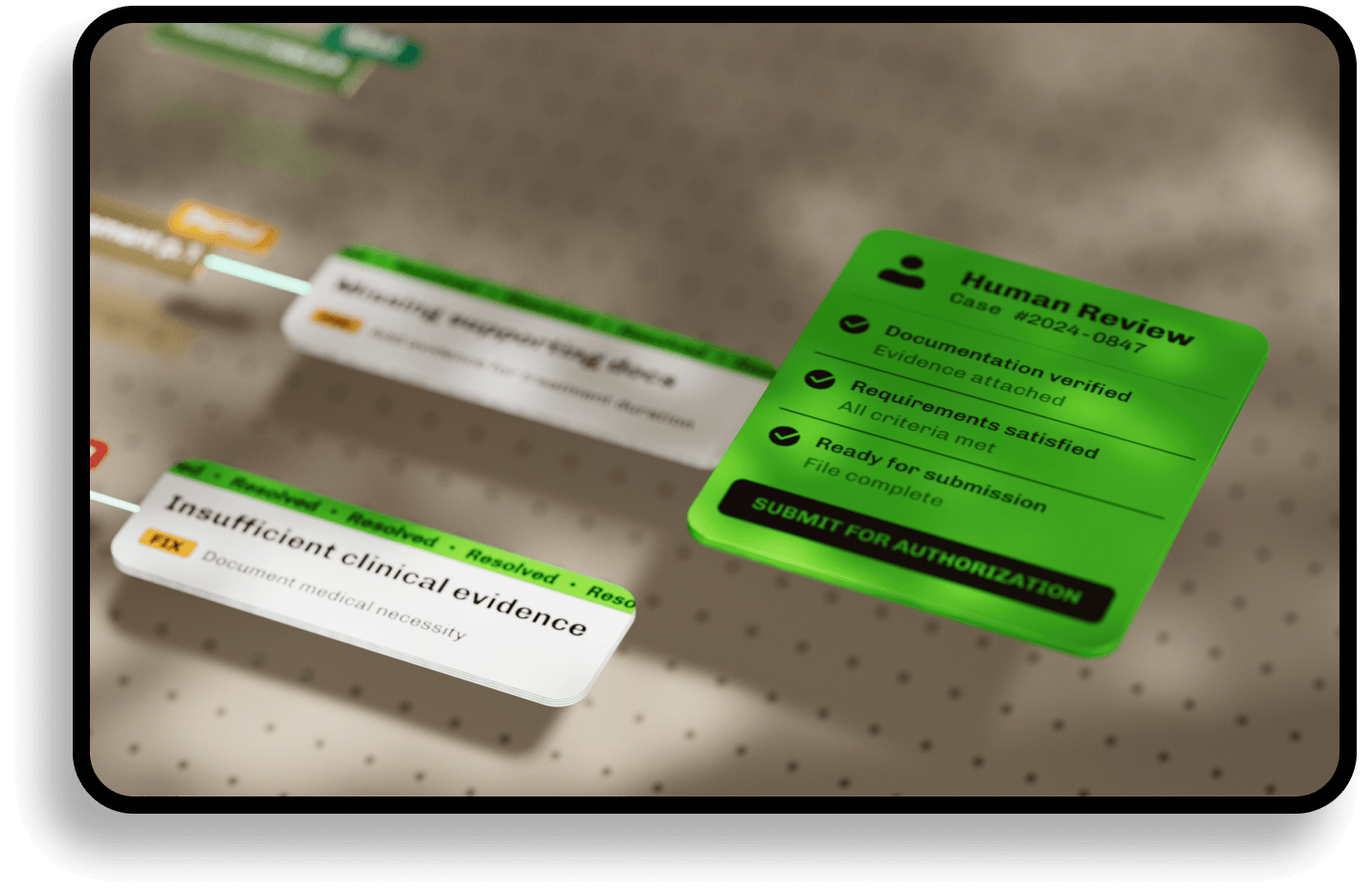
A US-based healthcare provider wanted to strengthen its clinical documentation review process and identify Medicare coverage gaps before claims were submitted. The existing process required reviewers to work through large volumes of clinical records, locate relevant treatment information, and manually determine whether the documentation supported applicable compliance requirements and regulatory standards.
CleverDev Software developed an intelligent web platform that brings this verification process upstream. The solution uses AI to extract treatment information from clinical files, turn unstructured documentation into structured case data, and evaluate each case against Medicare coverage requirements and relevant healthcare regulations.
The result is a practical pre-submission safety net. Instead of discovering documentation deficiencies after a claim has been denied, the client's team can identify potential gaps while there is still time to address them, supporting earlier risk mitigation and more informed submission decisions.
6.55% of Medicare Fee-for-Service payments were estimated to be improper in FY 2025, totaling $28.83 billion. CMS notes that improper payments include cases where insufficient information was provided to determine whether a payment was proper.
For FY 2025, CMS estimated $869 million in Medicare Part C improper payments were associated with missing documentation. CMS reported a 6.09% overall Part C improper payment rate, representing approximately $23.67 billion in improper payments.
The American Hospital Association reported that 50% of hospitals and health systems had more than $100 million in accounts receivable from claims older than six months, while 35% reported $50 million or more in foregone payments from denied claims.
The AMA's most recent survey found that physicians and staff spend an average of 13 hours per week on prior authorization, with 40% of physicians employing staff dedicated exclusively to prior authorization tasks. The survey also found that 74% reported denials had increased over the previous five years.
Our client is a US-based healthcare organization managing clinical documentation and claims-related workflows for a high volume of patient cases.
The organization needed to improve the way its teams reviewed supporting documentation without introducing another disconnected system into an already complex healthcare environment. The platform therefore had to work with sensitive patient data and protected health information while providing appropriate data security and data privacy measures.
Rather than replacing professional review, the goal was to give reviewers better information at the point where compliance decisions are made.
The project called for more than conventional compliance software. The client needed technology capable of understanding clinical records, connecting information across multiple files, and presenting compliance findings in a form that healthcare professionals could act on.
Healthcare documentation sits at the intersection of patient care, reimbursement, and regulatory obligations. For providers working with Medicare, the quality and completeness of supporting documentation can directly influence whether a claim can move forward successfully.
This creates a difficult operational problem. Clinical records are written for care delivery and may contain relevant evidence across several narrative documents, while coverage requirements are typically structured around specific criteria. Bridging those two formats manually can consume considerable reviewer time and increase exposure to documentation-related compliance risks.
The emergence of AI compliance solutions is creating a new approach to this problem. Instead of asking staff to manually translate every clinical record into a compliance checklist, AI can help identify relevant evidence and organize it for structured review.
At the same time, healthcare organizations need appropriate controls around AI. Questions around data access, human oversight, traceability, and model use make an AI governance assessment an important part of introducing intelligent systems into sensitive healthcare workflows. A broader governance framework can also establish how AI findings are reviewed, documented, and incorporated into existing compliance processes.
For this reason, the project was designed not simply as an automation initiative, but as a controlled regulatory compliance platform with clear review, accountability, and risk management mechanisms.
The client's review teams were spending substantial time working through clinical documentation before a case could be considered ready for submission.
A single case could contain several files, with relevant information distributed between treatment notes, assessments, orders, and other clinical records. Finding the right evidence was often as time-consuming as evaluating it.
The process created several challenges:
The client was looking for an AI compliance solution that could perform the repetitive discovery work while leaving the final assessment with qualified reviewers.
CleverDev Software developed a web-based AI compliance platform around the client's pre-submission documentation workflow.
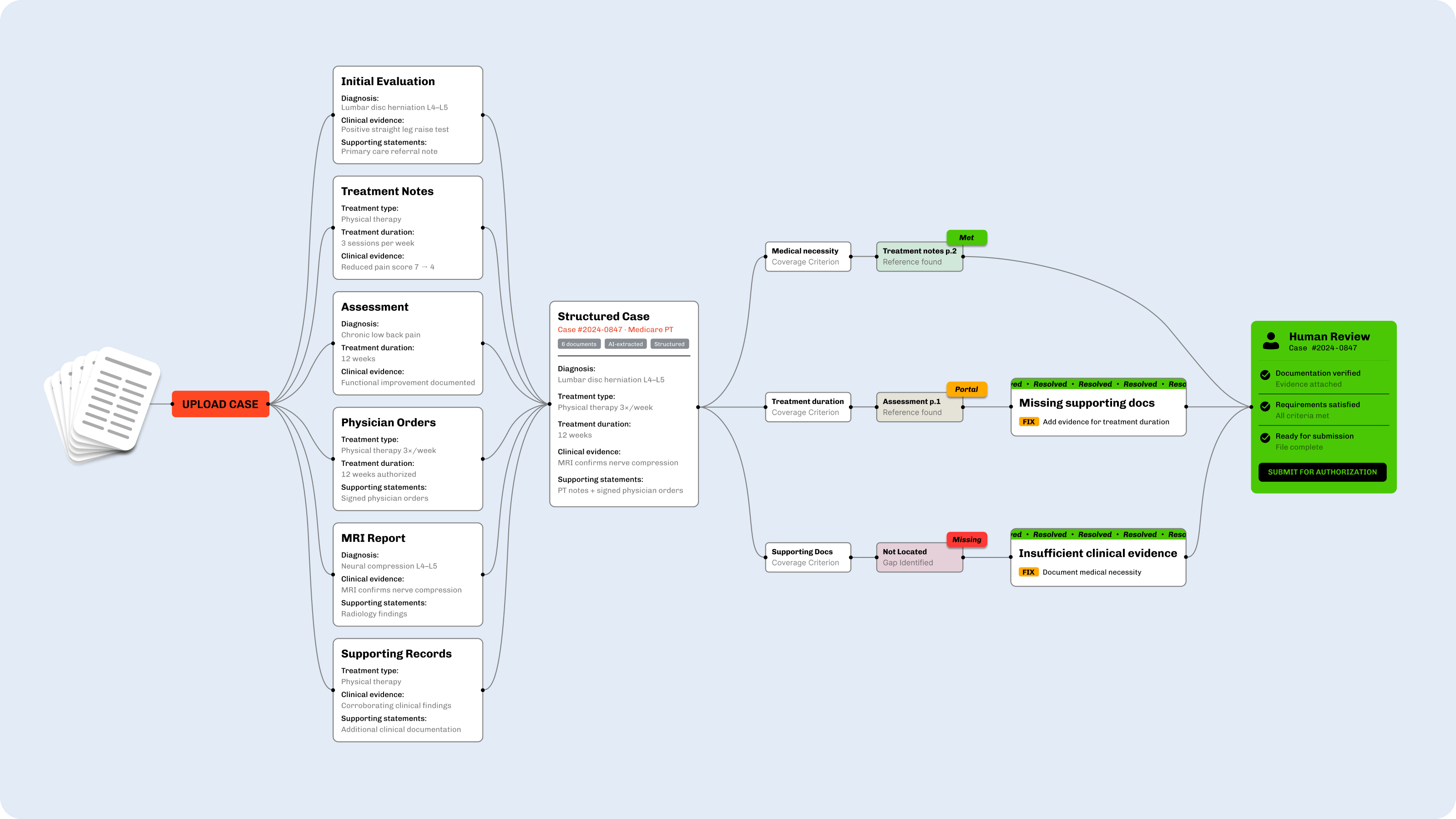
The platform starts with the complete clinical documentation package rather than requiring users to manually identify the relevant files. AI processes the records, discovers treatment-related information, and organizes the extracted content into a structured representation of the case.
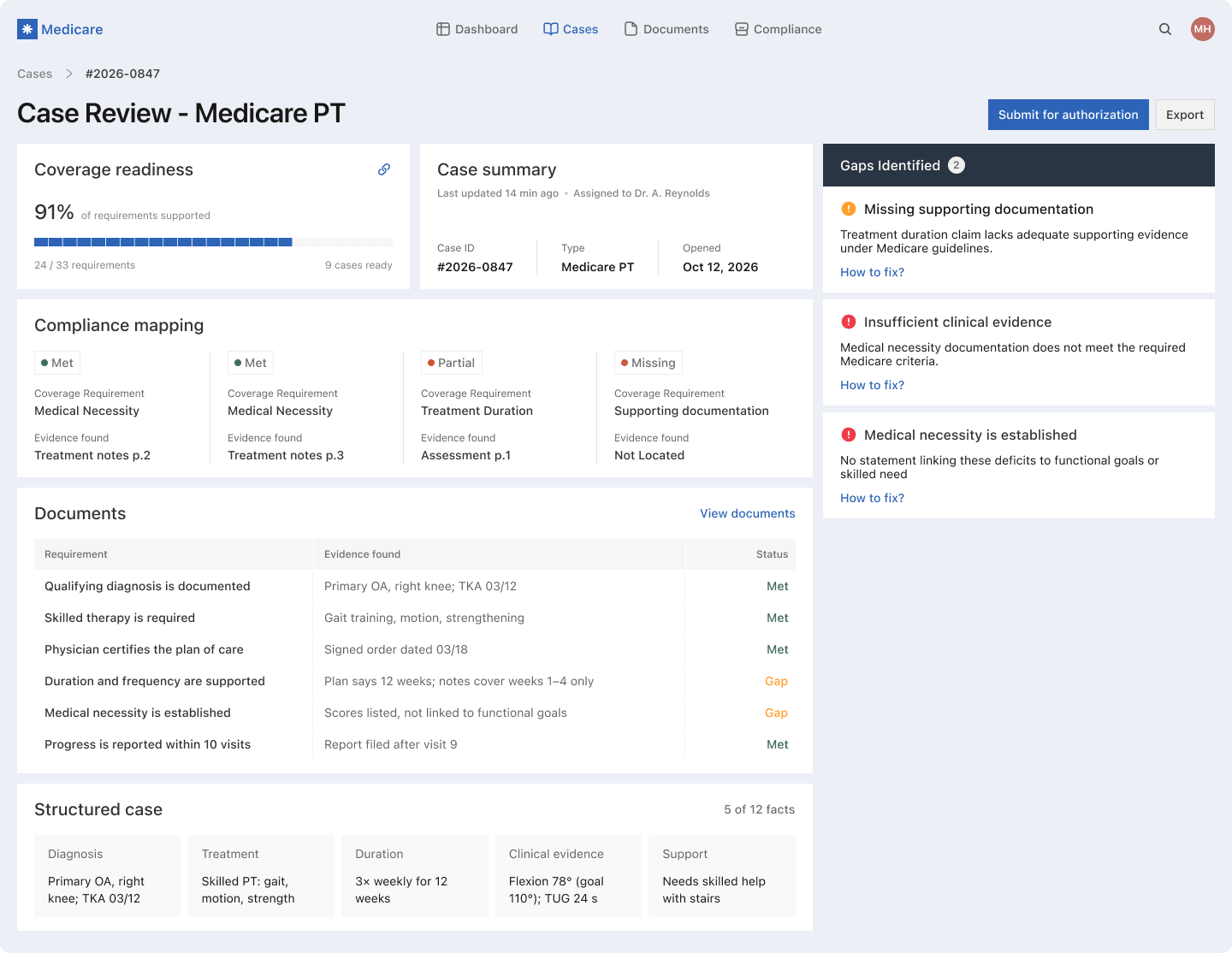
The structured case is then evaluated against configurable Medicare coverage requirements. Each check produces an understandable outcome, allowing reviewers to distinguish between documentation that supports a requirement, documentation that needs further attention, and information that could not be sufficiently established from the available records.
The platform effectively functions as compliance platform software within the client's existing review process, connecting document ingestion, AI analysis, compliance verification, and human review in one workflow.
Importantly, the system was designed around contextual evidence rather than isolated AI outputs. Findings remain connected to the underlying documentation and review criteria, reflecting the principles of an AI contextual governance solution while keeping professional oversight at the center of the process.
The platform turns the review process into a practical compliance management platform rather than another document repository. Reviewers can move from uploaded records to a structured compliance assessment without switching between multiple disconnected tools.
The solution also maintains audit trails around review activity and findings, creating greater traceability when cases need to be revisited or supporting information is required during future compliance audits.

The new workflow changed when and how the client addressed documentation risk.
Instead of waiting for a claim or downstream review to reveal a problem, the organization could evaluate supporting documentation before submission and give reviewers an opportunity to resolve potential gaps earlier.
The platform delivered several important operational benefits:
The platform also gives the organization a foundation for AI compliance automation beyond the initial use case. Because the extraction and verification layers are configurable, new documentation scenarios can be introduced without rebuilding the entire workflow.
The resulting information can support ongoing regulatory monitoring, helping the organization identify recurring documentation patterns and determine where workflows or policies may need refinement.
From an operational perspective, this means the organization can scale its review process through technology rather than relying solely on additional manual capacity. It also creates opportunities to introduce more specialized AI compliance monitoring tools as the client's compliance needs evolve.
The structured findings and reporting layer can further support compliance reporting, giving stakeholders a clearer view of review outcomes, recurring documentation issues, and areas requiring additional attention.
The project addressed a specific but costly point in the healthcare revenue cycle: finding documentation problems before they become claim problems.
By combining AI-based clinical information extraction with structured coverage verification, CleverDev Software helped the client move from a largely manual review process toward a more proactive model. Reviewers can see what information has been identified, understand how it relates to the applicable requirements, and investigate potential gaps before documentation reaches the submission stage.
The solution demonstrates how AI compliance software can be applied to a practical healthcare workflow without removing human judgment from the process. It also provides a foundation that can evolve as the organization introduces additional documentation requirements and workflows.
For organizations evaluating regulatory compliance platforms, the key opportunity is not simply to automate compliance checks. It is to put useful intelligence in front of the people who need to act on it — early enough for that intelligence to make a difference.
At CleverDev Software, we build healthcare technology around real operational challenges, combining AI, workflow automation, secure data handling, and human-centered design.
Our team can support organizations evaluating AI compliance consulting, developing specialized healthcare compliance AI tools, or replacing fragmented regulatory software with a solution built around their actual workflows.
We also help organizations assess and implement broader AI compliance capabilities, including solutions that complement existing compliance tracking software and other compliance software solution investments.
For healthcare organizations exploring HIPAA compliance healthcare conversational AI platforms, intelligent documentation review, or a broader compliance transformation, CleverDev Software can design and develop the technology needed to move from manual oversight toward scalable, explainable automation.


