
Picking a partner to build your product is one of the bigger commercial decisions you will make as a business owner, and the market for SaaS software development companies has never been more crowded or more uneven in quality than it is right now. Some teams will ship you a polished, multi-tenant product in six months. Others will burn through your budget for a year and hand you something held together with duct tape. Every fast-growing SaaS software company today depends on the engineering choices made at this early stage, which is why the partner selection deserves more attention than it usually gets.

This article walks you through what the leading providers actually do well, what to ask before signing, how much it really costs in 2026, and which firms are worth a serious conversation depending on your industry, your scale, and what you are trying to build.
Before you pick a partner, it helps to understand how big this opportunity has become and how quickly it is moving. According to Precedence Research, the global SaaS market reached $408.21 billion in 2025 and is forecast to hit $465.03 billion in 2026, growing at a compound annual rate of 13.32% through 2034. Gartner has projected that 85% of all business apps will be SaaS-based by 2026, with cloud applications identified as the fastest-growing IT spending category at roughly 15% year-over-year growth.
What does that mean for you as an owner? It means competition is intensifying, and the firms moving fastest already have product-led customer acquisition models, multi-tenant architectures, and AI baked into their core offering. A capable SaaS software company is no longer optional for most growing businesses since it is increasingly the operating layer your customers expect to interact with.
Custom software development approaches that prioritize cloud-native architecture and modular product strategy tend to outperform legacy build models because they let you ship faster and iterate against real customer feedback instead of locking everything in upfront. Working with a SaaS software development team that has shipped products at scale gives you the advantage of avoiding common mistakes that first-time builders learn the hard way.

Not every firm with a portfolio of cloud apps qualifies as a serious SaaS software development company. The ones worth your attention share a handful of characteristics that separate them from generic outsourcing shops.
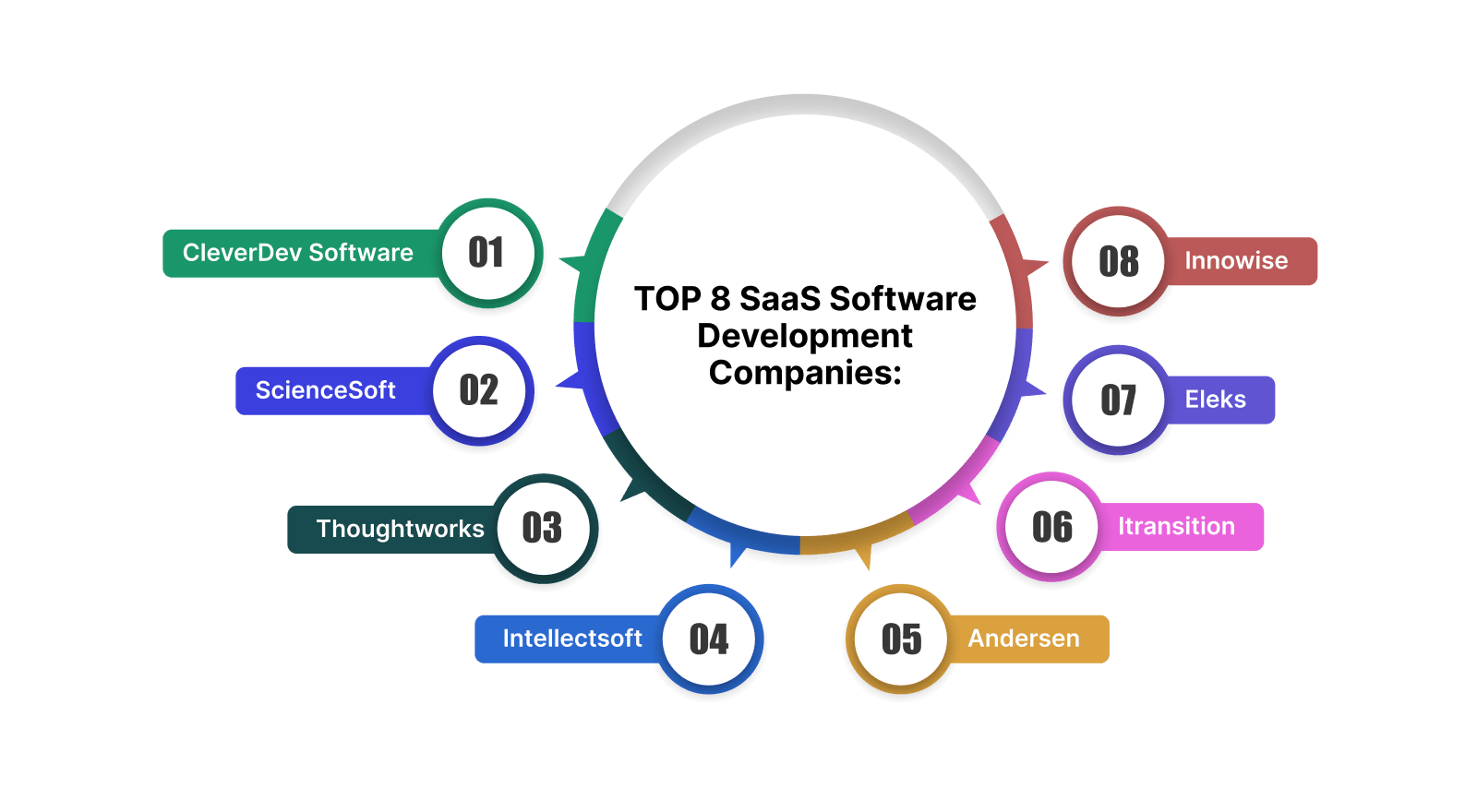
Here is a working list of firms that consistently come up in serious procurement conversations for SaaS builds in 2026. The order reflects a combination of breadth, depth, and recent client outcomes rather than a single ranking metric.
Every SaaS software development company on this list has shipped production-grade products and can show real reference customers, which is more than can be said for many vendors competing for the same work.
CleverDev Software is a custom development provider with deep experience across healthcare, fintech, logistics, and AI-driven products. We specialize in turning complex, regulated environments into maintainable, scalable products that perform reliably under real customer demand.
Our team delivers full-cycle development from discovery and architecture to product design, engineering, QA, and ongoing support, making us a strong partner for both startup MVPs and enterprise modernization initiatives.
Clients value our clear communication and our readiness to challenge weak product decisions early, before they turn into costly issues. For businesses seeking a SaaS software development company that treats compliance and scalability as core architectural priorities from day one, CleverDev consistently delivers.
A long-running firm with offices in the US and Europe, ScienceSoft has been building cloud applications since well before SaaS became a mainstream concept.
They have a strong reputation in enterprise-grade products, particularly in healthcare and logistics, supported by a large bench of certified engineers capable of handling complex, regulated environments and long-term system evolution.
A premium-tier consultancy with a strong engineering culture and a long track record of delivering large-scale transformation programs.
Thoughtworks is best suited for enterprise SaaS modernization and complex system overhauls rather than early-stage or greenfield startup builds, with a pricing model that reflects its senior talent and strategic focus.
A mid-market product development company with experience across fintech, construction tech, and hospitality SaaS.
Intellectsoft combines solid engineering delivery with structured processes and maintains distributed offices across North America and Eastern Europe, supporting repeatable product development for growing businesses.
A large-scale delivery organization with significant nearshore and offshore engineering capacity. Andersen is often chosen when predictable output and rapid team scaling are priorities, making it a strong fit for companies that already have internal product leadership and need execution power at scale.
A European-based engineering firm with broad industry coverage and strong expertise in complex integrations, system migrations, and enterprise modernization projects.
Itransition is frequently selected by mid-market organizations looking to replace or upgrade legacy systems with more scalable architectures.
An engineering-driven company known for solving highly complex technical challenges, including AI and machine learning–heavy platforms, geospatial systems, and high-throughput backend architectures.
Eleks is often chosen for projects where technical depth and problem-solving capability are more important than speed of delivery alone.
A mid-to-large delivery firm with strong staff augmentation and dedicated team models for organizations that need to scale engineering capacity quickly.
Innowise is typically used by teams that already own product direction internally but require additional development resources to accelerate execution and throughput.

Any serious AI-powered SaaS software development company in 2026 should treat AI not as a bolt-on feature but as part of the core product design. According to a 2023 McKinsey Global Survey on AI, 55% of enterprises have adopted AI in at least one business function, with sales forecasting, customer service, and IT operations being the most common entry points. McKinsey also found that Fortune 500 companies now run an average of 127 SaaS applications per organization, which gives a sense of how deeply embedded these products have become in everyday operations.
For owners based in the US specifically, working with an AI-powered SaaS software development company in the USA often comes down to time zone alignment, English-first product fluency, and the ability to operate inside US compliance frameworks without a translation layer. Many of the same considerations apply when evaluating an AI SaaS software development company in the USA for your roadmap. The right partner will tell you which AI capabilities will actually move the needle for your customers versus which ones are demo-floor gimmicks that look good in a sales pitch but get abandoned within three months of launch.
A thoughtful approach to cloud application development emphasizes embedding AI directly into product workflows rather than building separate AI features that users have to learn separately. That distinction matters because customer adoption of AI features is heavily influenced by how naturally they integrate into existing patterns. Research published in the Journal of Business Research has repeatedly found that perceived ease of use is the single strongest predictor of sustained AI feature adoption in enterprise environments.
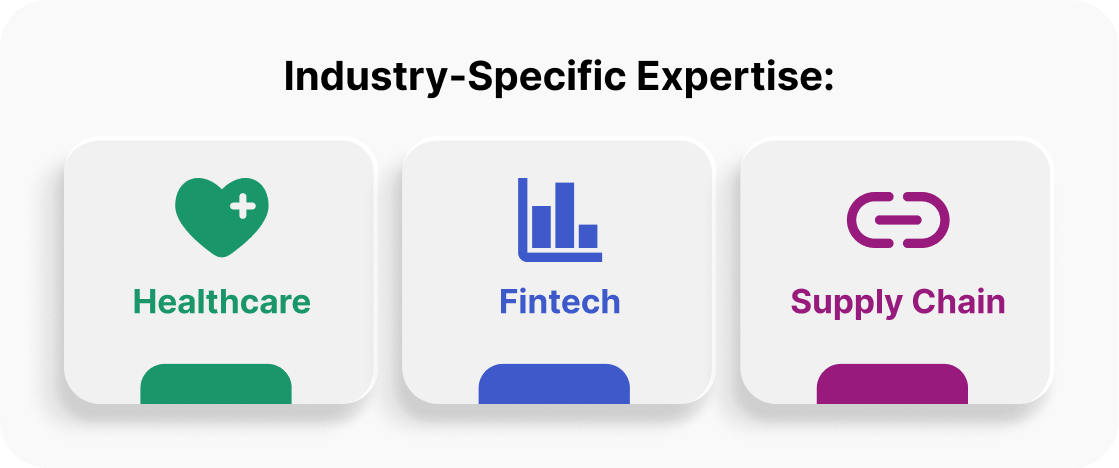
Specialty matters because the documentation rules, integration standards, and security baselines vary widely from one regulated industry to the next. Picking a generalist firm to build a regulated product is one of the more reliable ways to blow through budget and timeline at the same time.
A capable SaaS healthcare software development company has to handle HIPAA compliance, HL7 FHIR integration, audit logging, and increasingly the new CMS-0057-F prior authorization requirements that came into force in 2026. CleverDev Software has consistently delivered HIPAA-aligned products for both clinical and administrative workflows, and that depth shows up in shorter compliance review cycles. A good SaaS healthcare software development company will walk into the conversation with templates for risk assessments and a clear approach to handling protected health information in cloud environments rather than treating each project as a fresh research exercise.
Fintech software requires fluency in PCI DSS, SOC 2, and, increasingly, open banking APIs. The best fintech-oriented partners will already have payment gateway integrations, fraud detection patterns, and reconciliation workflows from prior builds rather than figuring them out on your dime. Regulatory readiness alone can cut six months off the path to a usable production product.
A specialized SaaS SCM software development company is often the right call when you are building inventory tracking, logistics orchestration, or warehouse management products. The integration surface area in supply chain SaaS is enormous, with ERPs, WMS platforms, carrier APIs, and customs systems all needing to talk to each other, and partners with prior experience can cut your timeline meaningfully.
Outsourcing decisions in 2026 are no longer driven primarily by cost. According to the ISG Index, 92% of G2000 companies use technology outsourcing, and Deloitte's 2024 Global Outsourcing Survey found that 80% of executives plan to maintain or increase their outsourcing investment. Market research published by Market.us reports that more than 70% of organizations that outsourced reported faster delivery timelines and tighter focus on core business functions.
For US-based business owners who want closer time-zone alignment, a SaaS software development company in Texas offers the advantage of overlapping working hours, in-person meetings when needed, and easier contract enforcement under US commercial law. Texas in particular has built a strong technology corridor across Austin, Dallas, and Houston, with rates that often sit below California and New York without sacrificing engineering quality. For organizations operating in regulated industries, the proximity also simplifies audit and compliance review processes.
A nearshore software development outsourcing firm for SaaS based in Mexico, Colombia, or Costa Rica delivers a similar time-zone benefit at lower hourly rates, which is why nearshore engagements have grown faster than traditional offshore models over the past three years. The trade-off is usually around engineering depth on the most complex problems, where European or US teams still hold an edge.

This is the question that derails most early conversations, and the honest answer depends heavily on scope and team composition. Here are realistic 2026 ranges based on what serious SaaS software development company engagements actually look like.
Hourly rates vary widely by region in 2026:
A reputable SaaS software company will give you a detailed breakdown of where the budget goes and which roles are loaded into the burn rate, rather than a single blended number. If a vendor cannot tell you exactly who is on the team and what each person does, that is information itself.
Custom software development companies' compliance security SaaS is the search phrase a lot of procurement teams type when they have been burned once by a build that failed an audit. The pattern is predictable: a great-looking product, a successful beta launch, and then a SOC 2 review that surfaces a long list of architectural problems that take six months to remediate while customer growth stalls.
The right partner will treat compliance as part of the architecture from day one. That means:
For products handling protected health information, financial records, or government contracts, this baseline is non-negotiable. A serious SaaS software company partner will produce evidence of these controls during due diligence rather than promising to add them later.

When you compare proposals from multiple firms, the question is rarely which one looks best on paper. It is which set of SaaS software development solutions actually fits the way your business needs to run. Here is a practical decision framework that has held up across hundreds of engagements.
The right blend of SaaS software development solutions for your business will combine product thinking, engineering depth, and ongoing accountability, rather than treating delivery as a transactional handoff. Remember also that good SaaS software development solutions are measured by what happens 18 months after launch, not on the day the product goes live. The first year of customer usage will surface problems and opportunities you could not have predicted upfront, and your partner needs to be ready to respond to that learning.

Even experienced operators get this decision wrong. They show up regularly in conversations with founders who are on their second or third attempt to ship the same product, and they are worth flagging before you sign anything.
It bookmarks digital acceleration in healthcare for industry-specific timelines and a breakdown of healthcare app development cost if your product sits in a regulated environment. A clearer picture of how budgets and timelines play out in real engagements helps to avoid any emerging issues.
Picking the right partner is one of the higher-leverage decisions you will make as a founder or operator. The market for SaaS software development companies has matured considerably, and there are now genuinely strong options at every price point and across every major specialization. The difference between a good outcome and a painful one usually comes down to clarity of brief, alignment on priorities, and willingness on both sides to engage seriously in discovery before writing code.
If your product is regulated, complex, or built for an industry with deep integration requirements, working with a partner like CleverDev Software that handles end-to-end product builds in those environments will save you both time and money over the long run. If you are earlier in the journey, prioritize a firm that will help you sharpen the product thinking, not just execute against a spec you have not pressure-tested yet.
The companies that will win in 2026 and beyond are the ones treating their SaaS software development company relationship as a strategic capability rather than a line item. That mindset shift, more than any single technology choice, is what tends to separate the products that grow into category leaders from the ones that stall out after the first round of customer feedback.


IT Expert at CleverDev Software
With a tech leadership spanning from 2008, Julia lives by the motto of diving deep into the innovation ocean. Her writing prowess, research acumen, and interviewing expertise enable her to share invaluable insights into IT trends.

Our newsletter is packed with valuable insights, exclusive offers, and helpful resources that can help you grow your business and achieve your goals.


